
A lawyer is not required for every federal whistleblower complaint, but a False Claims Act qui tam lawsuit must be filed through an attorney. The choice between DIY whistleblower filing vs hiring a lawyer depends on the program and the claim. Some programs allow anonymous filing only through an attorney, and confidentiality cannot always be guaranteed.
It is understandable to consider filing yourself: you may want to stay in control, limit expense, or avoid drawing attention to your identity. But agency and court requirements differ, and an early disclosure can affect your privacy and options. A lawyer can help assess where and how to report, though the right approach depends on the facts and the program.
This guide explains how legal representation may affect confidentiality and retaliation protections, what to consider when comparing the two approaches, and what may happen if the government declines to intervene in a False Claims Act case. It also covers fees, which vary by lawyer and program. Whistleblower cases are very complex and take a long time to resolve.
Key Takeaways
- Identify which whistleblower program applies before filing, because the required process can differ. False Claims Act qui tam cases must be filed through an attorney.
- Understand what happens if the government declines to intervene: a False Claims Act case may still continue, but the path forward requires careful legal assessment.
- Assess retaliation protections under the law that applies to your report, and keep an accurate record of relevant events.
- Consider how your filing method affects confidentiality. An attorney can help evaluate anonymity options and the limits of keeping your identity private.
1. False Claims Act Whistleblowers Need a Lawyer: Which One?
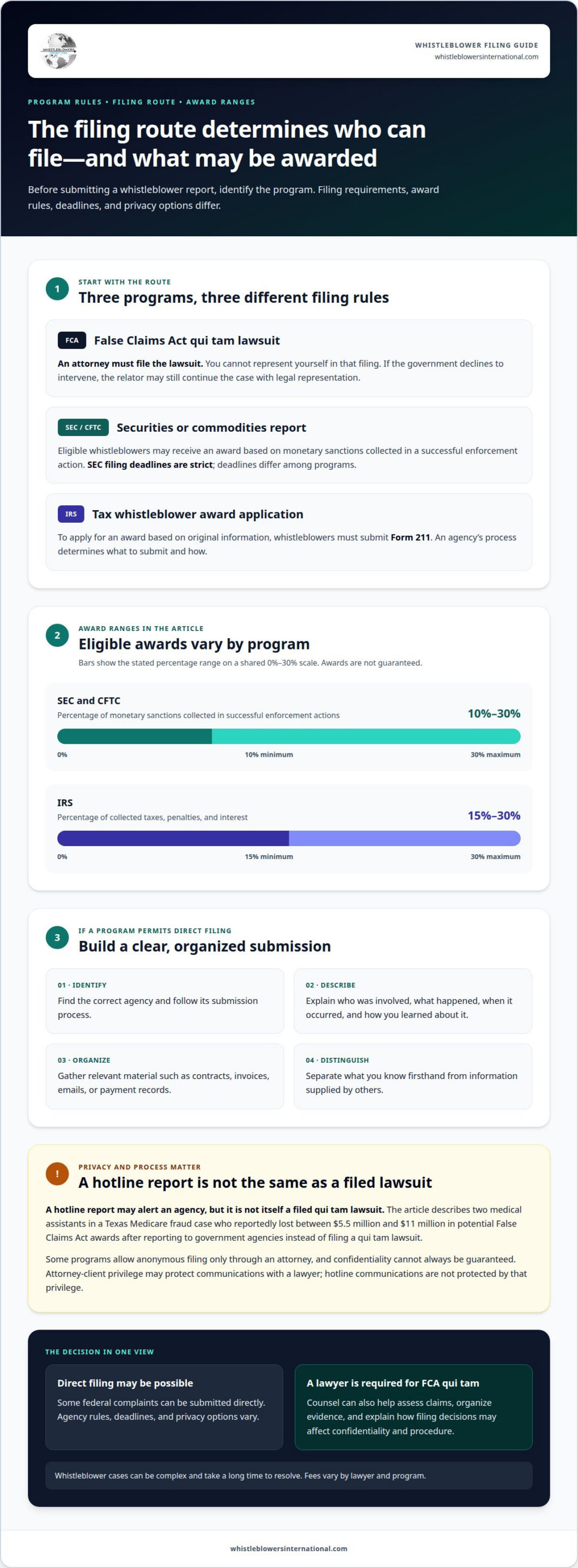
For a False Claims Act qui tam case, an attorney must file the lawsuit; you cannot represent yourself in that filing. So the choice in DIY whistleblower filing vs hiring a lawyer depends partly on the program. Some federal complaints can be submitted directly, but each agency has its own process. Counsel can assess your claims, organize evidence, and explain how filing decisions may affect confidentiality and procedure.
Award eligibility and percentages also depend on the program. The U.S. Securities and Exchange Commission and Commodity Futures Trading Commission can award eligible whistleblowers 10% to 30% of monetary sanctions collected in successful enforcement actions. According to the Internal Revenue Service, whistleblowers must submit Form 211 to apply for an award based on original information. Eligible IRS awards are 15% to 30% of collected taxes, penalties, and interest.
To file directly where a program permits it, identify the correct agency and follow its submission process. SEC filing deadlines are strict, and deadlines differ among programs. For an IRS award application, submit Form 211. Describe who was involved, what conduct you observed, when it occurred, and how you learned about it. Organize supporting evidence, such as relevant contracts, invoices, emails, or payment records, and distinguish firsthand knowledge from information supplied by others.
Attorney-client privilege may protect communications with your lawyer; hotline communications aren’t protected by that privilege. When comparing DIY whistleblower filing vs hiring a lawyer, consider whether you need help preparing a court filing, evaluating evidence, or addressing privacy concerns. For a False Claims Act matter, look for an attorney experienced in qui tam claims and federal investigations. Ask how they assess evidence, explain filing steps, and set out fees. If an intake is under review, keep seeking representation rather than assuming the review secures counsel. A dated timeline and organized records can help an attorney assess your claims.
2. Continuing a case if the government declines to intervene
The Department of Justice’s decision not to intervene does not automatically end a False Claims Act qui tam lawsuit. The whistleblower, known as the relator in the case, may continue pursuing it with legal representation. The choice between DIY whistleblower filing vs hiring a lawyer becomes especially important at this stage: continuing means managing court litigation, responding to legal arguments, and presenting evidence, not simply waiting for an agency response.
The DOJ typically investigates False Claims Act allegations for several months before deciding whether to intervene. It intervenes in about one out of five cases. If the government joins, its participation can shape how the lawsuit proceeds. If it declines, the relator may continue the case but must carry the litigation forward. A declination is not a court decision on whether fraud occurred; it means the government will not take over the case at that point.
A hotline report and a qui tam lawsuit are different routes. Reporting suspected fraud to a government hotline may alert an agency, but it isn’t itself a filed lawsuit. Two medical assistants in a Texas Medicare fraud case reportedly lost between $5.5 million and $11 million in potential False Claims Act awards after reporting to government agencies instead of filing a qui tam lawsuit. Before deciding between DIY whistleblower filing vs hiring a lawyer, determine whether your report concerns fraud against the government and whether a qui tam action may fit.
If the DOJ declines, a whistleblower attorney can assess the evidence and explain the demands of proceeding without government intervention. Keep a dated record of relevant events and preserve materials you already lawfully possess. An intake review or hotline report shouldn’t be treated as a court filing. A focused whistleblower case review can help clarify the available path and what continuing the lawsuit would involve.
3. Retaliation risks and whistleblower protections
Retaliation can include termination or demotion after an employee reports suspected wrongdoing. The United States has over 65 whistleblower laws, and each law defines its own protections and remedies. The False Claims Act prohibits employer retaliation against whistleblowers, although retaliation can still occur in practice. A report made anonymously may also make it harder to show an employer knew about the whistleblowing, a fact that can matter in a retaliation claim.
Under the False Claims Act, a successful retaliation claim may provide reinstatement to the employee’s former position with full benefits and seniority. Remedies may also include double back pay for wages lost because of retaliation. These remedies address employment harm, not the underlying fraud claim. Keep a dated record of relevant events, such as changes in duties, performance reviews, disciplinary actions, and communications related to whistleblowing.
Timing matters. Depending on the applicable program or law, a retaliation claim deadline may be 30 days or 180 days after retaliation. The relevant deadline depends on the law covering the disclosure, so record when each adverse action occurred and preserve related documents. A whistleblower attorney can evaluate which protections may apply and whether the facts connect the report to the employer’s action. Do not assume that an internal complaint automatically preserves a separate legal claim.
Retaliation and discrimination protections also vary across laws such as the federal Whistleblower Protection Act, Sarbanes-Oxley, and the Dodd-Frank Act. The Department of Justice may investigate fraud allegations, but employment retaliation raises a distinct issue: what action the employer took and how it relates to the report. If retaliation causes acute distress, people in the United States can call 988 for free, confidential support. For legal guidance about retaliation concerns, discuss your whistleblower protections.
4. Confidentiality and protection against retaliation
Anonymous, confidential, and public reporting involve different levels of identity disclosure. With an anonymous report, the recipient may not know who submitted the information; a confidential report identifies the whistleblower to the recipient but seeks to limit disclosure. Public reporting makes the person’s identity known. None of these labels guarantees that others cannot infer identity from the facts, workplace role, or communications in a report.
For a False Claims Act qui tam lawsuit, filing under seal keeps the case from public view during the investigation, but the whistleblower’s identity is ultimately revealed. The seal does not provide permanent anonymity. In other federal whistleblower programs, some laws allow anonymous filing only through an attorney. A lawyer can explain which filing method applies and what information the agency or Department of Justice may need to assess the allegations.
Confidentiality can also affect a retaliation claim. If an employer does not know about a disclosure, it may be harder to show that a later demotion or termination resulted from whistleblowing. Revealing your identity may help establish the employer’s knowledge, but it can increase workplace exposure. Consider this tradeoff before deciding how to report, and keep a dated record of disclosures and employment actions.
No recipient can guarantee confidentiality in every circumstance. Legal limits, insecure communications, or identifying details in the context may expose your identity. Before forwarding evidence, avoid discussing suspected fraud with coworkers, who may know about or be involved in the conduct. Use secure communication tools such as Signal when possible, while recognizing that personal devices can also be insecure. Do not use work email or devices for sensitive communications if your employer monitors them. A law firm can explain confidentiality choices and their practical limits before you submit information.
Take the Next Step With a Clear Filing Strategy
Before making another disclosure, pause to organize what you know, when you learned it, and which records support your concerns. Choosing between a DIY whistleblower filing and hiring a lawyer also means considering how to prepare for the consequences of reporting. A focused review can help identify the questions to resolve before proceeding, including what you can share and how to preserve relevant information.
Piacentile & Associates LLP handles False Claims Act and qui tam lawsuits, SEC Whistleblower Program filings, and IRS Whistleblower Program filings. If your concerns involve one of these paths, describe the conduct and the evidence you have gathered when you reach out. Contact Piacentile & Associates LLP to discuss your whistleblower matter and consider a next step grounded in your circumstances. You don’t have to make a rushed decision; you can move forward thoughtfully and with a clearer sense of your options.
Frequently Asked Questions
Can a whistleblower lawyer protect my anonymity and confidentiality?
A lawyer can assess available anonymity options but cannot guarantee that your identity will remain secret. In some federal whistleblower programs, anonymous filing is possible only through an attorney. A False Claims Act qui tam case is filed under seal during the investigation, but the whistleblower’s identity is ultimately revealed. Before sharing information, discuss who may receive it and how your role or evidence could identify you.
False Claims Act Whistleblowers Need a Lawyer: Which One?
Choose an attorney experienced in False Claims Act qui tam claims and federal court filings. Ask how they assess original evidence, prepare a complaint, and communicate with the government during its investigation. For example, records showing how a suspected scheme operated may need to be organized alongside a clear timeline. An attorney familiar with these cases can explain the process and evaluate whether your information supports further review.
How much do whistleblower lawyers charge for their services?
Fee arrangements differ, and some whistleblower lawyers work on contingency, receiving a portion of an award if the case succeeds. Piacentile & Associates LLP represents whistleblowers on a contingency-fee basis and is paid only if it secures a monetary award. Before proceeding, read the fee agreement carefully so you understand how the fee is calculated and what happens if the matter does not result in an award.
Should You Hire a Lawyer for Whistleblowers Before You Report Fraud?
Consulting a lawyer before reporting can help you consider the correct filing route, privacy concerns, and potential employment consequences. Contacting a law firm as a prospective whistleblower does not obligate you to report wrongdoing. You can first discuss what you observed and what records support it, then make an informed decision about whether and how to proceed.
WHY DO I NEED A WHISTLEBLOWER ATTORNEY?
An attorney can help match your information to a program’s filing process and present evidence in a structured way. This matters because an agency intake, a court complaint, and an award application are not interchangeable steps. For instance, an IRS whistleblower seeking an award must submit Form 211. Personalized guidance can help you understand which procedure applies to your report.
If I Am Thinking About Blowing the Whistle, At What Point Should I Contact a Lawyer?
Consider speaking with a whistleblower attorney as soon as you suspect reportable wrongdoing, ideally before making a disclosure. Early discussion lets you explain what you know, how you learned it, and whether supporting records exist. Keep a factual timeline and preserve materials you already lawfully possess. A lawyer can then discuss potential reporting options and confidentiality issues before you decide your next step.