

Quiet, methodical documentation is safer than confronting someone or accessing records you’re not authorized to see. The safest way to document fraud without getting caught is to preserve records you can lawfully access, note where they came from, and protect your personal information. Don’t alter originals or do anything that could compromise evidence.
It’s understandable to want clear proof before raising a concern, especially when suspected conduct could affect your finances, work, or safety. Careful recordkeeping can help distinguish a genuine discrepancy from possible evidence of alteration, while limiting unnecessary exposure.
This article explains what to look for in signatures and altered documents, which U.S. agencies and records may be relevant, and how to reduce the risk of identity theft while documenting concerns. You’ll also learn when a suspected fraud issue may call for legal guidance instead of further personal investigation.
Key Takeaways
- Compare suspicious signatures and document details with reliable records, but treat discrepancies as reasons for closer review, not proof of fraud.
- For suspected employment-document fraud, I-9 Central and the M-274 Handbook for Employers offer relevant information and resources.
- If your identity may be exposed, report the concern to the Federal Trade Commission and contact your bank and other account providers.
- Understand how fraud and its concealment can carry legal consequences, and consider whether a whistleblower filing is relevant to suspected financial misconduct.
Checking signatures and altered records
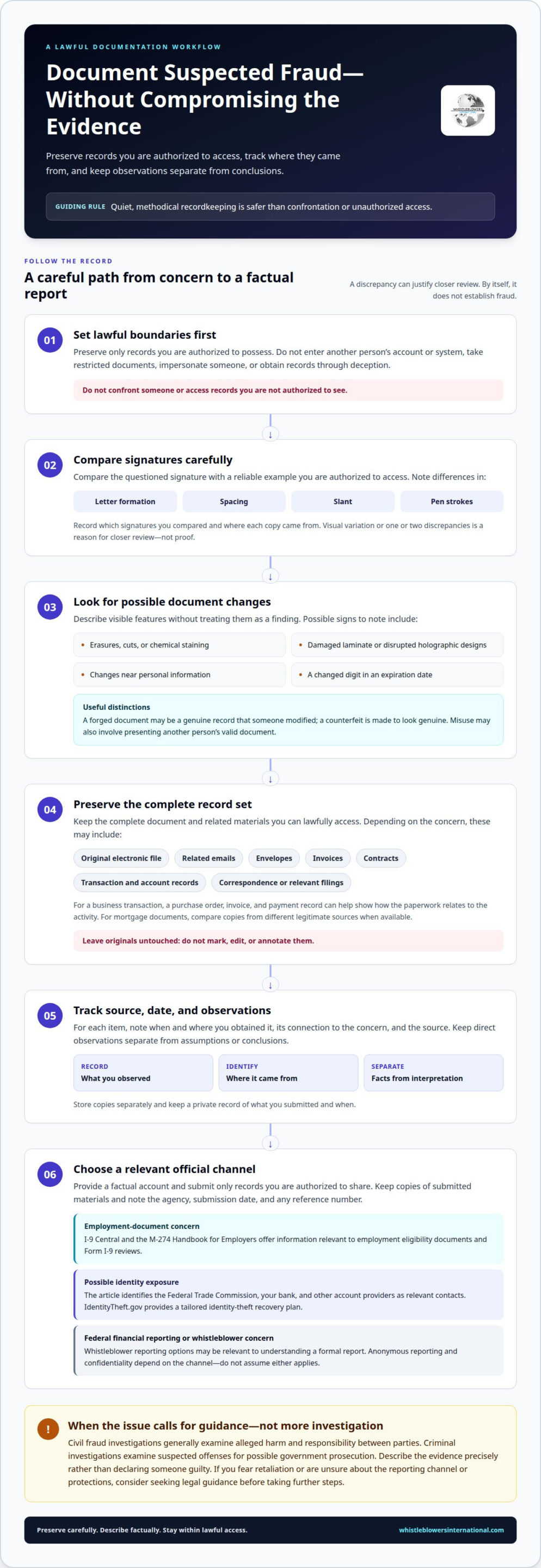
Fraudulent documents may be created, altered, or obtained through deception. A forged document may be a genuine record someone modified; a counterfeit is made to look genuine. Misuse can also involve presenting another person’s valid document, such as an impostor using someone else’s identity information. These distinctions help describe a concern without treating suspicion as a proven finding.
Compare a questioned signature with a reliable example you’re authorized to access. Note differences in letter formation, spacing, slant, and pen strokes, but don’t treat visual variation as proof. One or two discrepancies may warrant closer review without establishing fraud. Record which signatures you compared and where each copy came from.
Look for possible physical changes, including erasures, cuts, chemical staining, damaged laminate, or disrupted holographic designs near personal information. For example, changing a single digit in an expiration date could make an expired document appear current. Genuine records may also use intaglio printing, embossed seals, or laser engraving that counterfeiters may fail to reproduce.
Preserve the complete document, original electronic file, related emails, envelopes, and transaction records. Note when and where you obtained each item, and keep observations separate from conclusions. For mortgage documents, compare copies from different legitimate sources to identify discrepancies. Store copies separately and leave originals untouched: don’t mark, edit, or annotate them.
Civil fraud investigations generally examine alleged harm and responsibility between parties. Criminal investigations examine suspected offenses for possible government prosecution. The purpose and process differ, so describe the evidence precisely rather than declaring someone guilty.
If by documenting fraud without getting caught you mean protecting your identity while acting lawfully, preserve only records you’re authorized to possess. Don’t enter another person’s account or system, change files, or take restricted documents. A careful approach to documenting fraud without getting caught keeps your records and actions within lawful boundaries, rather than concealing wrongdoing or evading accountability.
Documents may also be fraudulently obtained through corruption, coercion, or false information, including forged or counterfeit supporting documents, even when the document itself shows no visible alteration.
Agencies and records to consult
Choose a reporting channel based on the record and suspected conduct. For suspected employment-document fraud, employers can consult I-9 Central and its M-274 Handbook for Employers. These resources address employment eligibility documents and provide information relevant to Form I-9 reviews. Keep the concern tied to specific records and observations, rather than conclusions about a person’s intent.
Build a record set from material you can lawfully access. Depending on the concern, this may include invoices, contracts, transaction confirmations, account statements, correspondence, and copies of relevant filings. Record each item’s date, source, and connection to the suspected event. For a business transaction, a purchase order, invoice, and payment record can help show how the paperwork relates to the underlying activity.
How can someone report suspected fraud safely and lawfully? Use an official reporting channel relevant to the suspected conduct, provide a factual account, and submit only records you’re authorized to share. Don’t access private accounts or systems, impersonate someone, or obtain records through deception.
Keep copies of submitted materials and note the agency, submission date, and any reference number. Separate direct observations from assumptions. If the concern involves employment eligibility documents, I-9 Central’s M-274 Handbook for Employers is a focused source; it helps employers understand the relevant review process without treating a discrepancy alone as proof of wrongdoing.
Where can fraud victims get free legal help or financial recovery assistance? Local legal-aid organizations may be a starting point for free legal assistance, subject to eligibility rules. For identity-theft recovery steps, IdentityTheft.gov provides a tailored recovery plan. The appropriate steps depend on which information or accounts were affected.
Use a consistent method: preserve records, describe how each was obtained, and report through an appropriate official channel. If suspected misconduct involves federal financial reporting or whistleblower concerns, whistleblower reporting options may be relevant to understanding a formal report.
Protecting personal information
Protecting your identity means limiting exposure while preserving and reporting evidence. Secure account records, use official reporting channels, and avoid collecting information you’re not authorized to access.
Anonymous Reporting and Whistleblower Protections
Anonymous reporting means submitting a concern without identifying yourself, but anonymity and confidentiality depend on the reporting channel. Don’t assume a report is anonymous or that a particular protection applies. Review the channel’s process before sharing identifying details. Keep a private record of what you submitted and when, so you can describe the report accurately if questions arise.
Responding to Fear of Retaliation
Retaliation concerns involve possible adverse treatment connected to reporting suspected misconduct. Preserve relevant messages, schedules, evaluations, or other records you already have lawful access to, and record dates and events in a separate log. Avoid confronting colleagues or copying restricted files. If you fear retaliation, seek legal guidance about the reporting channel and protections relevant to your circumstances before taking further steps.
Risks of Secret Recording and Evidence Collection
Secret recordings and unauthorized evidence gathering can create legal, privacy, and workplace risks. Recording rules can vary, and a recording may expose confidential information or undermine a report’s credibility. Don’t secretly record a conversation or enter an account or system without authorization. Stick to records you may lawfully possess, and get legal guidance before collecting material in a way that could affect someone else’s privacy.
Identity theft occurs when someone uses another person’s personal or financial information without permission. If you suspect exposure, report identity theft to the Federal Trade Commission by calling 1-877-438-4338 or using IdentityTheft.gov, which provides recovery steps. Contact the fraud departments at your bank, credit card issuers, and other account providers. Review statements and report suspicious transactions promptly.
Ask the three major credit reporting agencies to place fraud alerts and a credit freeze on your accounts. If you suspect tax-related identity theft but haven’t received an IRS notice, learn about filing Form 14039. Keep copies of reports and correspondence in a secure location, separate from the affected account credentials.
What are the legal consequences of committing or concealing fraud in the United States?
Fraud can trigger civil claims, criminal investigation, or both, depending on the conduct and evidence. In Texas, the cited offenses include false statements to obtain property or credit under Texas Penal Code §32.32, money laundering under §34.02, and engaging in organized criminal activity under §71.02. These labels identify potential offenses; they don’t establish that a particular person committed one.
Consequences depend on the alleged act, its connection to other conduct, and the evidence authorities examine. For example, a document altered to support a financial transaction may prompt investigators to review it alongside related communications and transaction records. Concealing or destroying relevant records can further complicate an investigation and raise additional concerns. Preserve what you lawfully possess, and don’t change, hide, or destroy material.
Time limits can also affect a case. A Texas legislative change increased the statute of limitations on money laundering and false statement to obtain credit from three to seven years. That change concerns the time limit for those offenses, not a universal deadline for every fraud claim. Chapter 59 of the Texas Code of Criminal Procedure addresses forfeiture of contraband, a separate issue from whether someone is charged or found liable.
When documenting suspected fraud, distinguish an observation from a legal conclusion. Record what a document or transaction shows, identify its source, and retain related records without editing them. A discrepancy may justify scrutiny, but it doesn’t by itself prove fraud or identify who was responsible. The facts and applicable legal provisions shape how authorities assess the conduct.
If suspected misconduct involves cross-border trade, explore import-export customs fraud legal action to understand the legal route for addressing that concern. Accurate records help establish what happened; the applicable law and evidence determine how the matter proceeds.
People in the United States can report identity theft online at IdentityTheft.gov. Review credit card and bank account statements, and report unauthorized or suspicious transactions. These steps can help document concerns and identify activity that may warrant follow-up, without treating a concern as proof of fraud.
The United Nations Office on Drugs and Crime trains law-enforcement officials to identify fraudulent or illegitimate documents and improve communication between countries. Document review and communication matter when concerns cross national borders.
Piacentile & Associates LLP: Import Export Customs Fraud Legal Action
Piacentile & Associates LLP handles import-export customs fraud legal action when suspected misconduct involves cross-border trade and customs processes. If your records point to inaccurate declarations, concealed transaction details, or other suspected customs fraud, legal action may be a relevant next step. The focus is on evaluating the evidence and the conduct it describes, not treating an unexplained discrepancy as proof.
Organized records can clarify the concern: preserve lawfully obtained documents, note their source, and keep observations separate from conclusions. Avoid altering records or accessing restricted information. This approach gives the matter a clearer evidentiary foundation while protecting the integrity of your documentation.
If you’re considering legal action over suspected import-export customs fraud, contact Piacentile & Associates LLP to discuss the matter.
Choose a careful next step
After documenting suspected fraud, the next decision is how to move from private records to a formal report or legal action. That choice should reflect the conduct involved, the evidence available, and the risks of disclosure. If your concern involves government funds, securities, or tax matters, a structured legal review can help determine whether a False Claims Act / Qui Tam lawsuit, SEC Whistleblower Program Filing, or IRS Whistleblower Program Filing may be relevant.
Careful documentation can support a clearer account, but it is not a reason to investigate beyond your authority or expose personal information unnecessarily. Take a measured next step, and seek guidance before sharing sensitive material or making accusations. The safest way to document fraud without getting caught is to protect your privacy while keeping any report accurate and lawful.
If you’re ready to discuss suspected fraud and possible legal action, contact Piacentile & Associates LLP. A considered next step can help you move forward with greater clarity.
Frequently Asked Questions
Which U.S. agencies investigate different types of fraud, and how do you contact them?
Use the reporting channel suited to the suspected conduct. Report identity theft to the Federal Trade Commission by calling 1-877-438-4338 or using IdentityTheft.gov. For tax-related identity theft without an IRS notice, review Form 14039. Employers examining suspected employment-document fraud can consult I-9 Central and its M-274 Handbook for Employers. Securities, commodities, and money-laundering concerns may involve SEC, CFTC, or FinCEN whistleblower programs; use the relevant agency’s official filing channel.