
What if the right whistleblower lawyer isn’t the one making the biggest promises, but the one asking the most precise questions? Knowing how to choose a whistleblower lawyer matters because your facts may fit a specific federal program, and the way evidence is handled can affect your case and professional privacy.
It’s reasonable to feel uncertain about where to report, what information to share, and whether coming forward could expose your identity or create workplace risks. Strong counsel should explain how your facts may align with a program such as the False Claims Act, SEC, IRS, CFTC, or FinCEN. They should also explain how they would assess the evidence, confidentiality concerns, and potential risks without promising an outcome.
This guide explains how to evaluate program-specific experience, investigative judgment, privacy practices, and fee terms. You’ll also learn what to prepare for an initial discussion and how firsthand whistleblower experience can inform a case assessment. The goal is to help you choose counsel based on fit, evidence, and careful judgment, not broad marketing claims.
Key Takeaways
- To understand how to choose a whistleblower lawyer, match the alleged conduct and government connection to counsel’s experience with the relevant federal program.
- Look for a careful approach to where information came from, whether it is reliable, and how privacy concerns will be handled.
- Review the written fee agreement to understand how fees are calculated, who is responsible for expenses, and what the engagement requires.
- Prepare a concise timeline, summary of your concerns, and questions for an initial discussion.
- Don’t access, remove, or share information unlawfully while preparing to speak with counsel.
How to Choose a Whistleblower Lawyer for Your Situation
Choosing counsel can feel consequential before you know where your information belongs. You may be weighing sensitive records, uncertainty about the applicable federal program, and the possibility that speaking up could affect your work or professional relationships. In that situation, how to choose a whistleblower lawyer is not about finding the boldest claim. It’s about assessing whether counsel can connect your facts to the right process and explain the decisions ahead.
A suitable lawyer brings more than a long list of practice areas. Look for experience with the relevant program and procedures, sound investigative judgment, and communication that makes complicated issues understandable. A firm’s headline recovery may show that it handled a prominent matter, but it doesn’t establish that your facts fit the same program or call for the same strategy. Marketing claims are no substitute for a careful assessment of your situation.
What makes whistleblower representation distinct?
Federal whistleblower matters may involve confidential or sealed filings, agency-specific submission processes, and investigations that require careful review of complex information. Procedures and eligibility considerations differ by program and facts, so don’t assume one approach applies to every disclosure. For background on the range of disclosures and potential risks involved, see What is a Whistleblower?
This work also calls for a different focus than general workplace guidance or criminal defense. The central task is to assess a potential report under the relevant whistleblower framework, including what the evidence may show and how the process works. At Piacentile & Associates LLP, former whistleblowers are part of the team, and firsthand experience informs a careful, empathetic review. That perspective can help counsel understand the personal stakes while keeping legal and factual analysis at the center.
Which questions should guide your first comparison?
Use an initial discussion to learn how counsel thinks, not just what outcomes the firm advertises. Ask whether the lawyer handles matters under the program that may relate to your reported conduct. Listen for a clear explanation of why that route may fit and what remains uncertain. For example, suspected fraud involving government payments may raise different program questions than suspected securities misconduct. The relevant connection and supporting facts matter.
- Program fit: Can the lawyer explain which federal program may apply and what facts support that preliminary view?
- Relevant experience: Has counsel handled matters involving comparable program procedures or investigative issues?
- Reasoned judgment: Does the lawyer identify uncertainties and risks instead of treating every allegation as a guaranteed case?
- Clear communication: Can counsel describe potential next steps in language you understand and answer questions directly?
These questions offer a practical way to assess the lawyer’s approach rather than promises of results. A measured explanation may be more useful than dramatic claims or a recovery figure that says little about your circumstances. Look for counsel who takes time to understand the facts, separates what is known from what needs investigation, and explains the reasoning behind the assessment.
Match Whistleblower Lawyer Experience to the Relevant Federal Program
Program fit starts with the reported conduct and its potential connection to the federal government. Similar-looking allegations can raise different legal questions depending on who was affected, what funds or markets were involved, and which records support the concern. A lawyer’s experience should relate to the relevant program and its procedures, not just whistleblower law in general.
How does program-specific experience help assess fit?
Each program has its own legal framework, agency context, and submission process. Ask how counsel determines whether the reported conduct may fit a particular program, what facts could affect that assessment, and what uncertainties remain. A useful explanation connects the alleged conduct to a potential program without treating one agency or filing route as right for every report.
For example, the SEC Whistleblower Program concerns potential securities-law violations, while allegations involving government payments may raise different questions. Counsel should be able to discuss the relevant process and agency context in plain language. For an overview of qui tam matters, see this False Claims Act guide; suspected tax misconduct is addressed in the IRS whistleblower program guide.
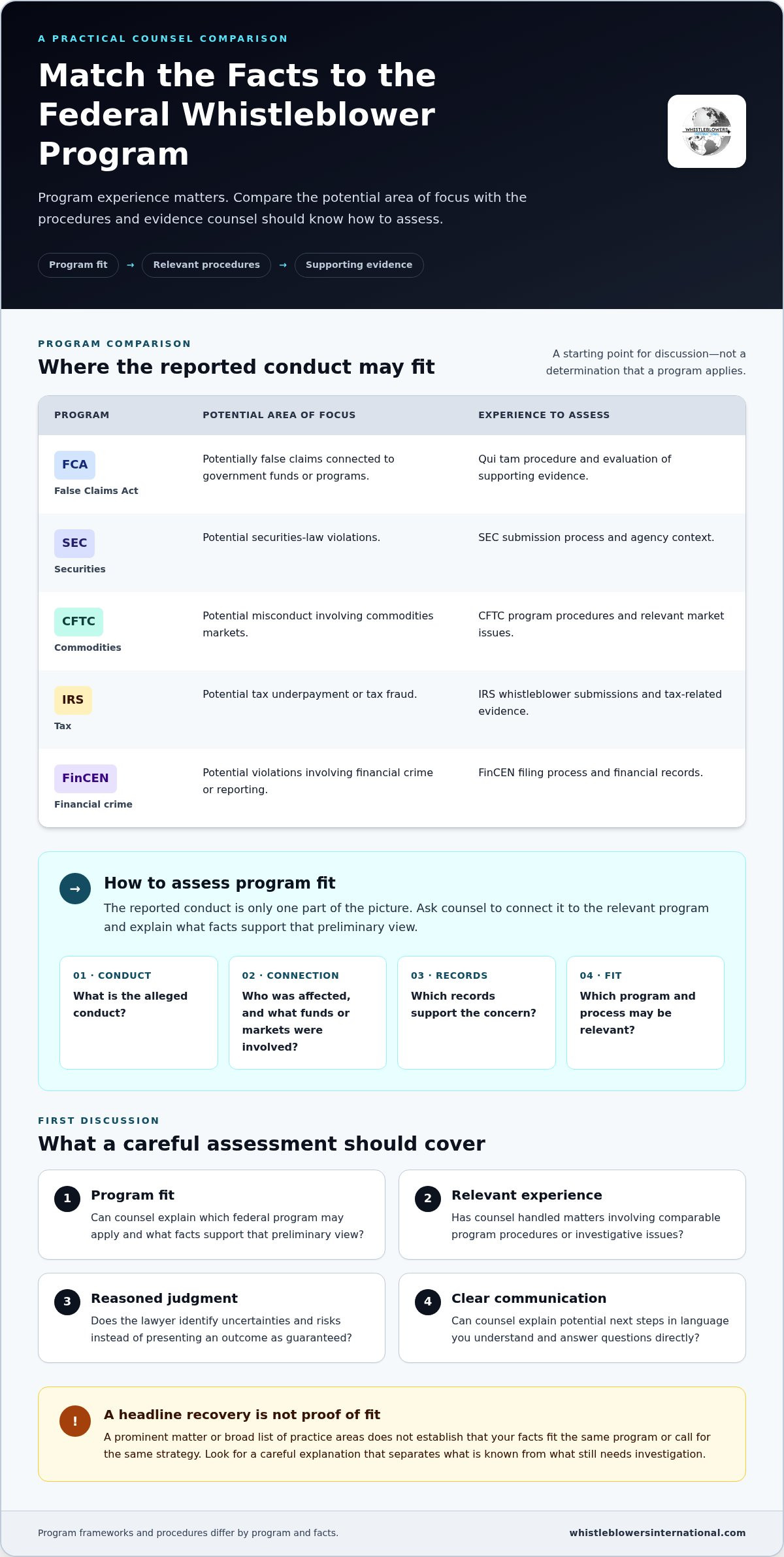
| Program | Potential area of focus | Experience to assess |
|---|---|---|
| False Claims Act | Potentially false claims connected to government funds or programs | Qui tam procedure and evaluation of supporting evidence |
| SEC | Potential securities-law violations | SEC submission process and agency context |
| CFTC | Potential misconduct involving commodities markets | CFTC program procedures and relevant market issues |
| IRS | Potential tax underpayment or tax fraud | IRS whistleblower submissions and tax-related evidence |
| FinCEN | Potential violations involving financial crime or reporting | FinCEN filing process and financial records |
The table is a starting point, not a determination of eligibility. Facts may be incomplete, overlap, or point to more than one issue. The applicable rules and route depend on the circumstances. Counsel should explain what needs further analysis rather than force the facts into a familiar category.
What should you look for beyond a list of practice areas?
A practice-area list shows what a firm says it handles, but not how its lawyers evaluate a matter. Look for relevant experience described with enough detail to show familiarity with procedure, evidence, and realistic uncertainties. Ask what makes a matter challenging and how counsel would investigate whether the available information supports a potential report.
Piacentile & Associates LLP represents individuals worldwide in U.S. federal whistleblower matters. If your concern involves a federal program, reviewing the firm’s whistleblower representation can help you understand its focus. Prioritize a lawyer who can explain how the reported conduct, program requirements, and evidence fit together, and identify what remains unknown.
Assess a Whistleblower Lawyer’s Investigation, Evidence, and Privacy Approach
A strong investigative approach does more than collect allegations. It tests what the information supports, where it came from, and what remains uncertain. As you consider how to choose a whistleblower lawyer, listen for careful reasoning about the evidence rather than an immediate conclusion that your matter is strong or weak.
How should counsel evaluate information about suspected fraud?
A methodical review considers source, reliability, context, and relevance. A record may appear to show a problem on its own, but its meaning could change when compared with surrounding transactions, policies, or other information. Counsel should distinguish firsthand knowledge from inference, identify what is independently supported, and explain which claims still need verification.
Ask how the lawyer would test your account and identify potential corroboration. For example, ask whether different records or witnesses could support the same explanation, whether the timeline is consistent, and what gaps could affect an investigation. A lawyer who can identify both strengths and limitations offers a more useful assessment than one who treats every detail as conclusive. Piacentile & Associates LLP uses investigative techniques to examine potential fraud and assess the facts rather than rely on assumptions.
Don’t take, copy, remove, or disclose materials if doing so could violate workplace policies or the law. Rules can depend on how information was obtained and what it contains. If you’re unsure whether an action is permitted, pause and raise the question with counsel before proceeding.
What should you ask about privacy and professional risk?
Discuss privacy before sharing sensitive details. Ask how information is handled, who may need access during representation, and how communications are managed. Also ask what confidentiality protections apply and whether any limits or exceptions could be relevant. Clear answers should describe the process without suggesting that every detail can remain secret in every circumstance.
Confidentiality and anonymity are not interchangeable. A lawyer’s handling of client information is one issue; whether a particular federal program permits or preserves anonymous reporting is another, and procedures can vary. The Department of Labor Whistleblower Protections page illustrates that different laws and agencies address different forms of reporting and retaliation. Counsel should assess the rules for the program that may fit your facts rather than make a blanket promise.
If you’re concerned about workplace consequences, describe the situation and ask how those concerns may affect decisions about timing, communications, and next steps. No lawyer can promise to prevent retaliation or guarantee a particular outcome, but a thoughtful discussion can clarify risks and relevant considerations. A confidential discussion with the firm gives you a setting to raise these questions and understand how privacy concerns factor into an initial assessment.
Compare Whistleblower Lawyer Fees, Communication, and Engagement Terms
Choosing counsel also means understanding how the working relationship will function after an initial assessment. Fee structure matters, as do the written terms, who is responsible for your matter, and how significant developments will be communicated. Look for a clear explanation you can refer back to, not just a reassuring verbal summary.
How can you understand a contingency-fee agreement?
A contingency arrangement generally ties legal fees to a defined outcome under the engagement agreement. The written terms should explain how the fee is calculated and what happens if the matter does not produce the outcome described. Don’t assume every whistleblower program or engagement uses identical terms. Read the agreement carefully and ask for a plain-language explanation of anything unclear before signing.
Pay particular attention to case expenses. The agreement should explain which expenses may arise, who is responsible for them, and whether they are treated separately from legal fees. Also review the scope of representation and what happens if the engagement ends. A whistleblower lawyer contingency fee guide can provide additional context, but your written agreement controls the terms of your engagement.
- Fee calculation: Identify the outcome or recovery used to calculate the fee and how the calculation is described.
- Expenses: Understand which costs may be incurred and how they are allocated.
- Responsibilities: Review what information, cooperation, or decisions the agreement expects from you.
- Ending the engagement: Read how termination is addressed and what happens to fees or expenses if representation ends.
Which working-relationship details deserve attention?
Good communication helps you understand the process and make informed decisions, though it cannot promise success. Before engaging counsel, clarify who your primary contact will be, who handles important work, and how you’ll receive updates. Ask how the firm explains significant developments, including delays, new questions about the evidence, or changes in its assessment.
Responsibility should be clear on both sides. The agreement and accompanying discussion should outline what counsel will handle, what cooperation may be needed from you, and how decisions are made. If several lawyers or team members may work on the matter, ask how their roles fit together and who will keep you informed. Straightforward answers help set realistic expectations.
Piacentile & Associates LLP works on a contingency-fee basis and receives payment when it secures a monetary award. Review the proposed terms in writing so you understand how they apply to your matter. To discuss representation and engagement terms, request a confidential discussion with the firm.
Prepare for a Whistleblower Lawyer Consultation and Choose Your Next Step
A focused initial discussion can turn a complicated concern into a clearer set of questions. You don’t need a complete investigation or legal theory before you speak with counsel. A concise, factual account can help counsel understand what you observed, identify what needs closer review, and discuss which federal program may be relevant. Prepare without taking steps involving sensitive information that could create additional risk.
What should you prepare before speaking with counsel?
Organize what you can lawfully and safely share. Keep your summary factual: distinguish what you personally observed from what you heard or inferred, and flag details you’re unsure about rather than filling gaps with assumptions. Don’t access, remove, copy, or disclose materials unlawfully to prepare. If you’re unsure whether an action is permitted, ask counsel how to handle it before proceeding.
- Summarize the concern. Describe the suspected conduct in a few sentences, including how you became aware of it.
- Note relevant dates. Create a simple timeline of important events, communications, or changes you observed.
- Identify known parties. List relevant organizations, agencies, and people only to the extent you know them lawfully.
- Write down questions. Include concerns about program fit, privacy, possible workplace consequences, investigation, and engagement terms.
This is a conversation aid, not a substitute for evidence review. Avoid altering records or conducting your own inquiry in ways that could violate workplace rules or legal obligations. Counsel can discuss how to handle information safely and what further assessment may be appropriate.
How do you make a careful decision after the consultation?
Consider the quality of the analysis, not confidence or predictions alone. Did the lawyer explain why a program might fit, what facts remain uncertain, and how the matter could be evaluated? Did you receive a clear discussion of investigative capability and privacy concerns, without a promise that your identity or job will be protected in every circumstance?
Assess the full picture: program-specific experience, approach to examining potential fraud, communication style, privacy discussion, and written engagement terms. Piacentile & Associates LLP’s team includes former whistleblowers and uses investigative techniques to examine potential fraud. Firsthand experience can bring insight into the pressures of coming forward, while disciplined fact assessment remains essential.
Review any proposed agreement carefully. If a term is unclear, ask for an explanation before deciding. You should understand the scope of representation, your responsibilities, and the fee terms. How to choose a whistleblower lawyer ultimately comes down to fit and informed judgment, not a prediction of results.
If you’re ready to discuss your concerns, discuss your whistleblower matter with Piacentile & Associates LLP.
Take the Next Step With Care
Choosing a whistleblower lawyer is part of a larger decision: how to move forward thoughtfully when the facts may be sensitive and the consequences personal. You don’t need to resolve every uncertainty before starting a conversation. Share what you know, raise the risks that concern you, and listen for a careful explanation of what can be assessed and what remains uncertain.
Piacentile & Associates LLP represents individuals worldwide in U.S. federal whistleblower matters. Its team includes former whistleblowers and uses investigative techniques to examine potential fraud, bringing firsthand perspective and fact-focused review to the discussion. No approach can promise a particular result, but a clear, candid exchange can help you decide whether the representation fits your situation.
When you’re ready to discuss your matter, speak with Piacentile & Associates LLP about your whistleblower concerns. An informed first step can help you move forward with greater clarity.
Frequently Asked Questions
How much does it cost to hire a whistleblower lawyer?
Piacentile & Associates LLP represents whistleblowers on a contingency-fee basis and receives payment when it secures a monetary award. Before engaging counsel, review the written agreement to understand how the fee is calculated and how expenses are handled, including what may happen if there’s no award. Terms can vary by matter, so ask for clarification about any provision you don’t understand before signing.
Can I speak with a whistleblower lawyer before reporting fraud?
Yes. Speaking with counsel before making a report can help you understand which program may fit and what issues to consider before taking action. Be ready to explain any steps you’ve already taken, such as internal reporting or discussions with an agency. If you’re unsure whether sharing or moving information is permitted, pause and ask counsel how to handle it safely rather than sending materials indiscriminately.
Can a whistleblower lawyer guarantee that I will receive an award?
No. A lawyer can assess potential program fit, develop a submission, and advocate for your interests, but can’t control an agency’s investigation, enforcement decisions, or whether an award is ultimately granted. Eligibility and award determinations depend on the applicable program and facts. Treat any promise of a guaranteed award as a reason to ask precisely what the lawyer can and cannot determine.
Can a foreign national hire a U.S. whistleblower lawyer?
Yes. Piacentile & Associates LLP represents individuals worldwide in U.S. federal whistleblower matters. A person’s location or nationality doesn’t, by itself, determine whether a particular claim or award is available; the relevant program’s rules and circumstances matter. In an initial discussion, explain where you are located, where the reported conduct occurred, and any connection to U.S. agencies, markets, or government funds.
What if I already reported the suspected fraud to an agency?
You can still discuss the matter with counsel. Explain which agency received the report, when and how you submitted it, and whether you received a response or reference number. An earlier report may affect the analysis or next step, but its significance depends on the program and details. Don’t assume it automatically qualifies you for an award or that a second submission is the right move.
How long does a whistleblower case take?
There’s no reliable single timeline for every whistleblower matter. Duration can depend on the program, complexity of the alleged conduct, evidence available, and time needed for agency review or related proceedings. Ask counsel to explain the likely stages for your situation and what could cause delays. A responsible assessment should distinguish procedural steps from predictions about when a matter will conclude.
What happens if the government declines to intervene in a False Claims Act case?
A declined intervention doesn’t necessarily end a False Claims Act case. Under the statute, the whistleblower, known as the relator, may be able to continue pursuing the action, subject to applicable procedures and court oversight. Whether continuing is appropriate depends on the evidence, legal issues, and resources involved. Discuss the government’s decision and possible next steps with counsel before taking action or assuming the case is over.