
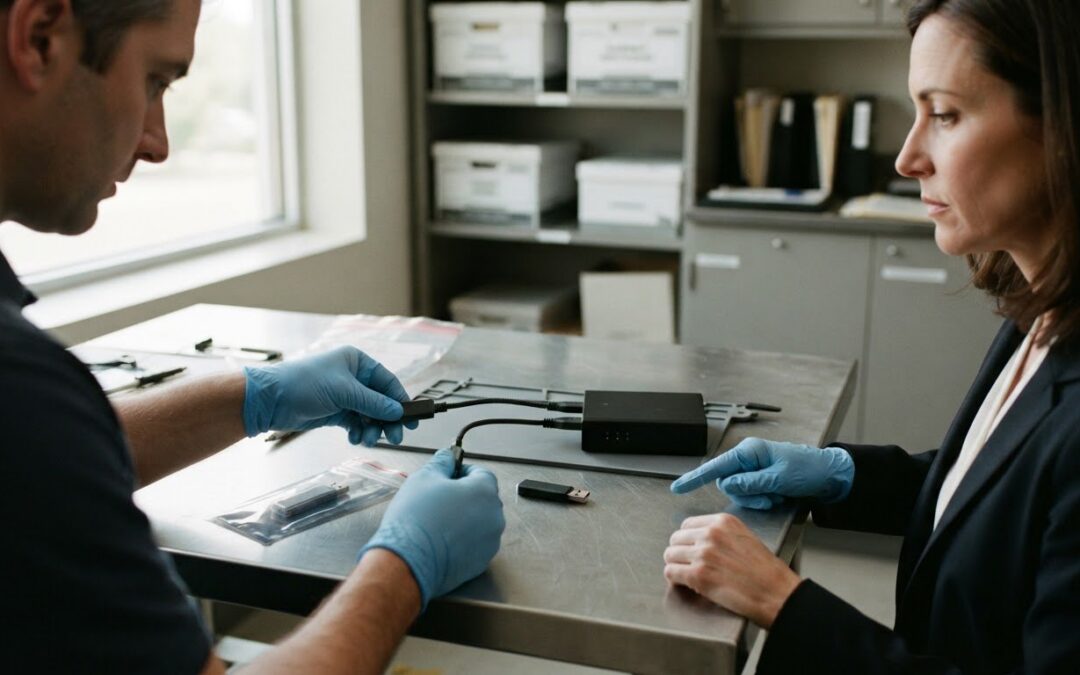
Evidence is strongest when its original context survives. To learn how to gather evidence of fraud safely, preserve original emails with full headers, save online interactions and records without altering them, and document when and how you obtained each item. Evidence may be admissible if it is relevant, can be authenticated, and was collected lawfully; a screenshot or suspicion alone doesn’t establish fraud.
It’s understandable to want to capture everything quickly, especially when messages or account records could disappear. A careful process can help preserve the material’s credibility and reduce the risk of unauthorized access or accidental changes. This guide explains how to preserve emails, chats, transaction records, and physical evidence; what to document about conversations and collection; and how relevance, authentication, and lawful collection can affect whether evidence is used in a legal proceeding.
Key Takeaways
- Choose a reporting channel that fits the suspected financial crime, and organize your account of events before reporting.
- Keep emails in their original form with full header information so their context can be examined.
- Capture online interactions alongside useful context, such as account details and transaction records.
- Document how evidence was obtained and avoid unauthorized access or changes that could undermine its credibility.
What is a Fraud Investigation?
A fraud investigation examines records, communications, and reported events to assess suspicious activity. In the United States, reporting suspected financial crime to the appropriate agency can help law enforcement identify conduct for review.
Don’t access another person’s computer, email, or property without authorization, and don’t alter original records. Separate what you personally observed from assumptions and information shared by others.
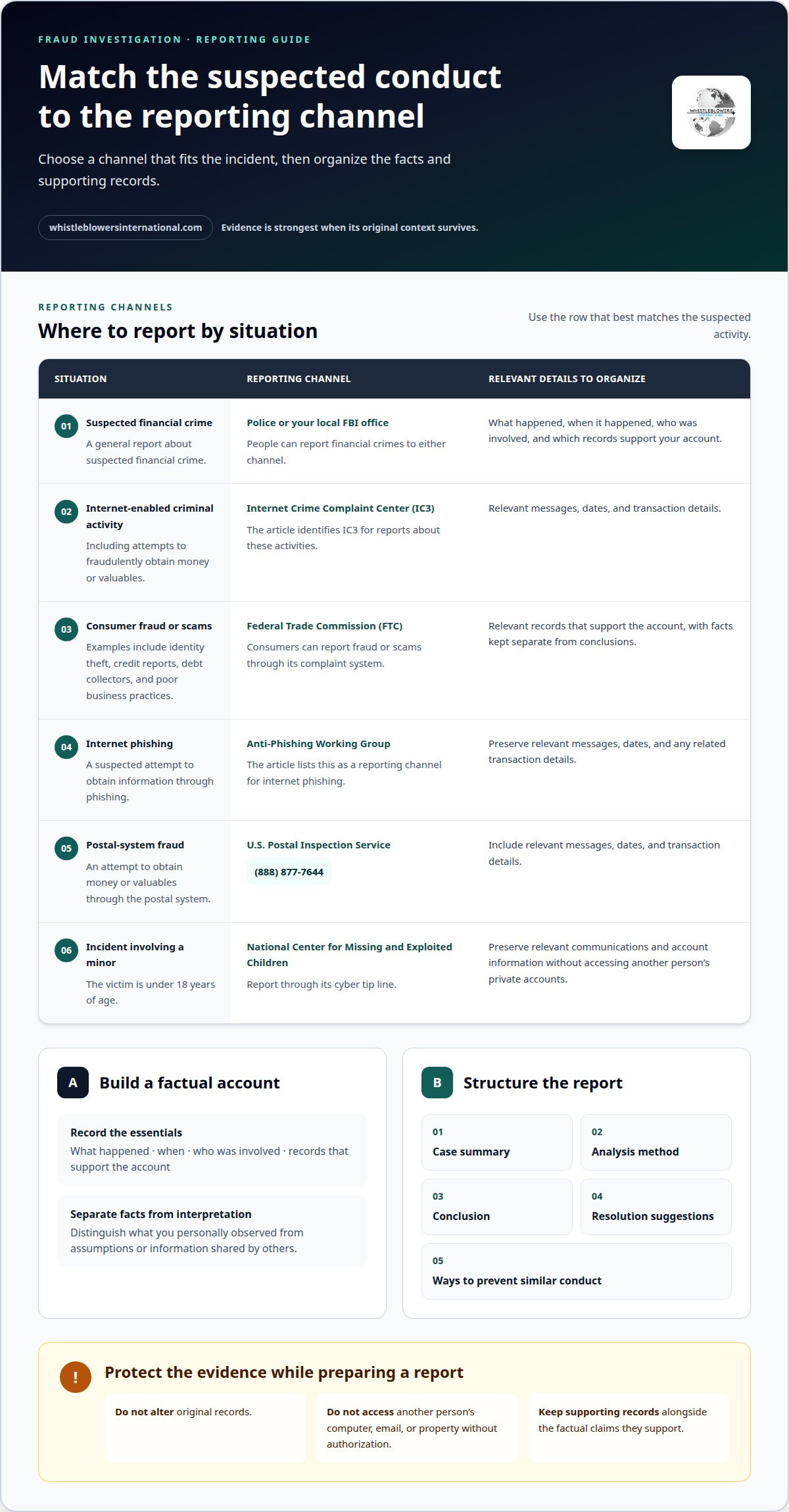
- Prepare a factual report. Write down what happened, when it happened, who was involved, and which records support your account. People can report financial crimes to police or their local FBI office. Keep conclusions separate from facts you directly observed.
- Match the report to the suspected conduct. The Internet Crime Complaint Center accepts reports about internet-enabled criminal activity and attempts to fraudulently obtain money or valuables. Consumers can also report fraud or scams to the Federal Trade Commission. Its complaint system covers matters including identity theft, credit reports, debt collectors, and poor business practices.
- Use a suitable channel for online or postal fraud. People can report internet phishing to the Anti-phishing Working Group. For attempts to obtain money or valuables through the postal system, report the matter to the U.S. Postal Inspection Service at (888) 877-7644. Include relevant messages, dates, and transaction details.
- Report incidents involving minors appropriately. If the victim is under 18 years of age, report the incident to the National Center for Missing and Exploited Children’s cyber tip line. Preserve relevant communications and account information without accessing another person’s private accounts.
- Organize findings into a clear presentation. A useful fraud investigation report summarizes the case, explains the analysis method, states the conclusion, and suggests ways to resolve the matter and prevent similar conduct. Present supporting records alongside each factual claim, and distinguish evidence from interpretation.
Preserve emails with full header information
Emails can show what was represented, when it was communicated, and who received it. Contracts, invoices, bank records, transaction confirmations, disclosures, sales materials, letters, and text messages may also help establish the surrounding facts.
Preserve original messages and records. Don’t edit or delete them, and don’t rely on a forwarded email as your only copy.
- Save the original message. Use your email program’s option to download or export the message, if available. Keep the resulting file unchanged, alongside the message in its original mailbox. A forwarded copy may omit header details, so don’t treat it as a substitute for the original.
- Include the complete header information. Preserve sender and recipient addresses, the subject, date and time, and routing information shown in the full headers. These details help retain context around an email, such as whether it came from a particular account and when it was transmitted.
- Keep a separate working copy. Store the original file without annotations, then use a duplicate for highlighting or notes. Record the date you collected it, the mailbox or folder where it appeared, and the person who saved it. This creates a clear record of your collection action.
- Collect related records together. An email about a payment may be clearer beside the invoice, account statement, wire receipt, or trade confirmation it discusses. Preserve each source record separately, then note how the documents connect. Don’t combine files in a way that hides their origin.
- Protect access and context. Keep evidence in an appropriately restricted location, and avoid accessing another person’s account or device without authorization. If messages concern import or export transactions, the records may relate to import export customs fraud legal action. Preserve the emails and associated transaction documents for review.
Preserve social media posts, chats, and other online interactions
A practical part of how to gather evidence of fraud safely is preserving online interactions with enough context to understand them. Save the original interaction where possible, record its displayed date and time, and keep a separate screenshot or export as a reference copy.
- Capture the complete interaction. To understand how to gather evidence of fraud safely, preserve the surrounding conversation, not just the suspicious line. Save relevant posts, chat logs, text messages, voicemail, and phone recordings. Include the account name, visible date and time, and platform context. A cropped screenshot of a payment demand, for example, may omit the earlier promise that explains its significance.
- Preserve the source and its metadata. Use the platform’s export or download feature when available, and keep the resulting file unchanged. Record the page or account location and the date you captured it. Retain screenshots as reference copies rather than substitutes for original records or metadata. Don’t edit timestamps, crop away identifying context, or add notes to the source file.
- Connect communications with transactions. If a chat refers to a transfer, preserve the related transaction record and note the connection. Access logs, account profiles, and messages may help investigators examine conduct, identify relevant sources, and assess whether events suggest suspected criminal activity. Keep each item distinguishable so reviewers can trace how the records relate.
- Interview witnesses carefully. Speak with people who directly saw or received relevant communications. Record each person’s account separately, including approximate dates and times, and distinguish personal observations from what someone else reported. Ask neutral questions, avoid suggesting answers, and don’t present an assumption as an established fact.
- Structure an internal investigation. Identify participants, their roles, the conduct under review, the evidence needed, and the investigation’s goal. For a federal enforcement matter, organize communications and transactions by event, then preserve relevant records before they can be deleted. Don’t enter another person’s account or device without authorization.
Forensic evidence gathering
Forensic work can connect records to specific events while protecting their integrity. Preserve source documents, note how you obtained each item, and avoid actions that could alter evidence.
-
Protect Your Identity, Accounts, and Personal Safety
Secure your own accounts and devices before collecting evidence. Don’t use someone else’s login or access their computer, email, or property without authorization. For sensitive workplace or business evidence, consult legal counsel before collecting it. Restrict records to people who need them, and don’t confront anyone if doing so could put you at risk.
- Build a record of events. Write down conversations with suspected fraudsters, including approximate dates and times. Gather account information, statements, trade confirmations, disclosures, and sales materials. For suspected wire fraud, document the communications, transaction timing, accounts involved, affected money or credentials, and intermediaries.
- Preserve related documents and proof of payment. Contracts, invoices, purchase orders, financial statements, bank records, emails, letters, text messages, and internal company memos may help explain what happened. Keep canceled checks and receipts for wire transfers, money orders, or prepaid cards with the corresponding transaction records. Note the source of each item.
- Handle electronic and physical evidence carefully. Preserve original electronic records without editing or deleting them. Forged documents, altered contracts, or defective products may also be relevant; handle and store physical items appropriately to avoid contamination. Witness testimony or digital metadata may be needed to authenticate documents.
-
Contact a Lawyer or Forensic Investigator
Consult legal counsel before collecting sensitive workplace or business evidence, or if your proposed method could involve another person’s records or property. A forensic investigator may help preserve and analyze electronic records, transaction logs, or physical items. If a government inquiry or litigation is underway, avoid altering records that may be relevant.
Piacentile & Associates LLP: SEC Whistleblower Program Filings
The Piacentile Law Firm, PLLC, led by Dr. Joseph Piacentile, Esq., known as “Dr. Joe,” represents individuals in the U.S. and internationally in U.S. legal whistleblower actions on a contingency fee basis. For suspected securities misconduct, the firm files claims through the SEC Whistleblower Program. Organize a concise chronology, identify the records supporting each event, and distinguish what you observed directly from what others reported. Keep original emails, transaction documents, and related communications intact so the information can be considered in context. The firm also handles matters involving the IRS, FinCEN, CFTC, the False Claims Act, and import-export customs fraud. Whistleblower cases are very complex and take a long time to resolve, and the firm needs strong information and evidence to evaluate a case. Contact the firm’s attorneys or investigators to discuss your information and possible next steps.
Turn preserved evidence into a considered next step
Evidence is more useful when its significance is assessed alongside the conduct it may document. A disciplined approach to how to gather evidence of fraud safely can help turn a collection of records into a clear account of what happened, what you observed, and what remains uncertain. Keep your explanations factual and records intact as you consider whether the matter fits a formal reporting path.
Piacentile & Associates LLP offers False Claims Act / Qui Tam Lawsuits, SEC Whistleblower Program Filings, and IRS Whistleblower Program Filings. If your evidence concerns potential securities fraud, tax fraud, or fraud involving government claims, consider whether one of these offerings aligns with your situation. Presenting the relevant records in an organized way can support a focused discussion about next steps.
Contact Piacentile & Associates LLP to discuss your concerns and the evidence you have preserved. A careful next step can help you move forward with clarity.
Frequently Asked Questions
Collecting Evidence of Fraud: What’s Legally Admissible?
Evidence must be relevant, collected lawfully, and capable of authentication. A witness generally testifies to facts they personally know, while circumstantial evidence may also help establish knowledge or intent. For example, a transaction record supported by a witness who can explain its origin may be more useful than an unverified image. Whether evidence is admissible depends on the evidence and the rules governing the proceeding.
How can I preserve emails, texts, and documents as evidence?
Keep messages in their original accounts or formats, and retain complete versions rather than selected excerpts. For a text exchange, capture enough surrounding messages to show context, then note the account or device where it appeared. Store copies separately from originals and maintain an index describing each item’s source and collection date. This helps reviewers distinguish source records from working copies.
How do I document fraud without altering or destroying evidence?
Make notes in a separate document rather than writing on, renaming, or editing original evidence. Record when you found an item, where it was stored, who handled it, and what actions were taken. If a paper document has writing on the reverse, preserve both sides. Clearly separate what a record shows from your interpretation.
Is it legal to record conversations or take photos when gathering evidence?
Whether recording is lawful can depend on where it occurs, who is involved, and the circumstances. Don’t assume that access to a phone or camera makes recording a private conversation or photographing private property lawful. Before recording, photographing, or collecting material in a workplace or business setting, seek legal guidance about applicable federal and state rules. Never trespass or access someone else’s device to obtain evidence.
How do I report suspected fraud to the FTC, police, or other authorities?
Choose a reporting channel that fits the suspected conduct. The Federal Trade Commission accepts consumer complaints about fraud and scams; police or the FBI can receive reports about financial crimes. The Internet Crime Complaint Center accepts reports involving internet-based criminal activity. Include a concise timeline and identify records that support each event. Regulatory complaint systems may help identify patterns but may not resolve an individual complaint.
What are the rules for collecting fraud evidence in the United States?
Use lawful methods, preserve original records, and avoid unauthorized access to another person’s computer, email, or property. Evidence should connect to relevant facts and be capable of authentication; witness testimony generally concerns personal knowledge, not speculation. Applicable rules depend on the proceeding and circumstances. If collection involves sensitive business information, a private conversation, or another person’s records, seek legal guidance before acting.