
What if the greatest threat to your professional future isn’t the misconduct you’ve uncovered, but the specific manner in which you choose to report it? You’ve likely spent sleepless nights weighing the moral obligation to speak out against the very real fear of industry blacklisting or aggressive legal retaliation from your employer. It’s a heavy burden to carry, and your anxiety regarding which government agency to trust is both valid and necessary for your survival. If you proceed without a comprehensive strategy, you risk becoming a target rather than a protected witness.
Learning how to protect yourself as a whistleblower involves far more than simply filling out a form; it requires a sophisticated blend of digital security and high-level legal maneuvering. This guide provides the essential roadmap you need to safeguard your reputation while reporting corporate or government fraud. We’ll examine the specific criteria to verify if your situation qualifies for federal protection, detail the protocols for maintaining absolute anonymity, and outline the professional steps required to insulate your career from counter-suits. By the end of this analysis, you’ll understand how to transform from a vulnerable insider into a strategic advocate with the full weight of federal statutes as your shield.
Key Takeaways
- Identify the specific federal statutes, including the False Claims Act and SEC protocols, that provide the necessary legal framework for your protection.
- Master the essential strategies for how to protect yourself as a whistleblower by prioritizing attorney-client privilege over internal reporting channels.
- Avoid the common pitfalls of internal hotlines and HR disclosures that can prematurely alert an employer to your investigation.
- Secure your digital footprint through the use of air-gapped devices and metadata management to maintain absolute confidentiality during the reporting process.
- Utilize elite professional advocacy to serve as a strategic interface between you and government agencies, ensuring your career remains insulated from retaliation.
Understanding the Landscape of Whistleblower Protection in 2026
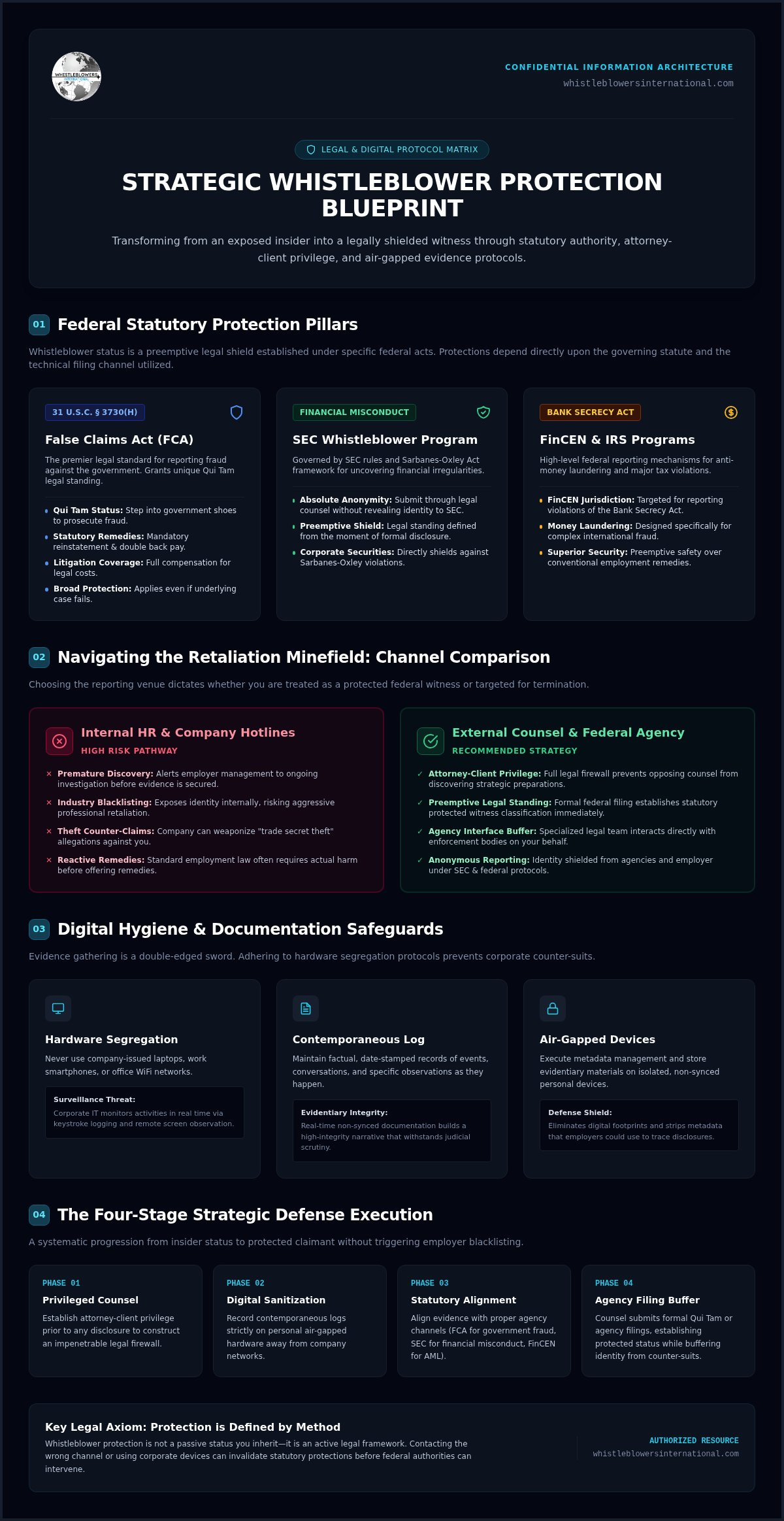
Whistleblower protection isn’t a passive status you inherit; it’s a rigorous legal framework designed to prevent and remedy retaliation. If you’re considering coming forward, understanding the whistleblower protection framework in the United States is the first step in learning how to protect yourself as a whistleblower. This landscape is built upon primary federal shields such as the False Claims Act (FCA), the Securities and Exchange Commission (SEC) rules, and the Sarbanes-Oxley Act. These statutes don’t just offer a safety net after you’ve been fired; they provide a preemptive structure that defines your legal standing from the moment of disclosure.
A “battle-tested” strategy recognizes that legal filing is the most effective form of protection. When you file a formal complaint through established federal channels, you aren’t just reporting a crime; you’re documenting your status as a protected witness. It’s vital to remember that these protections are often statute-specific. This means the specific agency you contact and the technical method you use to report fraud determine the exact level of safety you receive. If you report through the wrong channel, you might inadvertently strip yourself of the very safeguards you need to survive the process.
The Power of the False Claims Act
The False Claims Act remains the gold standard for those uncovering fraud against the government. Under 31 U.S.C. § 3730(h), the law provides robust anti-retaliation provisions that include reinstatement, double back pay, and compensation for litigation costs. By securing “Qui Tam” status, you gain a unique legal standing where you effectively step into the shoes of the government to prosecute the fraud. These protections are particularly resilient because they apply even if the underlying case isn’t ultimately successful, provided you had a reasonable belief that a violation occurred.
Agency-Specific Protections (SEC, IRS, FinCEN)
For those dealing with financial misconduct, the SEC Whistleblower Program offers strict anonymity protocols that allow you to report through counsel without ever revealing your identity to the agency. Understanding what is FinCEN reporting is equally critical for individuals uncovering money laundering or violations of the Bank Secrecy Act. These federal programs offer a superior level of security compared to standard employment law, which often requires you to suffer harm before offering a remedy. When you’re determining how to protect yourself as a whistleblower, focusing on these specific federal programs ensures you’re leveraging the most powerful investigative and protective tools available in 2026.
The Golden Rule: How to Document Evidence Without Risking Your Case
Documentation is a double-edged sword in any fraud investigation. While evidence is the foundation of your claim, the method you use to gather it can either solidify your protection or provide your employer with grounds for a “theft of trade secrets” counterclaim. Establishing attorney-client privilege is the first and most critical layer of documentation safety. When you work with counsel, your communications and the evidence you organize fall under a legal firewall that prevents the opposing side from accessing your strategic preparations. This is a fundamental component of learning how to protect yourself as a whistleblower without inadvertently handing your employer a weapon to use against you.
You must adhere to a strict protocol regarding hardware and networks. Never use company-issued laptops, phones, or office WiFi to document misconduct or communicate with your legal team. Corporate IT departments often utilize keystroke logging and remote screen monitoring that can alert the wrongdoers to your activities in real time. Instead, maintain a contemporaneous log on a personal, non-synced device. This log should be a factual, date-stamped record of events, conversations, and observations. By recording details as they happen, you create a high-integrity narrative that is far more persuasive to federal investigators than memories recounted months later.
What to Document (and What to Avoid)
Focus your efforts on “smoking gun” evidence that directly proves the fraud. This includes internal memos, financial spreadsheets showing discrepancies, and emails where misconduct is discussed or directed. While it’s tempting to record conversations, you must be extremely cautious. In “two-party consent” states, recording a conversation without everyone’s permission can lead to criminal charges. The OSHA Whistleblower Protection Program provides guidance on protected activities, but it won’t shield you from state-level wiretapping laws. Stick to documenting the “who, what, where, and when” of every interaction. If you are unsure if your evidence was obtained legally, speaking with a strategic legal advocate can help you evaluate your materials before they are submitted.
The Legal Way to Handle Proprietary Information
The line between “protected activity” and “data theft” is thin but manageable with elite guidance. Federal law recognizes that whistleblowers must sometimes use internal documents to prove a violation, yet this doesn’t grant you a license to download an entire corporate server. An experienced attorney acts as a vital filter, reviewing your documents to ensure they are relevant to the fraud and used within the scope of a legal filing. A protected disclosure is a report of information that an individual reasonably believes evidences a violation of law, gross mismanagement, or a substantial danger to public health and safety. By following a structured legal review, you ensure that your evidence serves its purpose without compromising your personal liability.
Internal vs. External Reporting: Navigating the Retaliation Minefield
The decision of where to first disclose misconduct is often the single most significant factor in determining your professional survival. Many corporate handbooks emphasize an “open door policy” or encourage the use of internal ethics hotlines, yet these channels frequently serve as an early warning system for the organization. When you report internally, you essentially hand the company the opportunity to begin defensive maneuvers before you’ve secured legal protection. A more sophisticated approach, often described as a “preemptive strike,” involves filing a formal report with the government through counsel before the company even suspects you’ve uncovered the fraud. This strategy is a cornerstone of how to protect yourself as a whistleblower, as it establishes your status as a protected witness while you remain invisible to your employer.
Why HR is Rarely the Answer
It’s vital to recognize that Human Resources (HR) departments have a primary fiduciary duty to the corporation, not to the individual employee. While HR personnel may be empathetic, their role is to mitigate risk for the entity. If your report threatens the organization’s financial standing or reputation, the company’s instinct is often to isolate the source of the information. We frequently see cases where an internal report is met with the sudden “manufacturing” of performance issues (such as unexpected negative reviews or disciplinary warnings) designed to justify a future termination. You should be vigilant for early signs of retaliation, which often include:
- Sudden exclusion from recurring strategic meetings or email chains.
- Unexplained changes in job responsibilities or a “demotion in duties.”
- Hyper-scrutiny of your arrival times or minor administrative tasks.
- A noticeable shift in the tone of communications from direct supervisors.
The Strategic Advantage of External Filing
Filing externally through an elite legal advocate provides a layer of insulation that internal reporting cannot match. In Qui Tam cases (actions brought under the False Claims Act), the complaint is filed “under seal,” meaning it’s kept secret from the public and the company while the government investigates. This allows you to continue your employment while federal agents gather evidence. Similarly, the SEC Office of the Whistleblower allows for anonymous submissions if you’re represented by an attorney, ensuring your name never appears on a government document during the initial stages.
If you’re dealing with complex financial misconduct, an IRS whistleblower lawyer can file a claim on your behalf, navigating the “First to File” rules that are prevalent in SEC and FCA programs. These rules dictate that only the first individual to provide original information is eligible for a reward and the accompanying legal safeguards. By prioritizing external filing, you ensure you’re the one setting the pace of the investigation. This proactive stance is the most effective way to understand how to protect yourself as a whistleblower while maximizing the impact of your disclosure.
Digital Hygiene and Confidentiality Protocols for Whistleblowers
Maintaining absolute digital silence is a prerequisite for a successful claim in 2026. When you’re determining how to protect yourself as a whistleblower, you must operate under the assumption that your employer’s IT infrastructure is a sophisticated surveillance tool. Mandating the use of “Air-Gapped” devices is a standard protocol for high-stakes communications. An air-gapped device is a piece of hardware, such as a dedicated laptop or tablet, that has never been connected to your company’s network or even your home WiFi. This prevents the accidental transmission of data through synchronized cloud services or shared networks that your employer might monitor.
Every digital file you share carries “Metadata,” which includes hidden information such as the original author’s name, the exact time of creation, and even GPS coordinates. If you submit raw files to third parties without scrubbing this data, you may inadvertently reveal your identity to the very people you’re reporting. We recommend using encrypted platforms like Signal or ProtonMail for all sensitive discussions. These tools offer end-to-end encryption that prevents unauthorized interception. It’s equally vital to avoid discussing your case on social media or with colleagues, even “off the record.” A single misplaced comment can dismantle months of careful preparation.
Securing Your Personal Digital Footprint
Hardening your personal email and cloud storage accounts is a non-negotiable step in your survival strategy. Use unique, complex passwords and hardware-based two-factor authentication (2FA) for all personal accounts. If you utilize personal devices for work under a “Bring Your Own Device” (BYOD) policy, be aware that employer monitoring software can often bridge the gap between work and personal data. When the time comes for an exit interview, remain neutral and professional. Revealing your intentions or evidence at this stage is a tactical error that gives the company a head start on their defense. If you’re ready to secure your digital footprint and initiate a protected filing, consult with our elite investigative team to ensure your data remains secure.
Confidentiality in the Investigative Phase
Government investigators are highly trained to protect the identity of their sources throughout the process. In many SEC actions, “John Doe” filings are utilized to allow you to proceed anonymously through your legal counsel. This ensures your name doesn’t appear on public dockets or even internal government documents during the initial scrutiny of the fraud. During the “Under Seal” period, your silence is your most effective defensive tool because it prevents the company from identifying the leak and initiating a retaliatory strike. By adhering to these strict confidentiality protocols, you maintain the strategic advantage while federal agencies build a case based on your disclosures.
Securing Elite Legal Counsel: Why Professional Advocacy is Your Best Defense
Securing elite legal counsel is the definitive step in your survival strategy. It transforms your position from a vulnerable individual into a formidable legal adversary. When you engage a firm of this caliber, your attorney serves as a vital barrier, acting as the primary interface between you and federal investigators. This buffer ensures that you aren’t forced to answer high-stakes questions without preparation, and it prevents your employer from directly pressuring you once a claim is active. If you want to know how to protect yourself as a whistleblower, you must understand that professional advocacy is the only way to ensure your voice is heard without your career being silenced.
Working with a firm that possesses an insider’s perspective offers a tactical advantage that traditional employment firms cannot replicate. Our team includes former whistleblowers who understand the psychological and professional toll of these actions. We don’t just provide legal advice; we offer a battle-tested roadmap based on real-world experience in the trenches of federal fraud investigations. During an initial consultation, a sophisticated firm looks for specific indicators of systemic fraud and the availability of high-integrity evidence. This rigorous vetting process ensures that your case is built on a foundation that can withstand the intense scrutiny of government agencies and corporate defense teams.
The Contingency Fee Model Explained
A primary concern for many insiders is the financial cost of challenging a billion-dollar corporation with unlimited resources. The contingency fee model levels this playing field by removing the burden of upfront costs or hourly billing. In this framework, the firm only receives compensation if the case is successful, which aligns the lawyer’s interests perfectly with your own success. If you’re interested in the specific mechanics of this arrangement, you can review our whistleblower lawyer contingency fee guide. This structure allows you to access elite, global-level representation without the financial risk typically associated with high-level litigation.
Taking the First Step Securely
The timing of your first contact with counsel is as important as the information you provide. You should seek a confidential evaluation before you are terminated or choose to resign, as this allows your legal team to document your status while you’re still in a position to observe the misconduct. Scheduling this evaluation is a secure process that does not leave a trail on company systems. By acting proactively, you ensure that every step you take is shielded by attorney-client privilege. Contact Piacentile & Associates for a confidential case evaluation today.
Taking Command of Your Professional Future
You now possess the strategic foundation required to navigate the complexities of federal fraud reporting. By prioritizing digital hygiene and bypassing internal corporate channels, you significantly reduce the risk of premature detection and retaliatory strikes. Understanding how to protect yourself as a whistleblower is not merely about legal theory; it’s about the precise execution of a battle-tested protocol that prioritizes your anonymity and professional reputation. Every decision you make, from the device you use to the counsel you select, determines the ultimate success of your claim.
Piacentile & Associates LLP provides the elite advocacy necessary to manage these high-stakes transitions. Led by a former whistleblower and attorney, our firm offers global representation on a contingency fee basis. We specialize in FCA, SEC, and IRS programs, ensuring you have access to seasoned experts without upfront costs. Secure Your Future: Request a Confidential Case Evaluation today to ensure your disclosures are handled with the scrutiny they deserve. You don’t have to face these massive complexities alone when you have a formidable ally ready to safeguard your integrity and your future.
Whistleblower Protection Frequently Asked Questions
Can I be fired for being a whistleblower?
While it’s illegal under federal anti-retaliation statutes like the False Claims Act, employers sometimes attempt termination to silence dissent. If you’re wondering how to protect yourself as a whistleblower, you must understand that the law provides remedies such as reinstatement and double back pay. Filing a formal action under seal before the company acts is the most effective way to establish your status as a protected witness and deter illegal firing.
How do I remain anonymous while reporting fraud?
Anonymity is primarily achieved by filing through legal counsel under specific federal programs. The SEC and CFTC whistleblower programs allow you to submit information anonymously if an attorney represents you. Your identity is shielded from the public and the company throughout the initial investigative phase. This protocol ensures that your name remains confidential while government agents evaluate the evidence you’ve provided, maintaining your privacy during high-stakes proceedings.
What should I do if I’ve already been retaliated against?
If retaliation has already occurred, you must immediately document every instance of adverse action and consult with a specialized attorney. Federal statutes provide specific protections for individuals who have suffered demotion, suspension, or harassment. A battle-tested legal team can help you file a retaliation claim alongside your fraud report, seeking compensation for lost wages and emotional distress while holding the employer accountable for their illegal conduct against you.
Do I need a lawyer to report fraud to the government?
While you can technically report fraud alone, programs like the SEC and CFTC require an attorney if you wish to remain anonymous. In False Claims Act cases, an individual cannot represent the interests of the United States without legal counsel. Engaging elite counsel ensures that your filing meets rigorous technical requirements and provides a strategic interface between you and the government, which is essential for maximizing your protection and potential reward.
Can I still get a reward if I was partially involved in the fraud?
You may still be eligible for a reward provided you were not the primary planner or initiator of the misconduct. Federal programs often include provisions that allow participants to come forward, although the government may reduce the final award percentage based on the level of involvement. It’s critical to have a lawyer evaluate your specific role to ensure that your disclosure is positioned as a voluntary act of transparency rather than a confession.
What is the difference between a whistleblower and a leaker?
A whistleblower follows established legal channels to report misconduct to government authorities, whereas a leaker typically releases information to the media. Whistleblowers who follow federal statutes like the False Claims Act receive specific anti-retaliation protections and potential monetary rewards. Leakers often lack these legal safeguards and may face significant personal liability because they bypassed the confidential, structured reporting systems designed to handle sensitive data without compromising corporate trade secrets.
How long does a whistleblower investigation typically take?
Federal investigations are methodical and often span several years depending on the complexity of the fraud. SEC or IRS cases may take three to five years to reach a conclusion, as government agencies must conduct exhaustive audits and interviews. Your legal team manages the process during this duration, allowing you to maintain your professional life while the government builds its case under seal, ensuring that every procedural requirement is met.
Will reporting fraud affect my future employment prospects?
If you utilize anonymity protocols and secure elite representation, it’s possible to report fraud without your current or future employers ever knowing. Learning how to protect yourself as a whistleblower involves using these confidentiality shields to prevent industry blacklisting. By filing under seal and communicating only through counsel, you maintain control over your narrative and ensure that your professional reputation remains insulated from the fallout of the investigation and potential industry gossip.