
To report suspected fraud in the United States, send a clear allegation to the agency responsible for the conduct: USCIS for suspected immigration benefit fraud, ICE for immigration violations, or the FBI’s Internet Crime Complaint Center for cyber-enabled crime. Reporting fraud as a foreign national starts with identifying what happened and which authority handles it. If the facts may involve a federal offense, this guide also explains when contacting federal prosecutors may be relevant.
Deciding what to disclose can be difficult, especially if you’re concerned about anonymity, personal safety, or the consequences of making an allegation. A useful report focuses on specific, supportable details rather than assumptions. Make clear what you observed firsthand and what you suspect.
Here, you’ll learn how to choose a reporting channel, organize names, dates, records, and other relevant information, and understand the limits of anonymous or confidential submissions. The steps also explain how to report from inside or outside the United States and how to assess whether the matter may warrant attention from federal prosecutors.
Key Takeaways
- Match the allegation to the agency’s jurisdiction, and distinguish suspected immigration benefit fraud from other types of misconduct.
- Build a focused record with identifying details and relevant evidence; separate what you directly know from what you infer.
- Understand the difference between an anonymous tip and a confidential complaint before choosing how to submit your information.
- Assess whether the facts point to a federal offense and whether a whistleblower filing may be relevant before approaching federal prosecutors.
Anonymous fraud tips and retaliation concerns
After a scam, contact your bank promptly to discuss protecting accounts or disputing transactions, and report the incident to local police. If someone faces immediate danger, call 911, as U.S. Citizenship and Immigration Services instructs.
- Choose how to identify yourself. A USCIS tip may be submitted anonymously, without your name, email address, or phone number in the submission. However, website monitoring may still collect technical information about your visit. Keep copies of submitted files and exclude details unrelated to the allegation.
- Distinguish anonymity from confidentiality. The DHS OIG Hotline accepts allegations anonymously, with a request for confidentiality, or with your identity disclosed. Confidentiality is not an absolute promise: the Hotline may disclose a complainant’s identity when needed to investigate or when law requires disclosure.
- Use a contact method that fits your concern. The Department of Homeland Security Office of Inspector General can be contacted at 1-800-323-8603. Its Hotline also recommends an online fillable complaint form. It processes complaints generally in receipt order, and a complaint number does not establish that an investigation will follow.
- Report immigration-related information through the appropriate channel. The ICE Tip Line is a 24/7 toll-free phone line at 866-347-2423, according to U.S. Immigration and Customs Enforcement. Consider whether your tip concerns immigration enforcement or another organization before choosing a reporting route.
- Plan around retaliation risks before submitting. Save relevant records securely, note who has access to them, and avoid using an employer-controlled device if that could expose your activity. If an official asks for follow-up, share only relevant information and clarify how your identity will be handled. The DHS OIG Hotline is not monitored continuously, so don’t use it for emergencies.
What information should I include in my allegations?
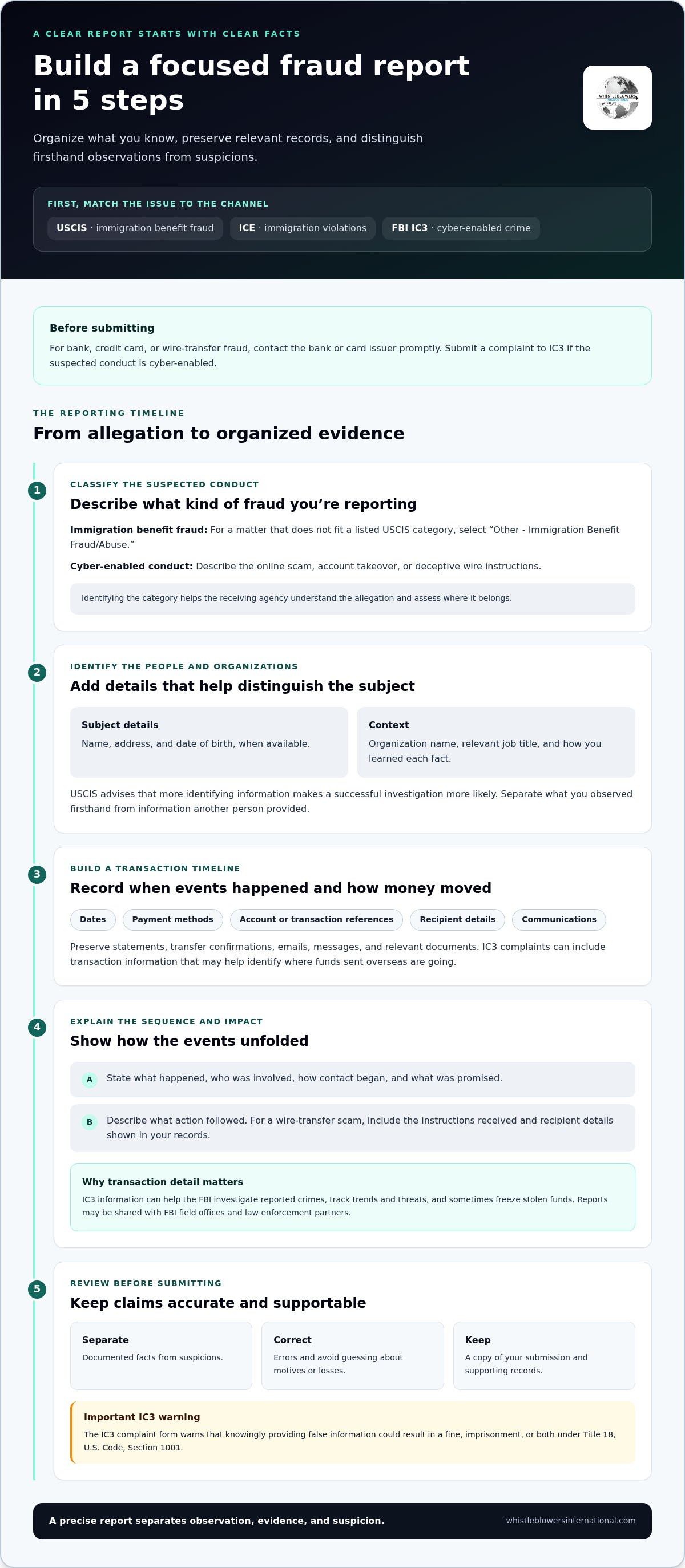
For bank, credit card, or wire-transfer fraud, contact the bank or card issuer promptly and report the transaction. Then submit a complaint to the Internet Crime Complaint Center (IC3) if the suspected conduct is cyber-enabled. When cryptocurrency or digital assets are involved, forensic investigators like Prime Asset Recovery can help trace the path of stolen funds to provide concrete evidence for your report.
- Identify the suspected fraud category. For immigration benefit fraud or abuse that doesn’t fit a listed USCIS category, select “Other – Immigration Benefit Fraud/Abuse.” For online scams, account takeover, or deceptive wire instructions, describe the cyber-enabled conduct. When reporting fraud as a foreign national, identifying the category helps the receiving agency understand the allegation and assess where it belongs.
- Give identifying details. Include the subject’s name, address, and date of birth when available. USCIS advises that more identifying information makes a successful investigation more likely. Add the organization’s name, relevant job title, and how you learned each fact. Distinguish firsthand observations from information another person provided.
- Build a transaction timeline. Record dates, payment methods, account or transaction references, recipient details, and communications. Preserve statements, transfer confirmations, emails, messages, and relevant documents. The Federal Bureau of Investigation says IC3 complaints can include transaction information that helps identify where funds sent overseas are going.
- Explain the sequence and impact. State what happened, who was involved, how contact began, what was promised, and what action followed. For a wire-transfer scam, identify the instructions received and recipient details shown on your records. IC3 information can help the FBI investigate reported crimes, track trends and threats, and sometimes freeze stolen funds. Reports may be shared with FBI field offices and law enforcement partners.
- Review every statement before submitting. Separate documented facts from suspicions, correct errors, and avoid guessing about motives or losses. The IC3 complaint form warns that knowingly providing false information could result in a fine, imprisonment, or both under Title 18, U.S. Code, Section 1001. Keep a copy of your submission and supporting records. Careful review makes reporting fraud as a foreign national more precise and supports a clear account of the evidence.
Submitting a tip from inside or outside the United States
- Match the report to the agency. USCIS accepts suspected immigration benefit fraud tips, while ICE handles immigration violations. The DHS Office of Inspector General Hotline receives allegations involving the Department of Homeland Security. For cyber-enabled crime, submit a complaint to the FBI-run Internet Crime Complaint Center (IC3). Foreign nationals can use these routes to report relevant conduct.
- State where you are submitting from. USCIS allows people reporting suspected fraud to indicate whether they are inside or outside the United States. Include your current country and the location of the suspected conduct. These details help distinguish your location from where the reported events occurred.
- Report identity theft or financial fraud to the FTC. Use the FTC’s official complaint process and explain that you live outside the United States. Describe the suspected account misuse, payment, or impersonation, and include relevant dates and records. Keep your statements factual and retain a copy of what you submit.
- Contact state or local authorities with jurisdiction. If you live abroad, identify the U.S. city or state connected to the incident, such as where the business operated or the alleged transaction occurred. Contact the relevant police department or state authority and ask how to submit your report and supporting records from overseas. Include your country and a reliable method for follow-up.
- Choose a submission method you can use safely. A DHS OIG allegation may be mailed to the Office of Investigations Hotline at 245 Murray Lane SW, Washington, DC 20528-0305. For online reporting, use the receiving agency’s official form and save a copy of your submission and attachments.
- Prepare for follow-up across borders. Give the agency a secure contact method if you want officials to reach you, and include time zones or preferred contact hours. If your evidence is in another language, identify the language and organize the original records by date. Don’t alter source files; label copies clearly.
Reporting fraud to federal prosecutors
Reporting fraud does not, by itself, resolve questions about your visa, immigration status, or taxes. The answers depend on the facts, including whether the allegation involves your own conduct or financial records.
- Assess whether the facts suggest a federal crime. Identify the conduct, people or organizations involved, and any connection to federal programs, interstate transactions, or federal agencies. Describe evidence and events rather than deciding guilt yourself. Prosecutors need a clear account of what happened and why you believe it may warrant criminal investigation.
- Identify the relevant federal district. U.S. Attorneys serve 94 federal judicial districts across the United States. Consider where the conduct occurred, where affected parties or organizations are located, and where relevant transactions took place. These details help you identify which district may be connected to the allegation.
- Prepare a concise written summary. State the alleged conduct, approximate timeline, involved parties, and how you learned the information. Separate direct observations from documents or statements supplied by others. Attach relevant records, label them clearly, and preserve originals without altering them.
- Contact the appropriate U.S. Attorney’s Office. Use the office’s official contact channel for the district connected to the reported conduct. Explain that you are submitting information about suspected fraud, then ask how the office accepts supporting materials. Do not send unrelated personal documents or sensitive originals unless requested through a secure process.
- Keep a record of your submission. Save the date, the materials sent, and any acknowledgment or reference number. A receipt confirms delivery, not that prosecutors opened an investigation or will take a particular action. If investigators contact you, answer accurately and distinguish what you know from what you cannot verify.
- Separate reporting from personal legal exposure. If documents reveal your own participation, immigration representations, or tax reporting, identify those issues before submitting a detailed account. Keep the facts intact, but get advice on how to describe your role accurately and avoid speculation. This distinction matters because an allegation can concern another party while also raising questions about the reporter’s actions.
Piacentile & Associates LLP: SEC Whistleblower Program Filings
Piacentile & Associates LLP assists with SEC Whistleblower Program Filings when suspected fraud involves securities and the information may be relevant to a whistleblower submission. The firm also handles IRS Whistleblower Program Filings, FinCEN Whistleblower Filings, and CFTC Whistleblower Program Filings. These are distinct channels, so the suspected conduct and the agency with relevant oversight help determine which filing fits.
If your evidence concerns securities, financial institutions, taxes, or commodities, organize the records and prepare a factual timeline before pursuing a program filing. A legal review can help clarify how the information relates to the relevant program and what submission path may apply. For allegations outside these areas, such as matters handled through ordinary local law enforcement, a federal whistleblower filing may not be the appropriate route.
Contact Piacentile & Associates LLP to discuss a potential whistleblower filing.
Choose a deliberate next step
Before taking action, consider what you want to accomplish: alerting authorities, documenting suspected misconduct, or pursuing a whistleblower filing. That distinction can shape how you organize your records and which path is relevant. When reporting fraud as a foreign national, keep your account factual and separate personal knowledge from inference to give your next decision a clear foundation.
When suspected misconduct involves government funds, securities, or taxes, a specialized filing may be relevant. Piacentile & Associates LLP represents whistleblowers in False Claims Act qui tam lawsuits and SEC and IRS whistleblower filings. The appropriate route depends on the alleged conduct and the information you can provide.
If you’re considering a whistleblower filing, contact Piacentile & Associates LLP to discuss your next step. A careful decision now can help you move forward with purpose and greater clarity.
Piacentile & Associates LLP and Reporting Fraud as a Foreign National
Piacentile & Associates LLP represents individuals in whistleblower filings with the SEC, IRS, FinCEN, and CFTC, and in legal actions under the False Claims Act and involving import-export customs fraud. These services may be relevant to foreign nationals reporting conduct covered by U.S. federal law or agency programs.
Turn to Piacentile & Associates LLP when you want to discuss which type of filing or legal action may fit the conduct you are considering reporting.
Frequently Asked Questions
How can I report an allegation?
Submit the allegation through the reporting channel responsible for the suspected conduct. For example, cyber-enabled payment deception can be reported to IC3, while suspected immigration benefit fraud belongs with USCIS. Describe the conduct and why you believe it warrants review. If an agency lacks jurisdiction, it may refer the information elsewhere; submitting a report is not a finding that wrongdoing occurred.
Who can file an allegation?
People with relevant information, including foreign nationals, can submit tips through appropriate U.S. reporting channels. You don’t need to be the direct victim to report suspected wrongdoing. For example, the DHS OIG Hotline accepts allegations from DHS employees, contractors, and concerned citizens. Choose a channel based on the conduct and agency involved, rather than assuming that only U.S. citizens can report.
Why should I provide my name?
Providing your name and a reliable way to reach you can help an agency ask follow-up questions if your report needs clarification. For example, the DHS OIG requires a point-of-contact email address if you want an email notification when it assigns a complaint number. Identifying yourself does not mean an investigation will follow, so weigh the potential for follow-up against your privacy concerns.
How can a foreign national report fraud in the United States?
Use the U.S. agency channel that matches the alleged conduct, whether you submit from inside the country or abroad. State where you are physically located and where the relevant events occurred. For example, a report submitted overseas about suspected immigration benefit fraud should identify the U.S. connection and include pertinent records. This context can help officials understand the report’s jurisdiction.
What information and evidence should I include in a fraud report?
Give a concise account of who did what, when it happened, and how you learned about it. Identify relevant witnesses, businesses, accounts, or transactions, and explain which event each record supports. For example, label an invoice with its date and describe its connection to the allegation. Keep claims precise, and distinguish documented facts from conclusions.
Can foreign nationals report fraud anonymously or confidentially in the U.S.?
Yes. You can submit a USCIS tip anonymously, and the DHS OIG Hotline accepts anonymous reports, confidentiality requests, or disclosed identities. These options differ: anonymity means withholding identifying details, while confidentiality means sharing your identity and asking for it to be protected. The DHS OIG may disclose a confidential complainant’s identity when necessary for an investigation or required by law.