

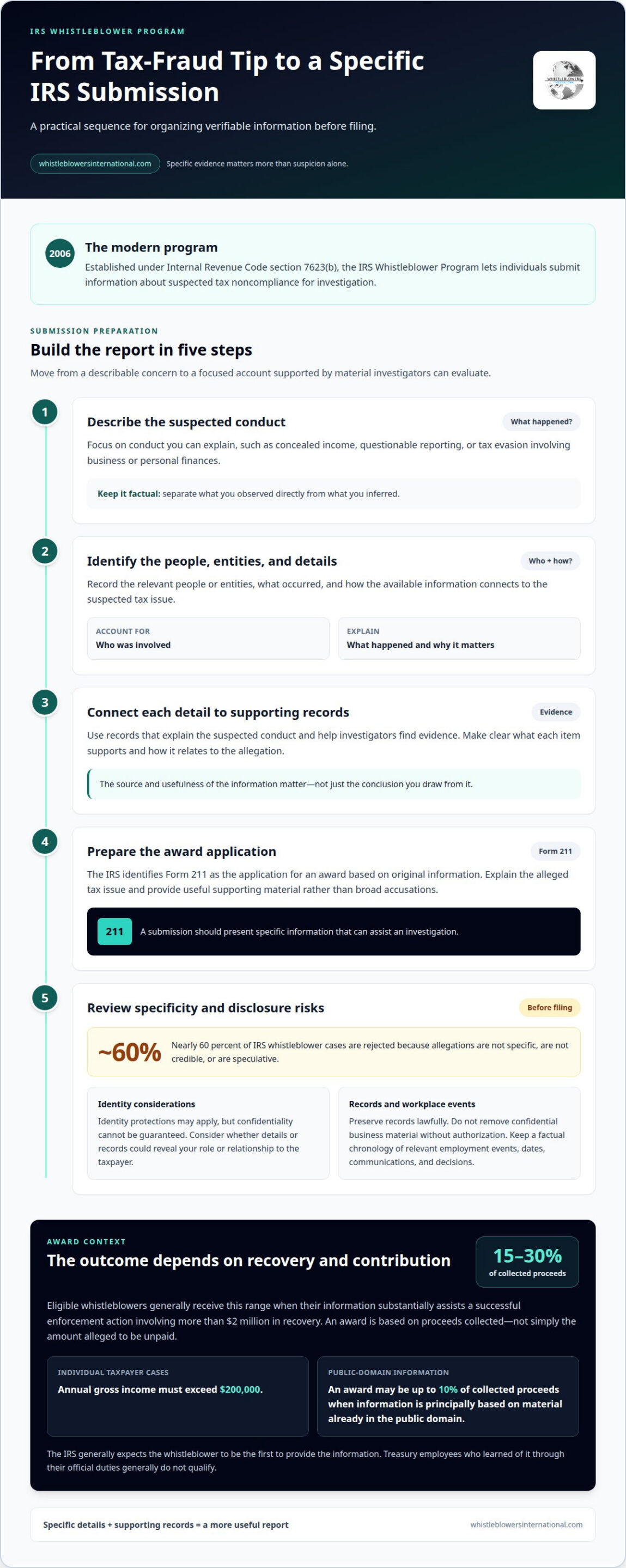
Evidence, not suspicion alone, gives a tax-fraud report substance. According to the Internal Revenue Service, eligible whistleblowers may generally receive 15 to 30 percent of collected proceeds when their information substantially assists a successful enforcement action involving more than $2 million in recovery. An IRS whistleblower attorney can help assess whether the information and supporting records are positioned to make a useful, specific submission.
It’s understandable to have concerns about what to disclose, how to support an allegation, and whether your identity will remain protected. A strong claim relies on verifiable details, such as records that explain the suspected conduct and help investigators find evidence, rather than unsupported conclusions.
This article explains how the IRS Whistleblower Program works, what evidence may support a report, and how identity protections operate. It also covers when legal assistance may help, what the reporting process involves, and how to consider your next steps before submitting information.
Key Takeaways
- Understand how the IRS evaluates whistleblower submissions and what can affect an award.
- Learn when legal help may strengthen a tax-fraud report and how to organize the facts before filing.
- See what identity protections may apply and what limits to confidentiality matter.
- Identify records and specific details that can make an allegation more useful to investigators.
What is the IRS Whistleblower program?
The IRS Whistleblower Program lets individuals submit information about suspected tax noncompliance for investigation. According to the Internal Revenue Service, eligible whistleblowers generally receive 15 to 30 percent of collected proceeds when their information substantially assists a successful enforcement action involving more than $2 million in recovery.
Program Overview
The modern program was established in 2006, when the Tax Relief and Health Care Act added Internal Revenue Code section 7623(b). Its purpose is to encourage individuals with specific information about tax violations to report it to the IRS. The relevant details should help investigators examine a taxpayer’s conduct, rather than simply express suspicion. Other federal programs include SEC, FinCEN, and CFTC whistleblower programs. Identifying the suspected misconduct and the appropriate reporting framework is an important first step.
Eligibility for an Award
Eligibility depends on the information, the taxpayer, and the government’s recovery. The IRS generally awards eligible whistleblowers 15 to 30 percent of collected proceeds when their information substantially assists a successful enforcement action involving more than $2 million in recovery. If the case involves an individual taxpayer, that person’s annual gross income must exceed $200,000. The IRS generally expects the whistleblower to be the first to provide the information. Treasury employees who learned of it through their official duties generally do not qualify. These criteria help distinguish an award claim from a report that may still assist an investigation.
Award Calculation
The award is calculated from collected proceeds, not simply the amount alleged to be unpaid. The IRS considers whether the information substantially assisted a successful enforcement action and applies the eligible award percentage to proceeds collected. If information is principally based on material already in the public domain, the award may be up to 10 percent of collected proceeds. The source and usefulness of the information therefore matter alongside the amount recovered. A whistleblower reward depends on the enforcement outcome and the contribution made by the submission.
Should I hire an IRS whistleblower attorney if I have information about tax evasion or tax fraud?
Legal assistance can help turn a serious allegation into a focused report. An IRS whistleblower attorney can assess your information, identify gaps, and organize the facts for submission.
Tax Fraud Covered by the Program
The program covers information about suspected tax fraud or underpayment that could assist a government investigation. Focus on conduct you can describe, such as concealed income, questionable reporting, or tax evasion involving business or personal finances. Separate what you observed directly from what you inferred. A clear account of who was involved, what happened, and how records support the allegation helps distinguish useful information from speculation.
Examples of Tax Fraud Cases
Offshore evasion cases show how financial arrangements can feature in whistleblower cases. Former banker Bradley Birkenfeld received a $104 million award after disclosures involving UBS. Those disclosures led UBS to pay $780 million in fines and disclose the names of 4,450 U.S. taxpayers with offshore Swiss accounts. These figures illustrate a case involving detailed information about offshore accounts, not a typical result or a prediction of future rewards.
Reporting Tax Fraud and Underpayment
Start by recording the suspected conduct, relevant people or entities, and the records that support each detail. The IRS identifies Form 211 as the application for an award based on original information. A submission should explain the alleged tax issue and provide useful supporting material, rather than rely on broad accusations. Nearly 60 percent of IRS whistleblower cases are rejected because allegations are not specific, credible, or are speculative. Careful review matters. An attorney can help assess the evidence, distinguish firsthand knowledge from assumptions, and present the information coherently before filing. For a potential report, IRS whistleblower filing support can be a relevant next step.
Does the IRS protect whistleblowers’ identities?
The Internal Revenue Service protects the identity of qualifying whistleblowers, but confidentiality cannot be guaranteed. Treat this protection as a safeguard, not a promise of anonymity. Before reporting a tax violation, identify records that reveal your role, access, or relationship to the taxpayer. Separating relevant facts from unnecessary personal details can keep your report focused while preserving context investigators may need.
Identity and Confidentiality
A whistleblower report may include names, documents, and details that connect you to the alleged conduct. Organize the material so the relevance of each item is clear, and leave out unrelated personal information. The IRS may use submitted information to evaluate an allegation and investigate it. Because confidentiality has limits, consider whether coworkers or business associates could recognize the facts even if your name is protected. An attorney can help assess these disclosure risks before you file.
Protection from Retaliation
Federal laws protect qualifying whistleblowers from being fired for reporting an employer to the IRS. This protection applies to qualifying reports; it is not a guarantee against every workplace consequence. Keep a factual record of relevant employment events, including dates, communications, and decisions affecting your role. Preserve records lawfully, and do not remove confidential business material without authorization. A clear chronology can help distinguish an employment action from the tax report itself.
Appeals and Practical Steps
If a whistleblower claim is denied, it may be possible to seek further review. Keep copies of your submission, IRS notices, and supporting records together so the decision and its basis can be reviewed. The appeal process is separate from the IRS investigation into the alleged tax violation and any resulting penalties. Before filing, write down questions about identity protection and seek legal guidance on confidentiality risks and appeal options. Avoid discussing sensitive details publicly or with people who do not need to know them.
Evidence for an IRS whistleblower claim
Useful evidence helps the Internal Revenue Service understand the suspected underpayment and identify where to investigate. No specific evidence type is required to qualify, but documents and firsthand details can make an allegation more concrete. Gather relevant records, such as transaction documents, accounting entries, correspondence, or explanations of how a reporting practice worked. For each item, note its source, date, and connection to the suspected conduct. Do not alter records or obtain material through unauthorized access.
Organize the information into a clear sequence: who was involved, what happened, when it occurred, and how you know. Distinguish firsthand observations from conclusions or information shared by others. Explain unfamiliar terminology and connect each document to the alleged tax violation. The IRS Whistleblower Office needs useful leads, not a pile of unrelated files. A concise index can help investigators find relevant details without obscuring the central allegation.
The claim process can take five to seven years or longer and involves at least four layers of review. This timeline reflects evaluation and enforcement, not just the act of submitting a report. Keep organized copies of your submission and supporting materials so you can track the matter over time.
Risks include disclosure of identifying details and a denial based on allegations that lack specificity, credibility, or reliable support; nearly 60 percent of claims are rejected for those reasons. According to the United States Congress, tax underpayment generally has a three-year reporting timeframe measured from the later of the return’s filing date or its due date; that period extends to six years when gross income is understated by more than 25 percent. These are tax limitation periods, not a guarantee that a whistleblower claim will be timely.
Before filing, arrange the evidence chronologically and mark each assertion with its supporting record or firsthand basis. Request a review of your IRS whistleblower evidence to assess how clearly it supports the allegations and where the submission needs stronger organization.
Piacentile & Associates LLP: SEC Whistleblower Program Filings
Piacentile & Associates LLP handles IRS Whistleblower Program filings for people preparing to report suspected tax violations. If your records point to tax underpayment or evasion, legal support can help organize the evidence, clarify the allegations, and prepare a focused filing. This can be a practical next step when you have relevant information but need help presenting it clearly to the IRS.
The firm also handles SEC, FinCEN, and CFTC whistleblower program filings. Each program addresses different types of suspected misconduct, so the facts and records should guide where information is reported. For an IRS matter, focus on what the records show and how they relate to the suspected tax violation.
Contact Piacentile & Associates LLP to discuss an IRS whistleblower filing and the information you’ve gathered.
Prepare Your Next Step with Care
Before moving forward, make your information easier to assess. Keep a clear timeline, preserve relevant records, and note which details come from firsthand knowledge. This preparation gives an IRS whistleblower attorney a concrete starting point to evaluate how your information may support a report and which issues require careful handling.
Piacentile & Associates LLP handles IRS whistleblower filings and other whistleblower matters, including False Claims Act and qui tam lawsuits and SEC whistleblower filings. The right path depends on the conduct involved and the evidence you can provide. A thoughtful review can help clarify whether your information belongs in an IRS submission or another reporting process.
If you’re ready to discuss the information you’ve gathered, contact Piacentile & Associates LLP. A careful first conversation can help you take a measured next step while keeping the focus on facts and documentation.
Frequently Asked Questions
Can I File Anonymously?
Don’t assume an IRS whistleblower submission will be anonymous. The IRS protects the identity of qualifying whistleblowers, but confidentiality cannot be guaranteed. Before filing, consider whether the facts or documents could identify you, such as records showing your job role or access. An IRS whistleblower attorney can help assess these disclosure concerns and prepare your information carefully.
Can I get fired for reporting my employer to the IRS?
Federal laws protect qualifying whistleblowers from being fired for reporting an employer to the IRS. Keep a dated record of work-related communications and employment decisions, including changes to your duties or termination notices. Preserve relevant documents lawfully, and distinguish events you experienced personally from conclusions about why they occurred. These records can help clarify the circumstances if retaliation becomes a concern.
How do I file a whistleblower claim with the IRS?
Use IRS Form 211 to apply for an award based on original information. Describe the taxpayer and alleged conduct as specifically as possible, then organize supporting records so each item connects to a factual assertion. Keep a copy of the completed submission and its attachments. A lawyer may help assess the information and prepare an IRS Whistleblower Program filing.
What Tax Fraud Does the IRS Program Cover?
The program covers information about suspected tax fraud or underpayment that could assist an IRS investigation. Examples include alleged concealed income or inaccurate tax reporting, provided the report explains the suspected conduct rather than relying on rumor. For instance, records showing a discrepancy between reported income and documented transactions may give investigators a useful lead. The facts determine what to report.
What evidence do I need to qualify as an IRS whistleblower?
No specific type of evidence is required to qualify. Useful information may include financial records, correspondence, transaction documents, or firsthand explanations of how a suspected practice worked. Explain where each item came from and what it shows, and separate direct knowledge from assumptions. Don’t alter documents or obtain records through unauthorized access. A clear explanation can make the information easier to evaluate.
What does an IRS whistleblower attorney do?
An IRS whistleblower attorney can evaluate your information, help develop the claim, and prepare a filing with the appropriate federal agency. The attorney can also help organize supporting records and address privacy considerations. Piacentile & Associates LLP represents individuals in whistleblower actions under U.S. federal law and through federal agency filings, including IRS submissions. The firm works on a contingency fee basis and is paid only if it wins you a monetary award. Past results do not guarantee future outcomes.