
Off-label prescribing and off-label promotion are not the same. Doctors may prescribe a drug for an FDA-unapproved use when they consider it appropriate for an individual patient. An off-label marketing of drugs whistleblower may instead be concerned that a manufacturer promoted an unapproved use and caused false claims to be submitted to federal healthcare programs. The distinction matters: an off-label prescription alone does not establish fraud.
If you’re concerned that a company’s marketing crossed the line, you may want a clear explanation of the legal process and its risks. This article explains off-label drug promotion, how a False Claims Act qui tam case is filed and investigated, and what protections may apply if an employer retaliates.
For an off-label marketing of drugs whistleblower, understanding the process can clarify what conduct may warrant scrutiny. A doctor’s prescribing decision does not by itself establish fraud. You’ll also learn what may happen after a complaint is filed under seal and how retaliation remedies may apply.
Key Takeaways
- Understand how FDA-approved uses differ from off-label prescribing and why a manufacturer’s promotion can raise separate legal concerns.
- See how a qui tam complaint is filed under seal and what may happen if the government intervenes or declines to join the case.
- Learn what retaliation protections may apply, including potential remedies under the False Claims Act.
- Explore why off-label promotion’s legality depends on the conduct and context, including First Amendment considerations.
What is off-label promotion and marketing?
FDA approval identifies a drug’s approved uses and patient groups, as well as its approved dosages. Off-label promotion means marketing a drug or medical device for a use not approved by the U.S. Food and Drug Administration. The Food, Drug, and Cosmetic Act governs manufacturer promotion. The False Claims Act may apply when promotion leads to false claims submitted to federal healthcare programs. These laws frame pharmaceutical marketing and whistleblower claims.
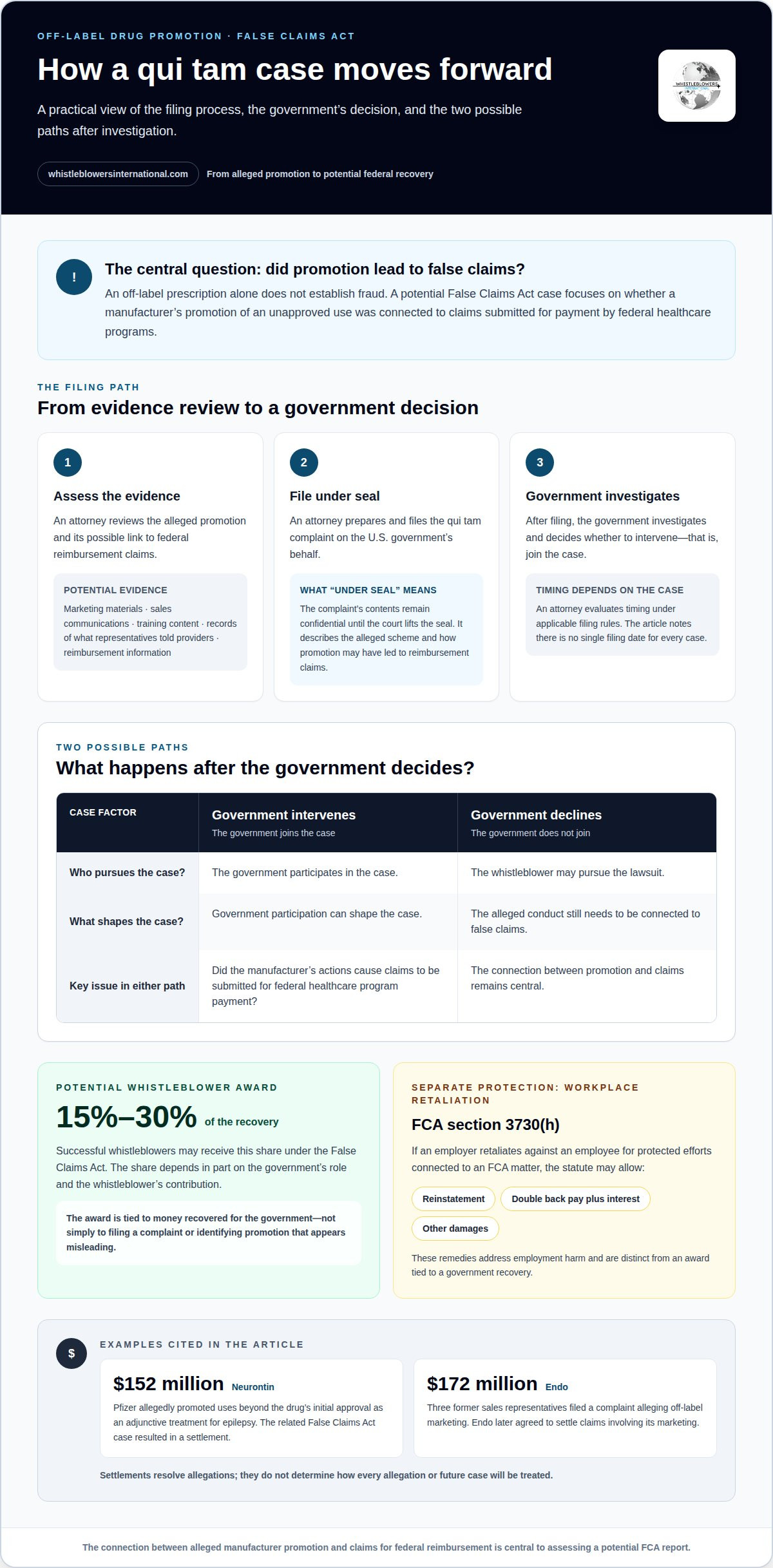
Off-label prescribing is different. A physician may prescribe a drug for an unapproved use when the physician considers it best for an individual patient. The concern is manufacturer conduct, not simply a provider’s prescribing decision. For example, Neurontin was initially approved as an adjunctive treatment for epilepsy. Pfizer allegedly promoted it for other conditions, including bipolar disorders and migraines. The related False Claims Act case resulted in a $152 million settlement.
Promotion can include sales messages or other marketing directed at healthcare providers to encourage unapproved uses. The legal analysis considers what the manufacturer communicated and whether that conduct was connected to claims paid by federal programs. Restrictions on manufacturer promotion do not make every off-label prescription unlawful. In clinical fields ranging from specialized medicine to aesthetics clinics like theglowupsociety.co.za, practitioners focus on patient-tailored treatments independently of manufacturer marketing. It is important to distinguish prescribing from marketing.
Evidence of alleged promotion may include specific marketing materials, sales communications, training content, or records of what representatives told providers. Those materials can be assessed alongside evidence of the drug’s approved uses and any resulting federal healthcare billing. An allegation of promotion alone does not establish that anyone submitted a false claim.
Under the False Claims Act, a pharmaceutical company may face liability if off-label promotion causes drugs to be billed to federal healthcare programs through false claims. The key issue is the connection between the manufacturer’s promotion and the claims submitted. That connection, not the off-label prescription alone, is central to assessing a potential whistleblower report.
False Claims Act qui tam reporting
The False Claims Act allows a whistleblower to bring a qui tam lawsuit on the U.S. government’s behalf. An attorney files the complaint under seal, which means its contents remain confidential until the court lifts the seal. The complaint describes the alleged scheme and how misleading promotion may have led to claims for federal reimbursement.
After filing, the government investigates and decides whether to intervene, or join the case. If it declines, the whistleblower may pursue the lawsuit. Government participation can shape the case, but the alleged conduct still needs to be connected to false claims. The central question is whether the manufacturer’s actions caused claims to be submitted for payment by federal healthcare programs.
Endo illustrates how a pharmaceutical marketing allegation can become a qui tam case. Three former sales representatives filed a complaint alleging the off-label marketing of drugs whistleblower provisions applied to. Endo later agreed to pay $172 million to settle claims involving its marketing. A settlement resolves allegations; it does not mean every claim or allegation in another case will be treated the same way.
Successful whistleblowers may receive 15% to 30% of the recovery under the False Claims Act. The share depends in part on the government’s role and the whistleblower’s contribution. The award is tied to money recovered for the government, not simply to filing a complaint or identifying promotion that appears misleading.
Filing is attorney-led: the attorney assesses promotion and billing evidence, prepares and files the qui tam complaint under seal, and supports the government’s investigation. The attorney also assesses timing in light of the alleged conduct and applicable filing rules; there is no single filing date that applies to every case. Sales communications, marketing materials, and reimbursement information may help explain the alleged link between promotion and claims.
A focused review of a potential qui tam claim can examine that connection and the available evidence before filing with the help of Piacentile & Associates LLP.
An attorney assesses the promotion and billing evidence, prepares and files the qui tam complaint under seal, and supports the government’s investigation. The attorney evaluates timing in light of the alleged conduct and applicable filing rules, since no single filing date applies to every case.
An employee can work with an attorney to file a qui tam complaint under seal, describing the alleged promotion and its connection to federal reimbursement claims. The government then investigates and decides whether to join the case.
Are there any protections for whistleblowers against retaliation?
The False Claims Act provides an employment-retaliation remedy under section 3730(h). If an employer retaliates against an employee for protected efforts connected to an FCA matter, the statute may allow reinstatement, double back pay plus interest, and other damages. These remedies address employment harm; they are distinct from any reward tied to a government recovery.
Retaliation can affect a worker’s position or employment, so the circumstances and connection to the FCA activity matter. A practical first step is to preserve relevant employment records and a clear chronology of events, including communications about the suspected conduct and any subsequent workplace action. A lawyer can assess how those facts relate to a potential claim under section 3730(h).
The Caronia decision raises a separate issue: how the First Amendment relates to pharmaceutical promotion. In December 2012, the Second Circuit vacated a pharmaceutical sales representative’s criminal conviction involving alleged off-label promotion. That decision concerns promotional speech and criminal prosecution; it is not itself an employment-retaliation remedy for whistleblowers.
Physicians may prescribe drugs for uses that are not FDA-approved, while manufacturers face separate questions about their own promotion. The Caronia decision should not be read as blanket permission for misleading promotion or as a guarantee against workplace consequences. Retaliation analysis instead focuses on the employee’s conduct, the employer’s response, and whether the facts support statutory relief.
A qui tam complaint filed under seal is confidential while the seal remains in place, but that does not mean every workplace detail will remain undisclosed throughout an investigation. Keep sensitive records secure and discuss how to handle them with a lawyer before sharing them. Careful documentation can clarify the timeline and the relationship between reporting and later employment action.
Discuss potential whistleblower protections when workplace action follows reporting suspected fraud.
Is off-label promotion of drugs illegal in the United States?
In the United States, the Food, Drug, and Cosmetic Act restricts manufacturers from promoting drug uses not approved by the FDA. Federal approval identifies specific uses, patient groups, and pharmaceutical dosages. This restriction does not make every off-label prescription unlawful. Physicians may prescribe drugs for unapproved therapeutic uses when they consider those uses best for individual patients.
Legal consequences can follow when pharmaceutical companies promote unapproved uses. GlaxoSmithKline paid $3 billion in 2012 to settle charges involving illegal off-label marketing of Paxil and Wellbutrin, as well as failure to report Avandia safety data to the FDA. Pfizer paid $2.3 billion in 2009 for illegally promoting drugs including Bextra, Geodon, Zyvox, and Lyrica for off-label uses.
Eli Lilly paid $1.42 billion to resolve criminal and civil charges related to promoting Zyprexa for unapproved uses and minimizing severe side-effect risks. These examples show that enforcement may involve different allegations and legal consequences. A settlement amount alone does not establish how another company’s conduct or claims will be assessed.
False Claims Act liability is a separate question. It may arise when alleged promotion causes drugs to be billed to federal healthcare programs through false claims. The connection between the company’s conduct and federal reimbursement matters; an off-label prescription alone does not establish that connection.
The Anti-Kickback Statute also prohibits payments made purposefully to induce or reward referrals or generate federal healthcare business. If alleged off-label promotion is paired with such payments, the facts may raise additional legal issues. A careful assessment distinguishes the physician’s prescribing decision, the manufacturer’s communications, any financial incentives, and claims submitted for government reimbursement. These distinctions help explain why off-label promotion can create legal exposure without making every off-label use illegal.
Take the next step with a focused review
A whistleblower reporting suspected off-label drug promotion can start by organizing what they observed: communications, decisions, and records that may help explain the conduct. Anyone considering becoming an off-label marketing of drugs whistleblower can identify what they learned firsthand and which documents support it. A focused legal assessment can clarify which facts need closer analysis.
An off-label marketing of drugs whistleblower may also need to consider how to handle sensitive information and which reporting route fits the allegations. Piacentile & Associates LLP handles False Claims Act / Qui Tam Lawsuits and whistleblower program filings with the SEC and IRS. The appropriate path depends on the alleged conduct and the government program involved.
Contact Piacentile & Associates LLP to discuss potential whistleblower reporting. A measured first step can help you move forward with greater clarity and purpose.
Piacentile & Associates LLP and Off-Label Marketing Claims
Piacentile & Associates LLP handles False Claims Act / Qui Tam Lawsuits. If you are considering whether alleged off-label drug marketing may relate to a False Claims Act matter, the firm’s qui tam work is a relevant next step.
The firm also handles SEC, IRS, FinCEN, and CFTC whistleblower program filings, as well as import export customs fraud legal action. Turn to Piacentile & Associates LLP when you want to discuss which of these offerings may fit your concerns.
Frequently Asked Questions
What Kinds of Wrongful Conduct Are Covered by Whistleblower Reward Laws?
These laws and programs address different forms of alleged misconduct, including fraud involving federal healthcare payments, securities, taxes, and government contracts. The appropriate route depends on the conduct and the government program involved. For example, an allegation about improper healthcare reimbursement differs from a securities-fraud report, so identifying the underlying scheme helps determine which reporting framework may apply.
When Is a Whistleblower Entitled to a Financial Reward?
A reward may be available when information leads to a qualifying recovery under the applicable whistleblower program. In a False Claims Act case, a potential award is tied to money recovered for the government, not merely to filing a complaint. Program requirements and the whistleblower’s contribution matter. The firm’s attorneys can assess the facts, but cannot promise eligibility or an outcome.
Who Can Be a Whistleblower?
U.S. citizens and non-U.S. citizens may bring False Claims Act lawsuits on behalf of the U.S. government. A person’s role or location alone does not establish whether a particular report qualifies. Relevant information may come from someone who observed company practices, reviewed records, or learned how a government-facing claim was prepared. Eligibility depends on the program and the specific facts.
What is off-label drug marketing?
Off-label drug marketing involves a manufacturer promoting a drug for a use outside its FDA-approved labeling. The alleged promotion might concern a different condition, patient population, or dosage. This differs from a clinician’s decision to prescribe a medicine for an individual patient’s needs. The distinction helps focus an assessment on the manufacturer’s communications and the circumstances in which they were made.
How do False Claims Act whistleblower lawsuits apply to off-label drug marketing?
A False Claims Act lawsuit may address alleged off-label promotion when it is connected to false claims for federal healthcare reimbursement. Evidence of sales messaging alone, for example, differs from evidence that a federal program paid claims connected to the promoted use. Assessing a case means examining that connection, the underlying billing, and whether the allegations support a claim under the Act.
What percentage of a government recovery can a False Claims Act whistleblower receive?
In successful False Claims Act cases, whistleblowers may receive 15% to 30% of the recovery. The percentage is not automatic: the government’s participation and the whistleblower’s contribution can affect the award. A potential claimant should distinguish this statutory share from any guaranteed payment. An attorney can evaluate how the case circumstances may bear on a potential award.