

A Ponzi scheme tip can still matter when an investigation is already underway. A Ponzi scheme whistleblower attorney can assess whether your information may support an SEC claim, prepare a submission, and represent you if you wish to report anonymously; anonymous SEC reporting requires legal counsel. According to the U.S. Securities and Exchange Commission, eligible awards range from 10% to 30% of sanctions recovered when monetary sanctions exceed $1 million.
It’s understandable to want clear answers before sharing sensitive information, especially if you fear retaliation or aren’t sure whether what you know is useful. A potential claim’s strength depends on the relevance and originality of the information and how much it contributes to an enforcement action, not simply on whether the suspected scheme has already attracted attention.
This article explains what a Ponzi scheme whistleblower attorney can do, the SEC award criteria, what information may help establish a claim, and how reporting works. You’ll also learn why information about an existing Ponzi scheme investigation may still matter, what to expect from the process, and when legal representation can help protect your interests as the SEC reviews a tip.
Key Takeaways
- Anonymous SEC reporting requires legal counsel, and an attorney can help assess how to submit sensitive information while protecting your identity.
- According to the U.S. Securities and Exchange Commission, eligible whistleblower awards range from 10% to 30% of sanctions recovered.
- Information about an existing investigation may still contribute to an award claim; the value of a submission depends on how it assists the SEC.
- If you reported concerns internally, submitting the same information to the SEC within 120 days can help preserve credit for that internal report when an award is considered.
How Can An SEC Whistleblower Attorney Help You?
A Ponzi scheme whistleblower attorney can assess a potential securities fraud report, prepare its submission, and address anonymity concerns. Counsel can also explain federal retaliation protections and evaluate whether the information is original and useful to enforcement.
Whistleblower Confidentiality Protections
An SEC tip can be submitted anonymously through counsel, who communicates with the government on the whistleblower’s behalf. The whistleblower program protects information that could directly or indirectly reveal a whistleblower’s identity. To receive an award, an anonymous whistleblower must disclose their identity to the SEC. Lawyers can review a submission for identifying details, such as a rare job title, a unique transaction, or a specific internal email. Those details may reveal a source even when the report omits their name. Ask how counsel will handle identity information during submission and follow-up.
Employer Retaliation Risks and Protections
The Dodd-Frank Act prohibits employers from retaliating against employees who report possible securities violations to the SEC. Rule 21F-17(a) addresses the prohibition on retaliation against securities whistleblowers. For covered SEC whistleblowers, employers may not fire, demote, suspend, threaten, harass, or discriminate against them for whistleblowing. The Dodd-Frank Act also creates a federal private right of action for SEC whistleblowers facing employer retaliation. An attorney can assess the connection between a report and an adverse job action, then explain how employment records or communications may inform that assessment. Protection does not erase the practical risk of workplace pressure.
Choosing a Qualified Attorney
How do you choose a qualified Ponzi scheme whistleblower attorney? Look for lawyers who handle SEC whistleblower program submissions and can explain how they assess original information, anonymity, and retaliation concerns. Ask how counsel will organize transaction records, communications, and firsthand observations into a clear account for enforcement staff. A useful discussion should cover who communicates with the SEC, how identity information is handled, and how counsel will respond if investigators request clarification. The attorney should also explain confidentiality limits and the award process without promising an outcome. Clear answers help you decide whether the proposed representation fits your circumstances.
SEC whistleblower award eligibility
An SEC award depends on the information, the resulting enforcement action, and compliance with application deadlines. According to the U.S. Securities and Exchange Commission, awards described on the page range from 10% to 30% of sanctions recovered. The SEC whistleblower award program requires monetary sanctions to exceed $1 million for a tip to potentially qualify. These thresholds make the connection between a report and an enforcement outcome central to eligibility.
Can whistleblowers receive a reward for reporting a Ponzi scheme to the SEC? Yes, a report about a Ponzi scheme may qualify if it meets the program’s requirements and contributes to an eligible action. Information generally must be original and provided voluntarily; its usefulness in advancing enforcement also matters. The SEC’s largest award to date is $279 million, but that figure isn’t a guide to an individual claim. An award reflects the case outcome and the whistleblower’s contribution, not simply the amount investors lost.
Timing matters after the SEC issues a notice. According to the U.S. Securities and Exchange Commission, an SEC whistleblower award application must be submitted within 90 days of the notice. Counsel can track notices, identify the relevant deadline, and prepare the required award submission. Treat that deadline as a distinct step from initially reporting suspected securities fraud; preserve communications about notices so the application process can be addressed promptly.
False Claims Act qui tam claims follow a separate federal process, even though both programs can reward qualifying whistleblowers. Relators who help the government recover money may be eligible for 15% to 30% of the amount collected through a settlement or penalties. A law firm assessing a matter should distinguish SEC securities reporting from a qui tam claim, then evaluate which program fits the alleged conduct. For guidance on an SEC report, explore SEC whistleblower filing support.
Does My Information Have to Support a New Investigation?
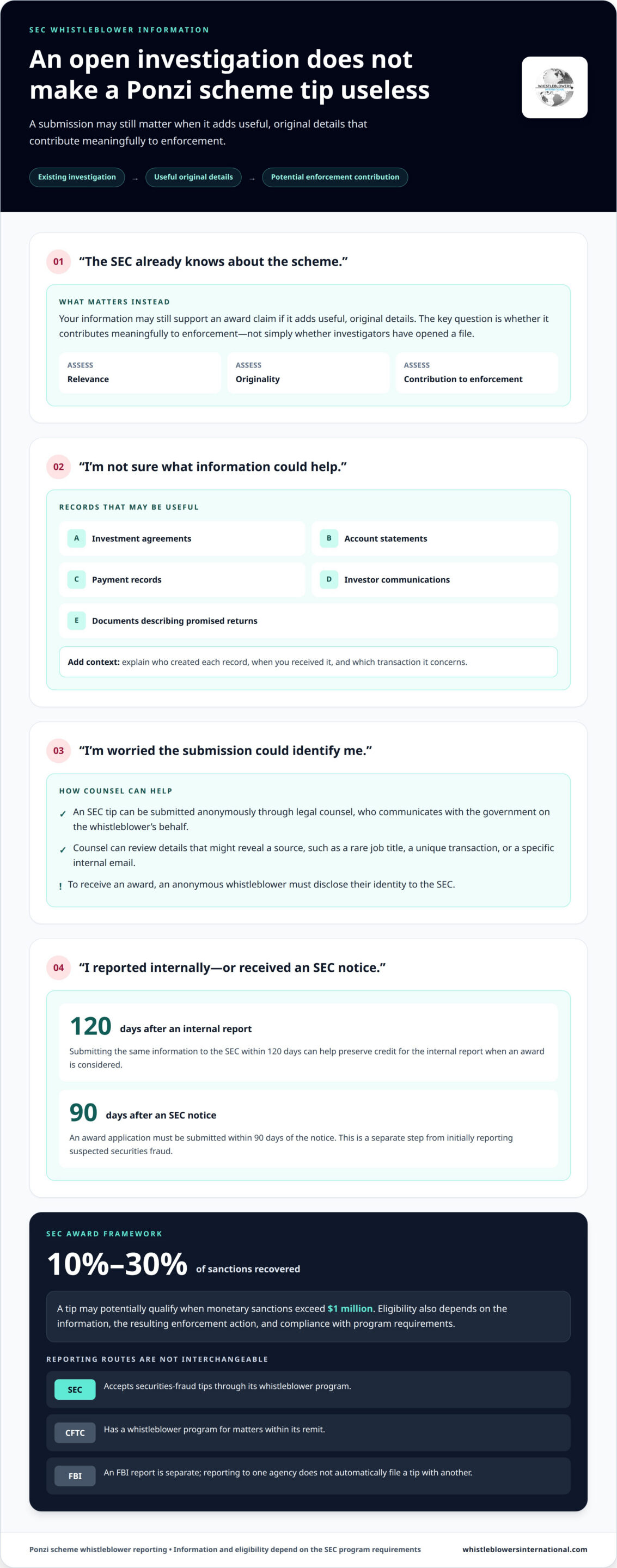
No. Information about an existing Ponzi scheme investigation may still support an SEC whistleblower award if it adds useful, original details. An attorney can assess how your account relates to known enforcement activity and explain how records, transaction timelines, or firsthand observations may assist the agency. The key question is whether your submission contributes meaningfully, not simply whether investigators have opened a file.
Which agencies accept Ponzi scheme whistleblower tips, including the SEC, CFTC, and FBI? The SEC accepts securities-fraud tips through its whistleblower program, and the CFTC has a whistleblower program for matters within its remit. An FBI report is separate from an SEC whistleblower submission, so reporting to one agency doesn’t automatically file a tip with another.
Useful evidence may include investment agreements, account statements, payment records, investor communications, and documents describing promised returns. Provide context about who created each record, when you received it, and which transaction it concerns. A securities law attorney can arrange these materials in a clear sequence, distinguish direct knowledge from inference, and identify gaps without overstating what the evidence shows. Don’t alter original files; preserve relevant versions and metadata.
Internal reporting can affect how the SEC evaluates an award claim. According to the U.S. Securities and Exchange Commission, a whistleblower who reports internally should generally report the same information to the SEC within 120 days to receive credit for the internal report when the SEC considers an award. Counsel can align the two accounts and track the timing of each disclosure.
How do state securities regulators handle Ponzi scheme complaints and whistleblower reports? State regulators handle complaints within their jurisdiction and may review suspected violations of state securities laws. Their process is separate from the SEC whistleblower program, so an attorney can assess which channels fit the suspected conduct. For help assessing an SEC submission, discuss SEC whistleblower reporting with counsel.
Ponzi scheme whistleblowing
The SEC defines a Ponzi scheme as investment fraud in which purported returns to existing investors come from new investors’ contributions. This structure can leave a paper trail: deposits, transfers, account statements, and explanations of how returns were supposedly generated. High returns with little or no risk are a warning sign identified by the SEC. Such claims alone don’t prove a violation, but records showing payments funded by later investments can help investigators assess whether the activity was fraudulent.
A useful report links specific evidence to the people, transactions, and dates involved. An attorney can organize investor communications, offering materials, payment records, and internal explanations into a sequence the SEC can evaluate. For example, a transfer record paired with a message promising investment returns may clarify how funds moved and what investors were told. Preserve original documents and distinguish firsthand observations from information you received from others. This helps investigators assess the report without overstating what it proves.
SEC whistleblower tips are submitted using Form TCR. The submission should explain the suspected conduct, identify relevant participants where possible, and show how supporting materials relate to the alleged scheme. A whistleblower may report information about an investigation already underway; additional evidence may still assist an enforcement action. An attorney can help explain how a tip relates to securities violations and keep follow-up responses consistent with the original submission.
A reward depends on the SEC’s enforcement outcome and the whistleblower’s contribution, not simply on investor losses. In one matter, two whistleblowers received a combined award of approximately $98 million for information and assistance leading to actions by the SEC and another agency. In a separate case involving an anonymous whistleblower who received an award in 2021, the SEC issued more than $31 million in related awards. These outcomes illustrate that substantial awards have occurred, not what any individual report will produce. Ponzi scheme cases can take years to resolve, especially when the scheme is complex and involves many potential victims. The practical takeaway is to present verifiable information clearly and preserve the records that explain its significance.
Take the Next Step With a Clear Reporting Strategy
Before making another disclosure, consider what you need counsel to address: the evidence, the appropriate reporting channel, or concerns about your identity and workplace. A Ponzi scheme whistleblower attorney can assess how your information fits an SEC submission and what preparation may be needed before reporting.
Piacentile & Associates LLP handles SEC Whistleblower Program Filings, False Claims Act / Qui Tam Lawsuits, and IRS Whistleblower Program Filings. These offerings address different kinds of suspected misconduct, so identifying the nature of your information is a practical starting point. A focused discussion can help clarify which reporting path aligns with the facts and what records may help explain them.
If you’re ready to discuss your potential claim and reporting concerns, contact Piacentile & Associates LLP. A careful next step can help you move forward with greater clarity and purpose.
Frequently Asked Questions
How Long Do Whistleblower Cases Take?
Whistleblower cases are very complex and take a long time to resolve, particularly when a Ponzi scheme involves complex transactions or numerous potential victims. Investigators may need to trace transfers, review records, and assess evidence from different sources before an enforcement action proceeds. Reporting and award review are separate stages, so a delay at either stage does not by itself determine the case’s eventual outcome.
How Much of a Reward Can I Claim?
The U.S. Securities and Exchange Commission says eligible SEC whistleblower awards range from 10% to 30% of sanctions recovered. The percentage is determined through the program’s award process, not by an investor’s individual loss or a requested amount. For example, a report that helps establish important violations may be assessed differently from information that adds little to the enforcement result.
What If I Face Retaliation?
If your employer takes adverse action after an SEC report, preserve relevant messages, performance records, and written explanations of workplace decisions. The Dodd-Frank Act provides a federal private right of action for SEC whistleblowers facing employer retaliation, and Rule 21F-17(a) addresses retaliation protections. An attorney can assess how the timing and documented reasons relate to your reporting and explain potential next steps.
What Types of Fraud Does the SEC Regulate and Invite Whistleblowers to Report On?
The SEC accepts tips about possible violations of federal securities laws, including Ponzi schemes and offering fraud. A report may describe misleading investment claims, suspicious payment flows, or other conduct connected to securities transactions. For instance, a promise of high returns with little or no risk is a warning sign identified by the SEC. The relevant issue is whether the evidence points to a possible securities violation.
Which Factors Affect the Whistleblower Reward Amount?
The SEC evaluates how useful the information was to an enforcement action, including whether it was original and voluntarily provided. The resulting sanctions and the whistleblower’s contribution also matter. A report backed by records that clarify a complex transaction may carry different weight from a later submission that adds little. Award eligibility and the final percentage are distinct decisions within the program.
What Does a Ponzi Scheme Whistleblower Attorney Do?
A Ponzi scheme whistleblower attorney assesses information, develops an SEC submission, and represents the whistleblower through reporting and award procedures. Counsel can organize records into a coherent account and address questions about confidentiality or workplace concerns. Piacentile & Associates LLP handles SEC Whistleblower Program Filings on a contingency basis, meaning the firm is paid only if it secures a monetary award. These cases are very complex and take a long time to resolve.