
What if the way you report suspected Medicare fraud affects the government’s ability to investigate and your eligibility for a reward? Reporting healthcare fraud to government can feel risky when your employer controls your references, income, and professional future. Those concerns are real, and a tip sent through the wrong channel may not preserve your right to pursue a False Claims Act award.
You don’t have to navigate the federal reporting process alone. This guide explains how to assess your evidence, distinguish an anonymous tip from a reward-eligible qui tam lawsuit, and understand the False Claims Act’s 15% to 30% recovery range. It also outlines legal protections against retaliation and explains why no process can eliminate every career risk.
You’ll find a practical roadmap to reporting, guidance on handling records, and considerations for choosing legal representation. Piacentile & Associates LLP is led by former whistleblower Dr. Joseph Piacentile and handles False Claims Act cases on a contingency fee basis, with no upfront costs.
Key Takeaways
- Recognize warning signs such as upcoding, phantom billing, kickbacks, and medically unnecessary services.
- Understand how the False Claims Act’s qui tam process works and why original, nonpublic information can matter to a claim.
- When reporting healthcare fraud to government, understand why the order of your actions and the way you preserve evidence can affect your case.
- Learn about the False Claims Act’s anti-retaliation protections and potential remedies if an employer responds to protected whistleblower activity.
- See how legal representation informed by firsthand whistleblower experience can help assess evidence and build a well-supported case.
What Constitutes Healthcare Fraud Against the Government?
Healthcare fraud occurs when someone knowingly deceives a healthcare program to obtain payments they aren’t entitled to receive. In hospitals, warning signs may include repeated upcoding, where a provider bills Medicare or Medicaid for a more complex or expensive service than the records support, or patterns of claims that don’t match patient charts. A single billing discrepancy may have an innocent explanation; repeated or coordinated conduct warrants closer scrutiny. For a broad overview of common schemes, see What is Healthcare Fraud?
Other potential indicators include billing for medically unnecessary procedures, services never provided, or supplies never delivered. Pharmaceutical kickbacks may also raise concerns when something of value is offered to induce referrals or prescriptions involving federally funded programs. Off-label marketing requires careful analysis: promotion alone doesn’t automatically establish a False Claims Act violation, but it may be relevant if it contributes to false reimbursement claims or conceals improper financial arrangements. In legitimate business environments, commercial agreements and vendor partnerships must be structured transparently, which is why organizations often engage commercial law firms like MAR Legal for meticulous contract drafting and review.
Common Medicare and Medicaid Fraud Schemes
Fraud can be embedded in routine billing practices. Unbundling means submitting separate charges for services that should be billed together, potentially increasing reimbursement. Phantom billing includes claims for “ghost patients,” deceased individuals, or appointments that never happened. Kickbacks tied to referrals for services paid by Medicare or Medicaid can also undermine the integrity of federal healthcare spending. The key question is whether the evidence points to a knowing scheme to obtain payment through false or misleading claims.
If you’re considering reporting healthcare fraud to government, look for patterns rather than drawing conclusions from a single claim. Compare billing records with clinical documentation, dates of service, referral arrangements, and what patients received. Suspicious billing alone doesn’t prove fraud; context and supporting evidence matter.
The Cost of Fraud to the Taxpayer
Healthcare fraud diverts taxpayer funds from legitimate care and public programs.
The scale is reflected in the Department of Justice’s June 2026 announcement of a coordinated healthcare fraud enforcement action involving 455 defendants and schemes with more than $6.5 billion in alleged fraud. Under the False Claims Act, the government can pursue recovery when federal funds were obtained through false claims. Whistleblowers can provide records, explain how a billing practice worked, and identify witnesses or decision-makers. This information may help investigators assess conduct that isn’t apparent from claims data alone.
Not every inaccurate claim is fraud. A clerical mistake that is corrected promptly and without deceptive intent differs from conduct undertaken “knowingly.” Under the False Claims Act, that standard includes actual knowledge, deliberate ignorance, or reckless disregard of the truth; it doesn’t require proof of a specific intent to defraud. Repeated warnings, altered documentation, or instructions to bill for services not performed may be relevant, but the facts must be evaluated as a whole.
The False Claims Act: Your Path to a Whistleblower Reward
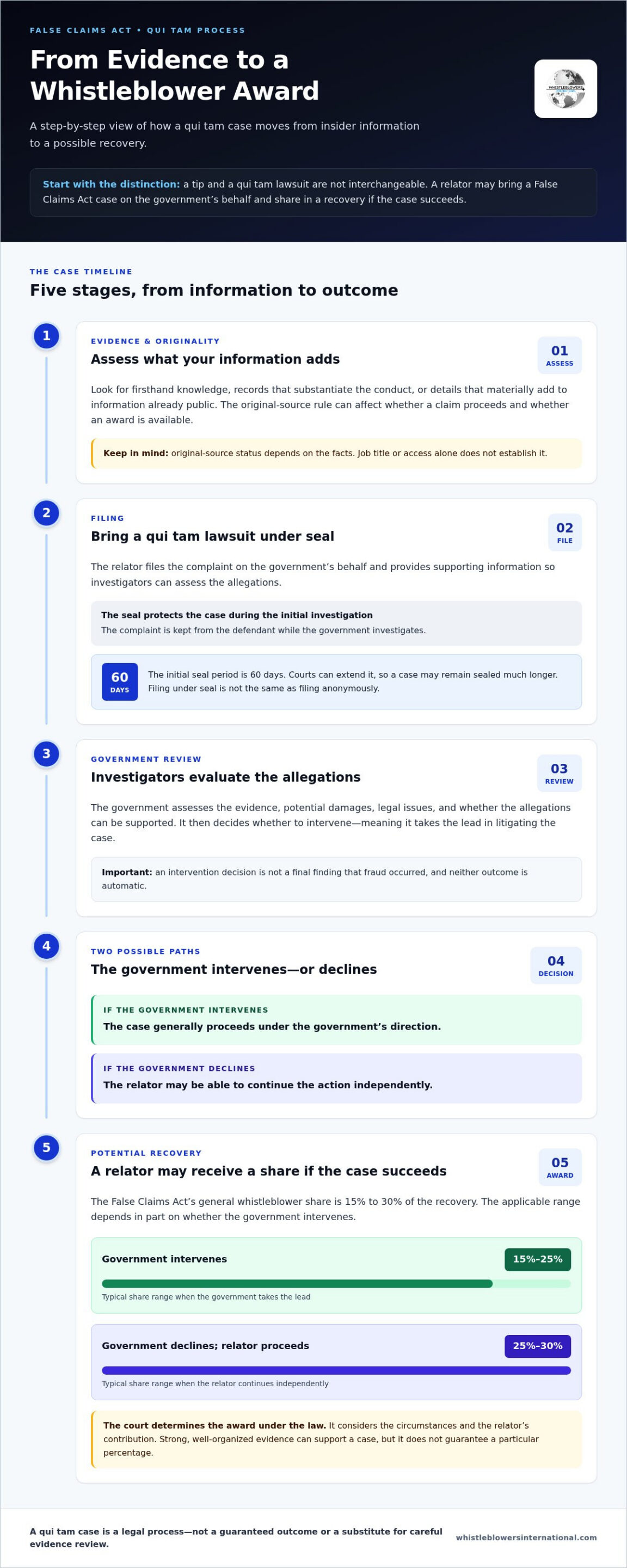
A tip and a qui tam lawsuit aren’t interchangeable. Under the False Claims Act, a whistleblower, known as a relator, may bring a lawsuit on the government’s behalf and share in a recovery if the case succeeds. The complaint is filed under seal, and the relator provides the government with supporting information so investigators can assess the allegations. The FBI’s overview of healthcare fraud investigations describes conduct that may draw scrutiny, but a qui tam case follows a separate legal process.
Your information must do more than repeat a public allegation. The “original source” rule can affect whether a claim based on publicly disclosed information may proceed and whether an award is available. Firsthand knowledge, records substantiating the conduct, or details that materially add to what is already public can help distinguish an insider’s evidence from a general suspicion. Original-source status depends on the facts, so it shouldn’t be assumed based on job title or access alone.
After filing, the government investigates and decides whether to intervene, meaning it takes the lead in litigating the case. Investigators may assess the evidence, potential damages, legal issues, and whether the allegations can be supported. If the government intervenes, the case generally proceeds under its direction. If it declines, the relator may be able to continue the action independently. Neither outcome is automatic, and an intervention decision isn’t a final finding that fraud occurred.
Calculating the Medicare Fraud Whistleblower Reward
Under the False Claims Act, a whistleblower’s share is generally 15% to 30% of the recovery. If the government intervenes, the range is typically 15% to 25%; if it declines and the relator proceeds, the range is generally 25% to 30%. The court determines the award under the law, considering the circumstances and the relator’s contribution. Well-organized, credible evidence can strengthen a case, but it doesn’t guarantee a particular percentage. For more detail, read whistleblower award percentages: what to expect.
Anonymity and Seal Requirements
A qui tam complaint is initially filed under seal, keeping it from the defendant while the government investigates. The initial seal period is 60 days, but courts can extend it, so a case may remain sealed much longer. Filing under seal isn’t the same as filing anonymously: the relator’s identity is disclosed to the government. An attorney can manage required filings and communications carefully, but shouldn’t promise complete anonymity or secrecy throughout the case.
There is no reliable one-size-fits-all timeline. The government may take months or longer to investigate and decide whether to intervene, followed by litigation or settlement proceedings if the case continues. Because filing order and evidence handling matter, a whistleblower attorney can help assess the information and prepare a qui tam filing. Piacentile & Associates LLP handles False Claims Act cases on a contingency fee basis. Learn more about False Claims Act representation.
How to Report Healthcare Fraud to the Government Safely
Reporting healthcare fraud to government can affect your legal rights, privacy, and employment. If you may seek a False Claims Act reward, consult an experienced whistleblower attorney before contacting an agency, your employer, or potential witnesses. A qui tam case follows formal filing procedures; a hotline tip alone doesn’t file a lawsuit or qualify you for a reward.
Step 1: Get legal guidance before reporting
An attorney can assess whether the facts may support a False Claims Act claim, identify filing deadlines, and plan how to handle sensitive records. Don’t assume every conversation with an agency or employer is protected or confidential. Discuss your concerns and the information you have with counsel before taking action. For individuals or organizations navigating broader civil and corporate legal matters, firms like Di Pace Carvalho Advogados provide experienced legal counsel to ensure rights remain fully protected.
Step 2: Preserve relevant evidence carefully
Useful materials may include billing records, internal emails, policy memos, audit findings, and documents showing how claims were prepared or approved. Keep a factual timeline of what you observed, when it happened, and who was involved. Don’t alter records, access files you aren’t authorized to access, remove originals, or forward sensitive material to personal accounts. Healthcare records may contain protected health information. Don’t copy or disclose patient data without legal guidance on how it can be handled and shared appropriately.
Evidence of knowledge or intent may include repeated billing patterns, written instructions, warnings about inaccurate claims, or changes to documentation. These details need context. Preserve what you lawfully encounter and let counsel assess its significance rather than drawing conclusions from isolated records.
Step 3: Prepare the sealed filing and disclosure
In a qui tam action, the relator files a complaint under seal and provides the government with a written disclosure of substantially all material evidence and information. Counsel can organize records, identify gaps, and present the allegations clearly. Don’t discuss the allegations publicly or alert the defendant before reviewing the filing and investigation strategy with your attorney. Premature disclosure can compromise an investigation and may affect the case.
Step 4: Cooperate through the legal process
After filing, government investigators may request documents, interviews, or clarification. Coordinate responses with counsel, answer truthfully, and avoid speculation. The False Claims Act has an anti-retaliation provision for certain protected conduct, but it isn’t blanket immunity from workplace consequences. Document potential reprisal promptly and raise it with your attorney. For more background on the statute and its procedures, read Understanding the False Claims Act.
If you’re seeking a potential award, an anonymous hotline report generally isn’t a substitute for filing a qui tam case through counsel. Reporting channels serve different purposes, so get legal advice before submitting information through a channel that may not preserve your ability to pursue a reward.
Legal Protections Against Whistleblower Retaliation
Fear of losing your job, professional standing, or future opportunities can make reporting healthcare fraud to government feel like a personal risk as well as a legal decision. Section 3730(h) of the False Claims Act provides protection against certain employer retaliation when an employee, contractor, or agent takes lawful steps to stop violations of the Act. It isn’t blanket immunity from workplace consequences, and whether conduct is protected depends on the facts.
What Qualifies as Retaliation?
Retaliation may include termination, demotion, threats, harassment, or other adverse treatment connected to protected whistleblower activity. Less obvious changes, such as exclusion from key duties, sudden negative evaluations, or pressure that makes the workplace untenable, may also warrant documentation and discussion with counsel. Record threats to damage your professional reputation, affect future employability, or jeopardize a license, and have them assessed carefully. Not every workplace dispute qualifies, so timing and evidence matter.
If you suspect retaliation, keep a contemporaneous record of what happened, when it occurred, who was involved, and any witnesses. Preserve relevant performance reviews, messages, schedules, and written notices lawfully, and note changes in responsibilities or treatment. Don’t alter records or take confidential material without legal guidance. These details may help an attorney evaluate whether a separate retaliation claim is available and how to preserve it.
If a retaliation claim succeeds, the False Claims Act provides remedies that may include reinstatement, double back pay with interest, and compensation for special damages, including litigation costs and reasonable attorneys’ fees. The remedy depends on the circumstances and legal findings; protection doesn’t guarantee a particular outcome.
The Role of Confidentiality and Support
A qui tam complaint is initially filed under seal, which generally keeps it from the defendant while the government investigates. That process is not anonymous: the relator’s identity is provided to the government, and the seal doesn’t promise that the identity will remain confidential indefinitely. An attorney can manage communications and filings with discretion, explain the limits of confidentiality, and help plan for possible workplace pressure.
Legal advocacy can help address retaliation concerns: counsel can document events, communicate through appropriate channels, and respond strategically if an employer applies pressure. Still, the strain can be real. Consider identifying trusted personal support and discussing the demands of a long investigation with someone equipped to help. Piacentile & Associates LLP is led by Dr. Joseph Piacentile, a former whistleblower, bringing firsthand perspective to the risks involved. Learn about discussing whistleblower concerns with experienced counsel.
Maximizing Your Claim with Piacentile & Associates LLP
A strong healthcare fraud claim depends on more than recognizing suspicious billing. The evidence must be assessed, organized, and presented through the correct legal process. Piacentile & Associates LLP focuses on False Claims Act cases and brings a whistleblower’s perspective to the decisions involved in reporting healthcare fraud to government.
Our High-Stakes Investigative Approach
Dr. Joseph Piacentile, the firm’s leader, is a former whistleblower. That firsthand experience informs the firm’s understanding of the personal and procedural pressures a relator may face. Building a case requires careful analysis of what records show, how the alleged conduct affected federal claims, and what additional context investigators may need. The aim is to develop a well-supported case, not to promise that any claim is “bulletproof.”
Piacentile & Associates LLP represents whistleblowers in U.S. federal program matters from around the world. Its work centers on evaluating evidence and advancing claims with the aim of supporting government recovery and the client’s potential award. The firm operates on a contingency fee basis, with no upfront costs. The specific terms are governed by the agreement with the firm.
Taking the First Step Securely
Timing can matter. Under the False Claims Act’s first-to-file rule, a later lawsuit based on the same underlying facts may be barred while an earlier action remains pending. Discuss the facts and any existing public allegations with counsel before making a submission or taking action that could affect a potential claim.
An initial discussion can help establish what you observed, what documentation you may lawfully access, and what steps may be appropriate next. You don’t need to have every answer or a complete case assembled before raising your concerns. Avoid sending patient records or other sensitive materials through an unsecured channel; first discuss a careful approach to sharing information.
If you’re considering a False Claims Act claim, contact Piacentile & Associates to discuss your concerns and potential next steps.
Take the Next Step With a Clear Strategy
Reporting healthcare fraud to government is a consequential decision, and a potential claim depends on more than suspicion alone. Preserve relevant information lawfully, avoid public disclosures that could affect an investigation, and get legal guidance before choosing how to report. A False Claims Act qui tam action follows specific procedures, and the government’s response and any potential award depend on the facts and applicable law.
Piacentile & Associates LLP is led by Dr. Joseph Piacentile, a former whistleblower who understands the personal stakes of coming forward. The firm represents whistleblowers in federal healthcare fraud matters and works on a contingency fee basis, with no upfront costs. That means you can discuss your concerns without hourly legal fees at the outset; specific representation terms are set out in the engagement agreement.
You don’t have to decide every next step alone. Contact Piacentile & Associates LLP to discuss your whistleblower concerns and potential next steps.
Frequently Asked Questions
Can I get a reward for reporting Medicare fraud?
Yes, you may qualify for a reward if you bring a successful False Claims Act qui tam lawsuit on the government’s behalf. The relator’s share is generally 15% to 30% of the recovery. If the government intervenes, the share is typically 15% to 25%; if it declines and you proceed, it can range from 25% to 30%. Eligibility and the final percentage depend on the case and applicable law.
Do I need a lawyer to report healthcare fraud to the government?
You can submit a tip without a lawyer, but a False Claims Act qui tam lawsuit must be filed through an attorney. Legal counsel can assess whether your information may support a claim, help organize evidence, and prepare the required filing and disclosure. Before contacting an agency or sharing sensitive records, consider getting legal advice so you understand how your chosen reporting route may affect your rights and potential reward.
What is the statute of limitations for healthcare fraud whistleblowers?
For a False Claims Act qui tam action, the deadline is generally the later of six years from the violation or three years after the government knew or should have known about it, subject to a 10-year maximum from the violation. Applying these rules can depend on the facts and procedural details. Don’t assume a claim is timely based only on when you discovered the conduct; have an attorney assess the dates promptly.
Can I report healthcare fraud anonymously?
You can generally submit an anonymous tip to the Department of Health and Human Services Office of Inspector General, including by phone or online. However, an anonymous tip generally doesn’t qualify you for a False Claims Act reward. A qui tam case is filed under seal, but it isn’t anonymous to the government: the relator’s identity is disclosed as part of the process. Discuss privacy limits before submitting information.
What happens if I was involved in the fraud scheme?
Your involvement doesn’t automatically determine whether you can report the conduct or qualify for an award. The nature and extent of your participation may affect your legal exposure and the government’s assessment of your role and potential award. Don’t destroy records, coordinate accounts with others, or assume reporting grants immunity. Speak with a whistleblower attorney promptly and provide an accurate account so counsel can evaluate the risks and appropriate next steps.
How much does it cost to hire a whistleblower attorney?
Piacentile & Associates LLP represents whistleblowers on a contingency fee basis, with no upfront costs. Under this arrangement, the firm’s fee is tied to a monetary recovery or award rather than billed hourly. The specific fee terms are set out in the engagement agreement, so review it carefully to understand how fees and any case-related expenses are handled before representation begins.
What is the difference between a tip and a Qui Tam lawsuit?
A tip alerts an agency to suspected fraud, often through a hotline or online form. A False Claims Act qui tam lawsuit is a formal case filed by a relator on the government’s behalf, under seal, with a written disclosure of supporting evidence. A tip alone generally doesn’t preserve eligibility for a False Claims Act reward. If you’re seeking a potential award, get legal guidance before choosing how to report.
Will I be blacklisted from the healthcare industry for whistleblowing?
No one can guarantee how an employer or industry contact will respond, and the False Claims Act doesn’t prevent every possible career consequence. Its anti-retaliation provision may protect qualifying employees, contractors, or agents from certain employer actions tied to protected conduct, with remedies potentially available if a claim succeeds. Keep records of adverse treatment, such as termination, demotion, or harassment, and discuss concerns with counsel. Protection depends on the facts.