

What if the very algorithm you’ve been ordered to ignore is actually your ticket to a life-changing financial reward and a clean exit from a toxic trading floor? You’re likely aware that reporting spoofing in commodities markets feels like a career-ending gamble, especially when firms prioritize speed over transparency. The fear of being blacklisted is a valid concern, and the technical complexity of proving an “intent to cancel” can feel insurmountable without elite support.
It’s understandable to feel hesitant when the stakes involve your livelihood and professional reputation. However, the 2026 regulatory framework has shifted in favor of the whistleblower, offering robust protections and a presumptive 30% reward for many successful enforcement actions. You don’t have to face the Commodity Futures Trading Commission (CFTC) alone or risk your identity in the process.
This guide explains how to strategically report commodities fraud to secure a significant payout while maintaining total anonymity. We’ll preview the latest CFTC enforcement priorities, the mechanics of gathering evidence without violating internal policies, and why a legal partner operating on a contingency fee basis is your most critical asset during a high-stakes investigation.
Key Takeaways
- Understand the expanded scope of commodities fraud in 2026, which encompasses traditional energy and agricultural futures as well as the rapidly evolving digital asset markets.
- Master the strategic requirements for reporting spoofing in commodities markets to ensure your evidence meets the rigorous standards necessary for a successful CFTC enforcement action.
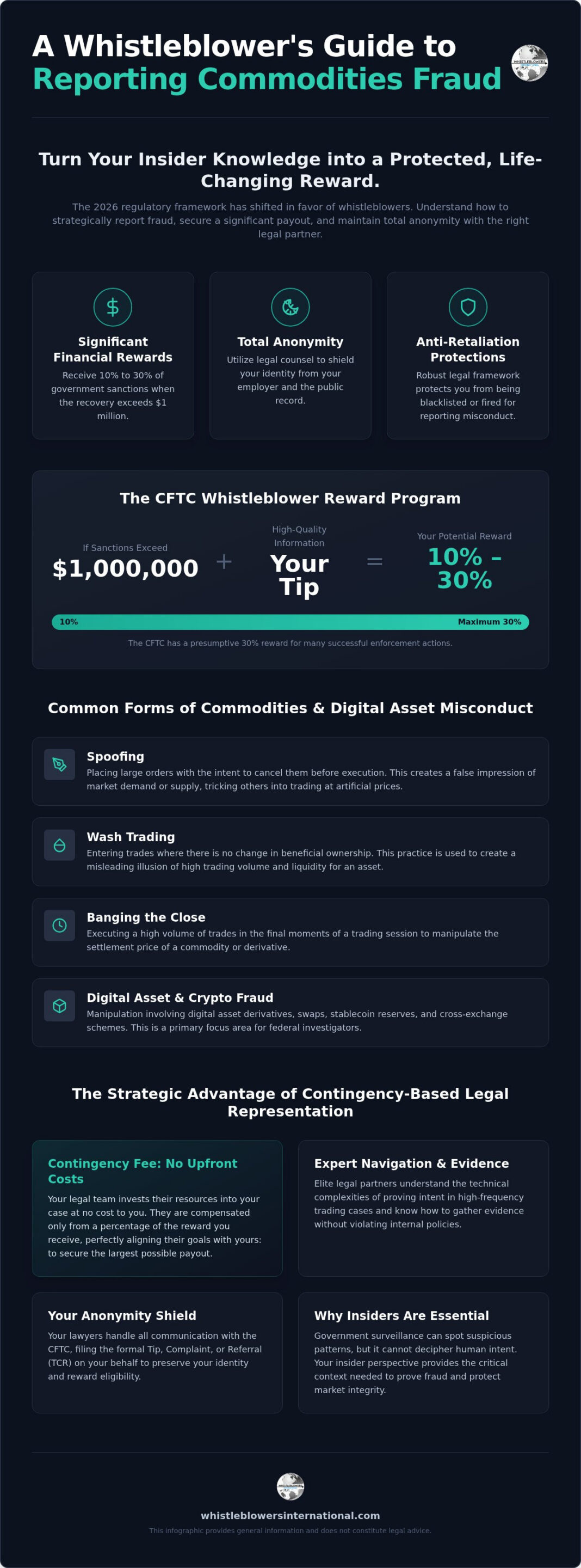
- Identify the criteria for mandatory financial rewards, which range from 10% to 30% of collected sanctions when the government recovery exceeds $1 million.
- Learn how to maintain total anonymity throughout the investigative process by utilizing legal counsel to shield your identity from both your employer and the public record.
- Leverage the tactical advantages of a contingency fee model, which aligns your interests with an elite legal team that handles the complexities of high-frequency trading cases at no upfront cost.
Understanding Commodities Market Fraud in 2026
The modern commodities market is a vast ecosystem that extends far beyond traditional agricultural futures like wheat or corn. In 2026, this landscape encompasses global energy supplies, precious metals, and the rapidly expanding sector of digital assets and carbon credits. Commodities market fraud is a violation of the Commodity Exchange Act (CEA) through deceptive practices. As trading has shifted almost entirely to high-frequency algorithms, the methods used to manipulate these markets have become increasingly opaque. To understand the gravity of these violations, one must look at What is Spoofing in Financial Markets, a practice where traders place orders with the intent to cancel them before execution to create a false impression of market demand. This sophisticated environment requires oversight that is equally advanced, as automated systems often struggle to keep pace with evolving tactics. The Commodity Futures Trading Commission (CFTC) stands as the primary regulatory body responsible for policing these complexities and maintaining a level playing field for all participants.
The Role of the Commodity Futures Trading Commission (CFTC)
The CFTC serves as the primary regulatory authority tasked with ensuring that these markets remain competitive and free from systemic risk. Its mission centers on fostering transparency, yet the agency faces immense pressure as market volume reaches record highs. The Division of Enforcement relies heavily on high-quality tips to initiate investigations. When you are considering reporting spoofing in commodities markets, you must use a formal Tip, Complaint, or Referral (TCR) submission to preserve reward eligibility, as a general complaint rarely suffices for statutory recovery.
Why Whistleblowers are Essential to Market Integrity
Government surveillance technology can flag suspicious price movements, but it cannot decipher human intent. While automated systems catch patterns, they don’t explain the “why” behind a specific sequence of trades. This is where the insider perspective becomes indispensable. By providing the context necessary to prove fraudulent intent, you help protect the integrity of global financial hubs. This mission-driven purpose ensures that markets operate on merit rather than manipulation, stopping systemic corruption that affects everything from fuel prices to the stability of retirement funds.
Common Forms of Commodities and Digital Asset Misconduct
Market misconduct in 2026 has evolved into a multi-layered challenge involving both traditional assets and decentralized finance. While core illegalities like front-running and unauthorized trading within broker-dealer environments persist, the rise of algorithmic dominance has amplified the impact of market manipulation. Reporting spoofing in commodities markets now requires an understanding of how these deceptive orders interact with high-frequency trading systems to distort global price discovery. Beyond manipulation, the commodities space remains a frequent target for Ponzi schemes and fraudulent solicitations that exploit the volatility of energy and metals markets.
Market Manipulation and Spoofing Explained
Spoofing remains the most prevalent form of disruptive trading. It involves placing large orders with the specific intent to cancel them before execution, thereby creating a false impression of market depth. This tactic tricks other participants into buying or selling at artificial prices. Proving the legal threshold of “intent” in these cases is notoriously difficult, especially when trades are executed by complex algorithms. Other common violations include:
- Wash Trading: Entering into trades where there is no change in beneficial ownership to create an illusion of liquidity.
- Banging the Close: Executing heavy trading volumes in the final minutes of a session to manipulate the settlement price.
- Cross-Exchange Manipulation: Using orders on one platform to benefit a position held on a completely different exchange.
Fraud in the Digital Asset and Cryptocurrency Space
The intersection of commodities fraud and digital assets has become a primary focus for federal investigators. Fraudulent activities often involve digital asset derivatives, swaps, and the manipulation of stablecoin reserves. We’ve seen a rise in the misappropriation of customer funds within both centralized and decentralized exchanges, where “rug pulls” and liquidity drainings are frequently disguised as technical failures. Understanding what is fincen standards is essential here, as many digital asset commodities are subject to strict Anti-Money Laundering (AML) protocols. If you’ve witnessed systemic misappropriation in a crypto-trading environment, seeking strategic legal guidance is a vital first step.
Corruption and Bribery in Global Commodity Trading
In global energy and precious metals trading, misconduct often extends into international corruption. This includes paying foreign officials to secure trading advantages or lucrative procurement contracts. There is a powerful synergy between the CFTC and the FCPA whistleblower lawyer programs, which work in tandem to uncover kickbacks and illicit payments. These violations don’t just undermine market fairness; they facilitate systemic global corruption that requires an elite investigative approach to uncover and document effectively.
The CFTC Whistleblower Program: Rewards and Eligibility
The CFTC Whistleblower Program operates as a statutory mandate rather than a discretionary system of rewards. If a whistleblower provides information that leads to a successful enforcement action with monetary sanctions exceeding $1,000,000, the government is legally required to issue a reward. These payouts range from 10% to 30% of the total sanctions collected. In a notable shift for 2026, there’s now a presumption that awards totaling $5 million or less will receive the maximum 30% payout, an initiative intended to prioritize smaller but significant violations that might otherwise go unreported.
While the percentage is fixed within this range, the specific amount depends on the degree of assistance provided and the timeliness of the submission. Foreign nationals should note that U.S. citizenship isn’t a prerequisite for eligibility. If you’re witnessing fraud in U.S. regulated markets from an international trading desk, you’re fully entitled to the same protections and financial incentives as a domestic whistleblower. This global reach ensures that market integrity isn’t limited by borders, especially in the energy and precious metals sectors where much of the activity occurs outside the United States.
Eligibility Criteria for a Monetary Award
To qualify for a reward, your submission must consist of “original information.” This means the data must be non-public and derived from your independent knowledge or unique analysis of market data. The “voluntary” requirement is equally critical; you must report before the government initiates an inquiry or requests information from you. Delaying the process can significantly reduce your final percentage or, in some cases, disqualify you entirely if the government moves first. It’s often the case that those who hesitate find their information has already been superseded by a more proactive colleague or a government audit.
The Technical TCR Filing Process
The path to a successful claim begins with the Form TCR (Tip, Complaint, or Referral). This document is the foundation of the government’s investigation. When reporting spoofing in commodities markets, the precision of your initial filing often dictates whether the Division of Enforcement prioritizes your case. A vague tip is easily ignored, but a strategically developed file that mirrors a government enforcement action ensures immediate scrutiny. In cases where market manipulation overlaps with complex financial structures, an IRS whistleblower lawyer may be necessary to address concurrent tax evasion issues that often accompany large-scale commodities fraud. Our firm handles these massive complexities on a contingency fee basis, ensuring that elite representation is accessible regardless of your current financial position.
Anonymity and Anti-Retaliation: Protecting the Whistleblower
The fear of professional fallout often outweighs the lure of a financial reward. For traders and compliance officers, the prospect of reporting spoofing in commodities markets carries the heavy risk of being excluded from future opportunities in a tight-knit industry. However, the legal framework governing these disclosures is specifically engineered to mitigate these risks. The Commodity Exchange Act contains rigorous confidentiality provisions that allow you to provide information without your identity ever being disclosed to your employer or the public. Privacy is not a luxury; it’s a statutory right. This protective reassurance is the cornerstone of a successful filing, ensuring that your career path remains intact while you pursue justice through the proper channels.
How to Maintain Anonymity via Legal Counsel
The primary mechanism for safeguarding your identity is the use of elite legal representation. When you work with a seasoned advocate, your attorney submits the Form TCR on your behalf. This allows you to remain entirely anonymous to the CFTC throughout the investigative process. Your identity is only revealed to the Commission if and when an award is granted, and even then, it remains shielded from the public record. There are very limited, specific circumstances where the government might request disclosure, such as during a criminal trial where your testimony is required, but these instances are rare and managed with extreme care. In high-stakes trading environments, this layer of separation is essential for maintaining your current professional standing and avoiding the “whistleblower” label in the eyes of the market.
Anti-Retaliation Protections and Legal Recourse
Federal law provides a clear “if-then” framework for handling workplace retaliation. If an employer takes adverse action against you, such as termination, demotion, or harassment, because of your whistleblowing activities, then you have the right to seek significant remedies in federal court. These protections are robust. You can sue for reinstatement to your former position, double back pay with interest, and the coverage of all associated legal fees. Crucially, these anti-retaliation provisions apply regardless of whether the government’s underlying enforcement action is successful. Even if the investigation does not result in a fine, your right to report without fear of reprisal is legally protected. If you are facing pressure or threats of termination, it is vital to secure your professional future by engaging an investigative team that understands the nuances of financial sector litigation.
The Strategic Advantage of Contingency-Based Legal Representation
Engaging in the process of reporting spoofing in commodities markets involves navigating a landscape of immense technical and legal complexity. For many financial professionals, the primary hurdle isn’t just the act of reporting, but the financial risk associated with high-stakes litigation. This is why the whistleblower lawyer contingency fee model is so critical. Under this structure, attorney and client interests are perfectly aligned; the firm only receives a fee if the whistleblower successfully secures a government reward. This “no recovery, no fee” approach serves as a powerful risk-reduction strategy, allowing individuals to challenge massive institutional misconduct without the burden of upfront legal costs or hourly billing.
Piacentile & Associates LLP provides an investigative depth that goes far beyond traditional legal advice. We leverage an “insider” perspective to scrutinize and organize evidence before it ever reaches the CFTC. Our team understands that a successful enforcement action requires more than just a tip; it requires a strategically developed file that mirrors the government’s own investigative standards. Whether you’re a trader on a domestic desk or an international professional dealing in global energy or crypto-commodities, our firm offers the global reach and technical expertise necessary to handle the nuances of algorithmic trading and multi-layered manipulation schemes.
Building a “Battle-Tested” Case File
A methodical approach to organizing evidence is what separates a prioritized tip from one that is buried in the CFTC’s backlog. We focus on creating a “battle-tested” case file by verifying data logs, synthesizing witness testimony, and providing the necessary context for complex trading patterns. If the government can see a clear path to a successful prosecution within your initial filing, they’re far more likely to commit the resources needed for a full-scale investigation. Our role is to act as a powerhouse advocate, ensuring that every piece of information is validated and structured to withstand the intense scrutiny of federal regulators.
Why Choose Piacentile & Associates LLP?
Our firm is led by Dr. Joseph Piacentile, a former whistleblower who possesses a unique dual perspective on the personal and professional risks involved in these actions. This “insider” experience allows us to provide a level of protective reassurance that is unmatched in the industry. We are committed to transparency, integrity, and the maximization of client results through rigorous analytical work. We don’t just file paperwork; we lead the charge in uncovering systemic corruption. If you’ve witnessed market manipulation, don’t wait for a government audit to find you first. Contact Piacentile & Associates LLP today for a strictly confidential evaluation of your commodities spoofing claim.
Securing Your Future in the 2026 Commodities Market
The 2026 regulatory landscape has transformed the act of reporting spoofing in commodities markets into a strategic opportunity for financial professionals. By leveraging the CFTC’s robust anonymity protections, you can expose systemic manipulation without jeopardizing your career or professional reputation. A successful enforcement action depends on the precision of your initial filing and the investigative depth of your legal team, as the government prioritizes cases that are presented with clarity and substantiated evidence.
Piacentile & Associates LLP offers a unique insider’s perspective, led by Dr. Joseph Piacentile, a former whistleblower who understands the gravity of your situation. We operate exclusively on a contingency fee model, ensuring our interests are entirely aligned with yours; we only receive payment if you secure a reward. Our firm provides global representation for international traders, handling the massive complexities of high-frequency trading with a resolute commitment to integrity and transparency.
If you’ve witnessed deceptive trading practices, now is the time to act with confidence and elite support. Secure Elite Legal Advocacy for Your Commodities Fraud Claim and take the first step toward a significant financial reward. You don’t have to navigate this labyrinthine process alone when you have a battle-tested ally by your side.
Frequently Asked Questions
What is the maximum whistleblower reward for reporting commodities spoofing?
Whistleblowers can receive a maximum of 30% of the total monetary sanctions collected by the government. To qualify, the sanctions must exceed $1,000,000. Under the 2026 regulatory framework, there is a presumption that awards of $5 million or less will receive the full 30% payout. This statutory range of 10% to 30% is mandatory, ensuring that individuals who provide original information are fairly compensated for the professional risks they undertake.
Can I report commodities market fraud anonymously to the CFTC?
You have a statutory right to maintain total anonymity throughout the investigation process. To exercise this right, you must be represented by legal counsel who submits the Form TCR on your behalf. Your identity is shielded from the public and your employer. While the CFTC will eventually require your identity to process a financial reward, this information remains confidential and is only shared with specific government personnel under strict privacy protocols.
Do I need a lawyer to file a CFTC whistleblower claim for a reward?
While you can technically file a claim alone, you cannot maintain anonymity without legal representation. Reporting spoofing in commodities markets involves massive technical complexities that require a strategically developed case file to ensure government prioritization. An elite advocate organizes your evidence, data logs, and testimony to mirror an enforcement action. Most successful whistleblowers utilize a contingency fee model, which aligns attorney interests with the goal of maximizing the final reward.
What happens if my employer retaliates against me for whistleblowing?
Federal law provides robust anti-retaliation protections for individuals who report commodities fraud. If your employer demotes, terminates, or harasses you, you are entitled to seek remedies in federal court, including reinstatement, double back pay with interest, and the coverage of your legal fees. These protections apply regardless of whether the government ultimately wins its case. Having a battle-tested legal partner ensures you have the resources to litigate these claims effectively while protecting your professional future.
Does the CFTC whistleblower program apply to cryptocurrency and DeFi spoofing?
The CFTC treats most digital assets as commodities, meaning the whistleblower program fully applies to cryptocurrency and DeFi manipulation. This includes fraud related to digital asset derivatives, swaps, and stablecoin reserves. As of 2026, the Division of Enforcement has made market abuse in decentralized finance a primary priority. Reporting spoofing in commodities markets now frequently involves identifying “rug pulls” or algorithmic manipulation within centralized and decentralized exchanges that distort global price discovery.
Can foreign citizens receive rewards for reporting commodities fraud to the U.S. government?
The CFTC whistleblower program has a global reach and does not require U.S. citizenship or residency. International financial professionals who witness fraud on global energy, metals, or digital asset desks can qualify for the same 10% to 30% rewards as domestic whistleblowers. If the misconduct impacts U.S. regulated markets or involves U.S. entities, the government is authorized to issue payouts to foreign nationals who provide high-quality, original information from abroad.
How long does the CFTC whistleblower award process typically take?
The process from the initial submission of a claim to the final issuance of a reward typically takes over two and a half years. This timeline reflects the duration of the underlying government investigation and the subsequent administrative review of the award application. While the proposed 2026 legislation aims to establish stricter statutory deadlines for processing claims, whistleblowers should expect a methodical, multi-year journey. Patience is essential as the government validates every technical detail of the enforcement action.
What is the difference between reporting to the SEC and the CFTC in 2026?
The primary difference lies in the jurisdiction over the specific financial instrument involved. You report to the SEC for securities fraud, such as insider trading in stocks or bonds. You report to the CFTC for fraud involving commodities, futures, swaps, and most digital assets. In 2026, both agencies have harmonized their rules, including the 30% presumptive award for smaller cases. Determining the correct venue often requires an elite advocate who understands the nuances of cross-market manipulation.