
What if evidence of customs fraud could also put your career at risk? Reporting trade fraud to customs can involve federal laws, sensitive company records, and questions about protecting your identity. Before taking action, it helps to understand the difference between a public agency tip and a False Claims Act (FCA) case, and how to preserve relevant information lawfully.
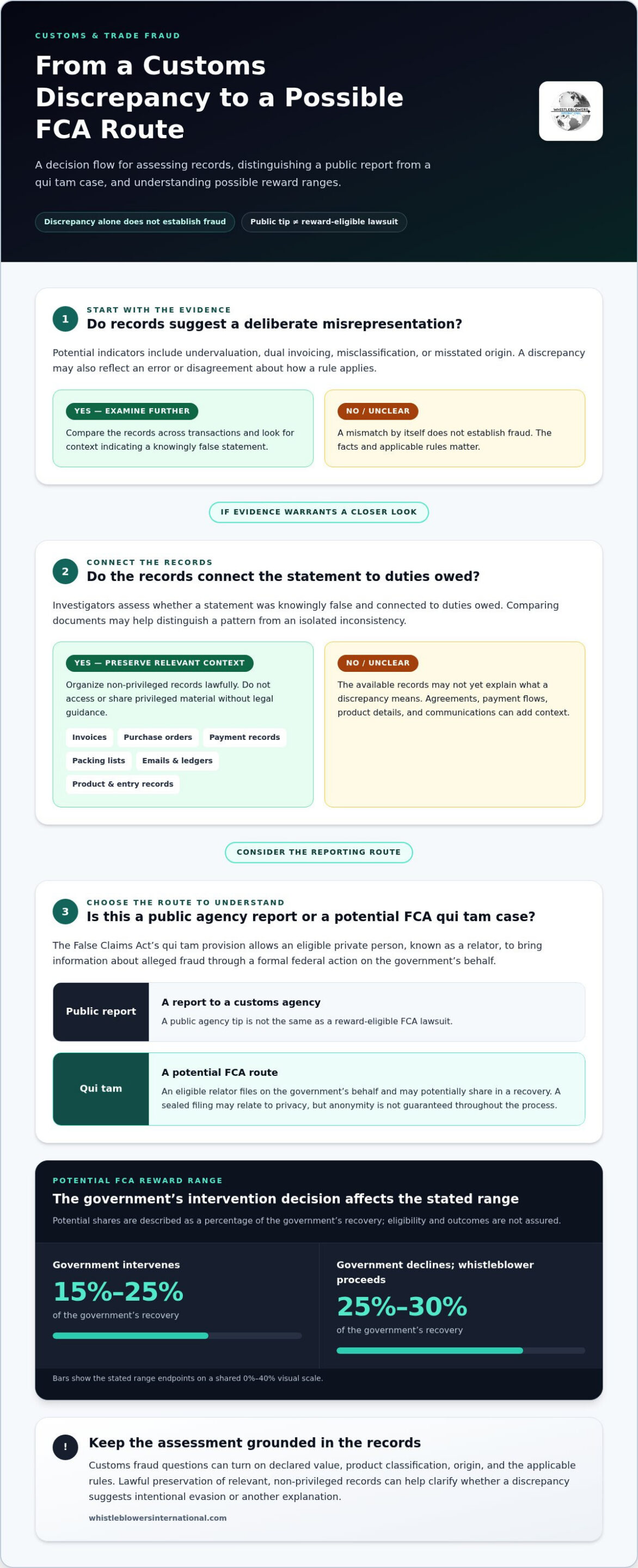
This 2026 guide explains how to report suspected customs duty evasion, what a sealed qui tam filing may mean for privacy, and why anonymity isn’t guaranteed throughout the process. It also covers the FCA’s potential reward range: generally 15% to 25% of the government’s recovery if it intervenes, or 25% to 30% if it declines and the whistleblower proceeds with the case.
You’ll learn which records may help show a pattern, how federal enforcement fits into the process, and what can affect reward eligibility. Trade fraud cases may involve complex import records and cross-border supply chains. Piacentile & Associates LLP represents whistleblowers in these matters on a contingency basis, receiving a portion of a monetary recovery or agency award only if the case is successful. Led by Dr. Joseph Piacentile, a former whistleblower, the firm helps clients assess evidence and reporting options. No outcome is assured, but a careful legal assessment can clarify possible next steps.
Key Takeaways
- Look for customs fraud indicators such as undervaluation, dual invoicing, and misclassification intended to reduce duties.
- Understand how the False Claims Act’s qui tam process lets an eligible whistleblower bring information about alleged fraud to the government.
- Distinguish a public customs report from a qui tam filing when considering a potential FCA reward.
- Organize relevant, non-privileged records such as invoices, emails, and ledgers without compromising sensitive information.
- Consider how legal review can assess the evidence, filing strategy, and factors that may affect reward eligibility.
What is Customs and Trade Fraud in 2026?
Customs and trade fraud involves deliberately evading duties, tariffs, or fees owed to U.S. Customs and Border Protection (CBP). Misrepresenting a product’s value, origin, or classification can reduce an importer’s payment, shifting costs to the government and businesses that follow federal requirements. For someone considering reporting trade fraud to customs, a key first step is distinguishing a deliberate scheme from an error or a disagreement about how a rule applies.
The False Claims Act (FCA) may provide a route for bringing certain allegations forward. Its qui tam provision allows a private person, known as a relator, to file a lawsuit on the government’s behalf and potentially share in a recovery. The False Claims Act explains this framework. Whether particular conduct supports a claim depends on the facts and applicable law.
The Massive Scale of Undetected Duty Evasion
Customs fraud involves deliberately misrepresenting goods or transactions to evade federal revenue laws. CBP cannot physically inspect every shipment, so an inspection alone cannot reveal every false declaration or concealed arrangement. The agency also uses data analytics to help identify potential tariff evasion. Records held inside a company may add context that shipment data does not show.
Employees and other insiders may have access to invoices, communications, classification decisions, or other records that explain how a suspected scheme operated. That information can help authorities assess whether discrepancies point to intentional evasion or routine mistakes. Preserve relevant materials lawfully, and do not access or share privileged information without legal guidance.
Economic Impact and the 2026 Enforcement Landscape
When an importer avoids duties, compliant competitors may face an uneven cost burden, while the federal government loses revenue. Evasion involving trade remedies can also undermine measures addressing unfair pricing or subsidized imports. The details matter: Section 301 tariffs and antidumping and countervailing duties (AD/CVD) involve different legal frameworks, and a product’s origin, classification, and declared value can affect the duties assessed.
In 2026, federal enforcement has a more coordinated focus. DOJ and DHS issued a Resource Guide to Trade Fraud Enforcement on July 14, 2026, and the joint Trade Fraud Task Force reported more than $1 billion in recoveries, penalties, forfeitures, and publicly charged losses in less than a year. CBP is also using data analytics to identify potential evasion. International trade agreements and overlapping origin and tariff rules add complexity. Investigators assess possible misrepresentation against the applicable requirements and records.
One FCA theory may apply when a company knowingly avoids a debt owed to the government. This is often called a “reverse false claim.” The FCA’s qui tam process lets eligible insiders present evidence through a formal federal action. A public report to an agency is not the same as a reward-eligible lawsuit.
Common Types of Customs Fraud Targeted by Whistleblowers
Trade fraud can be hidden in ordinary import records. A lower declared value, different tariff classification, or changed origin statement may reduce duties, but a discrepancy alone doesn’t establish fraud. Investigators look for evidence that a statement was knowingly false and connected to duties owed. When reporting trade fraud to customs, comparing records across transactions can help show whether inconsistencies form a deliberate pattern.
Undervaluation and Dual-Invoicing Schemes
In a dual-invoicing scheme, customs records may show one price while another document or payment reflects a different amount. Compare commercial invoices with purchase orders, payment records, and packing lists, noting differences in price, quantity, or shipment details. Internal communications or accounting records may add context. Preserve them lawfully and do not access privileged material.
Other arrangements may also warrant scrutiny. For example, a payment labeled a “buying commission” or royalty may be relevant to declared customs value, depending on the transaction and applicable valuation rules. The label alone does not prove wrongdoing. The underlying agreements, payment flows, and parties’ relationship can help clarify what the payment represents and whether it was treated properly.
Misclassification, Transshipment, and AD/CVD Evasion
Misclassification occurs when goods are declared under a tariff classification that doesn’t accurately describe them, potentially resulting in a lower duty rate. Misstating their composition or specifications can serve a similar purpose. Relevant records may include product descriptions, technical specifications, classification decisions, entry documents, and emails explaining why a code was selected. A recurring mismatch between product records and customs declarations may merit closer examination.
Origin fraud can involve routing goods through a third country and declaring that country as their origin, even though the processing there may not support that claim. “Light assembly” or other limited processing can raise questions, but origin determinations depend on the applicable rules and facts, including the work performed and the product before and after processing. A transshipment route by itself doesn’t prove evasion.
False origin or classification declarations may also affect Section 301 tariffs or antidumping and countervailing duties (AD/CVD). To assess a suspected scheme, compare production records, supplier documents, shipping routes, origin declarations, and customs entries. The CBP e-Allegations program is an official channel for reporting suspected trade violations. If you’re evaluating a potential False Claims Act case, consider how an agency report relates to the qui tam process before submitting information. For legal representation concerning customs fraud evidence, explore customs fraud whistleblower representation.
The False Claims Act: Calculating Your Whistleblower Reward
The False Claims Act (FCA) can reach customs schemes that cause the government to lose revenue. Under its “reverse false claims” provision, liability may arise when a company knowingly conceals, avoids, or improperly decreases an obligation to pay the government, such as customs duties it owes. The issue is not simply whether a declaration was wrong. The evidence must support the legal requirements, including knowledge and an obligation to pay.
The FCA’s qui tam provision allows a private individual, called a relator, to bring a lawsuit on the government’s behalf. If the case results in a recovery, the relator may receive a share. Under the 2026 reward ranges, that share is generally 15% to 25% if the government intervenes, and 25% to 30% if it declines to intervene and the relator successfully pursues the case. These are statutory ranges, not guaranteed outcomes.
Factors That Can Affect Your Reward Percentage
The relator’s share depends on the circumstances of the case, including the extent and value of the whistleblower’s contribution. Well-organized evidence and meaningful assistance to the government’s investigation can support the case for a larger share. The initial filing and accompanying disclosure should clearly explain the suspected scheme, how it allegedly worked, and which records support the allegations.
A customs fraud lawyer can assess evidence, develop the disclosure, and present information for government review. For more on contingency arrangements, see this 2026 guide to whistleblower lawyer contingency fees.
Original Source, First to File, and Timing
Reward eligibility may depend on whether the relator meets the FCA’s “original source” standard when allegations have already been publicly disclosed. In general, the law considers whether the person has independent knowledge that materially adds to the publicly disclosed information. Repeating public allegations may not be enough. How the information was obtained and what it adds require legal analysis.
Timing matters. The FCA’s first-to-file rule can prevent a later relator from pursuing a case based on allegations substantially the same as those in an earlier-filed action. If multiple people know about the same suspected scheme, an earlier qualifying filing may affect later claims. A prompt, confidential legal assessment can help identify that risk before reporting trade fraud to customs.
Deadlines also apply. Under the general FCA limitations framework, a case must be filed within six years of the violation, or within three years of when the responsible federal official knew or should have known of the material facts, subject to an outside limit of ten years after the violation. These rules are fact-specific. A delay may affect whether a claim can proceed and whether a whistleblower can qualify for a share.
Strategic Steps: How to Document and Report Trade Fraud
A disciplined approach can protect the integrity of your evidence and help preserve your legal options. If you’re considering reporting trade fraud to customs and may seek a reward under the False Claims Act (FCA), don’t assume that submitting information through a public reporting portal is the same as filing a qui tam lawsuit. A portal report may alert authorities, but it does not itself establish a right to an FCA relator’s share. Speak confidentially with whistleblower counsel about the reporting strategy before sending materials to an agency.
Gather Evidence Lawfully and Preserve Its Context
Company ownership of a record doesn’t automatically authorize you to access, copy, or remove it. Don’t bypass security controls, take privileged communications, or violate privacy or confidentiality obligations to obtain evidence. Instead, make a factual record of what you observed, when you encountered it, and where relevant documents are maintained. Keep originals intact and avoid editing, annotating, or circulating sensitive files.
Potentially relevant materials may include non-privileged emails, invoices, ledgers, purchase orders, and shipping documents. Customs entry records, shipping manifests, and entry summaries, including CBP Form 7501, may help connect declared values, classifications, quantities, and origin information to a shipment. Whether a record is privileged or can be shared is fact-specific, so get legal guidance before transferring it.
For digital records, don’t forward company files to personal email, upload them to public storage, or try to defeat encryption. Note where information is stored and preserve relevant dates and context without altering the source. Legal counsel can advise on a secure, lawful way to review and transmit materials, including encrypted communications where appropriate.
Protect Confidentiality, Including Across Borders
Foreign nationals can bring qualifying FCA qui tam actions. U.S. citizenship isn’t itself a requirement for a potential relator’s share. The same core questions apply: whether the allegations and evidence meet the law’s requirements, whether filing deadlines apply, and whether earlier public disclosures or cases affect eligibility. International whistleblowers should also consider how employment, privacy, and document-transfer rules where they are located may affect evidence handling.
In 2026, a qui tam complaint is generally filed under seal, meaning it is initially kept from public view while the government investigates. This does not provide permanent anonymity: the government and court know the relator’s identity, and it may become known as litigation proceeds. A confidential discussion with counsel before filing can help plan the submission and address retaliation concerns without overstating what the seal protects.
Piacentile & Associates LLP represents whistleblowers in international trade matters and handles customs fraud actions on a contingency basis, receiving a portion of a monetary recovery or agency award only if the case is successful. For a legal assessment of your records and reporting options, discuss a trade fraud whistleblower case.
Why Piacentile & Associates is Your Elite Ally in Trade Fraud
Reporting trade fraud to customs can put your livelihood, professional relationships, and privacy at stake. Piacentile & Associates LLP represents whistleblowers in customs and trade fraud matters under the False Claims Act. Led by Dr. Joseph Piacentile, a former whistleblower, the firm brings firsthand perspective to assessing sensitive information and planning a reporting strategy.
Trade cases may involve more than a questionable entry or invoice. Evidence can span import records, company communications, and international supply chains. The firm applies an investigative focus to evaluating how records fit together and what they may show, while guiding clients through the legal process. That means assessing the facts methodically, explaining risks clearly, and helping whistleblowers make informed decisions without overstating what a case can achieve.
A Mission-Driven Approach to Integrity
The firm’s work focuses on uncovering alleged financial misconduct through whistleblower actions. It represents clients in international trade matters, where relevant facts and documents may cross borders. Privacy is a strategic concern, not a promise of complete anonymity: qui tam filings are initially sealed, but the government and court know the whistleblower’s identity, and it may become public as a case proceeds. For another example of the firm’s whistleblower work, read its 2026 guide to reporting foreign bribery.
Representation is on a contingency basis. The firm receives a portion of the final government recovery or agency award as payment for legal services. The terms and application of a contingency arrangement depend on the representation agreement.
Evaluation and Next Steps
A case review can help organize what you know: the suspected conduct, your role and access to information, relevant records, and any steps already taken to report it. Keep communications and documents secure, and don’t remove or disclose company materials without appropriate legal guidance. A confidential discussion can also address retaliation concerns and the limits of confidentiality before filing decisions are made.
There is no universal 90-day timetable for a trade fraud investigation. Early work and later milestones depend on the evidence, the government’s process, and case-specific circumstances. Counsel can explain what is known, identify immediate preservation concerns, and discuss possible next steps without promising a particular timeline or outcome.
To discuss your circumstances and potential False Claims Act options, contact us for a confidential evaluation of your trade fraud case.
Take the Next Step with a Clear Strategy
Customs duty evasion can be concealed through undervaluation, false classifications, or misrepresented country of origin. The False Claims Act may give eligible insiders a route to bring evidence of certain unpaid government obligations forward, but reward eligibility depends on legal requirements, timing, and the information provided.
Before reporting trade fraud to customs, consider how to protect relevant records, avoid improperly disclosing privileged or sensitive materials, and choose a reporting path that preserves your legal options. A public tip and a qui tam filing are different processes, and a filing under seal doesn’t guarantee permanent anonymity.
Piacentile & Associates LLP represents whistleblowers in complex international trade matters. Led by Dr. Joseph Piacentile, a former whistleblower, the firm helps clients assess high-stakes cases and works on a contingency basis, receiving a portion of a monetary recovery or agency award only if the case is successful. No recovery or reward is guaranteed. A careful legal assessment can help you understand your options and proceed deliberately.
Contact Piacentile & Associates LLP for a confidential evaluation of your trade fraud case. A careful first step can help you understand your options and decide what to do next.
Frequently Asked Questions
Can I report customs fraud anonymously and still get a reward?
You may be able to discuss suspected fraud confidentially with a lawyer, but a False Claims Act (FCA) qui tam case doesn’t guarantee permanent anonymity. A complaint is initially filed under seal, meaning it’s not publicly available while the government investigates, but the government and court know the relator’s identity. If you’re considering reporting trade fraud to customs, get legal advice before submitting information through a public channel or taking steps that could identify you.
What is the average whistleblower reward for reporting trade fraud in 2026?
There’s no single reliable average that predicts what an individual whistleblower will receive in 2026. Under the FCA, a relator’s share is generally 15% to 25% of the government’s recovery if it intervenes, or 25% to 30% if it declines and the relator successfully pursues the case. The actual share depends on the case, the relator’s contribution, and other legal factors. A recovery or reward isn’t guaranteed.
Do I need to be a U.S. citizen to file a customs fraud whistleblower claim?
No. U.S. citizenship isn’t generally a requirement to bring a qualifying False Claims Act qui tam action, and foreign nationals may be eligible for a relator’s share. Eligibility still depends on the allegations, evidence, filing requirements, and other case-specific factors. If you’re outside the United States, consider local privacy and employment rules before collecting or transferring company records, and get legal guidance on handling sensitive information.
What happens if my company finds out I reported the trade fraud?
Your employer may learn your identity during the process, even though a qui tam complaint is initially filed under seal. The FCA includes protections against certain retaliation for lawful acts in furtherance of a claim, but no process can guarantee that your employer won’t discover your involvement or that workplace consequences won’t occur. Preserve relevant information lawfully, keep a factual record of any adverse treatment, and seek legal advice promptly if you face retaliation.
How long does a trade fraud investigation typically take under the False Claims Act?
There’s no standard timetable for a trade fraud investigation under the FCA. The government’s review may depend on the complexity of the import records, the scope of the alleged scheme, the evidence available, and investigative priorities. A qui tam case remains under seal while the government investigates, but the length of that period can vary. Counsel can explain procedural developments as they occur, but can’t reliably promise a resolution date.
Can I be held liable if I was involved in the customs fraud scheme?
Potentially, depending on your conduct, knowledge, and role. Reporting a scheme doesn’t automatically eliminate exposure for someone who participated, and the facts may raise separate civil or criminal concerns. Don’t destroy, alter, or conceal records, and don’t make statements to investigators without understanding the risks. Speak with counsel about your specific circumstances before approaching the government. This FAQ isn’t a substitute for advice about individual liability.
What specific evidence is needed to prove undervaluation in 2026?
No single document proves undervaluation by itself. Relevant evidence may include customs entry summaries, commercial invoices, purchase orders, payment and ledger records, packing lists, shipping documents, and communications explaining differences between declared and paid prices. Investigators assess the records together to determine whether a discrepancy reflects an intentional false statement and duties owed. Preserve materials lawfully, retain their context, and avoid accessing privileged files or bypassing company security.
What is the difference between reporting to the CBP portal and filing a Qui Tam lawsuit?
A report through CBP’s e-Allegations portal alerts the agency to suspected trade violations. It isn’t itself a qui tam lawsuit and doesn’t automatically create FCA reward eligibility. A qui tam action is a formal lawsuit filed under the False Claims Act on the government’s behalf, subject to specific filing and procedural rules. If you’re seeking a potential relator’s share, get legal guidance before submitting information through a public portal.