

The difference between a multi-million dollar award and a career-ending blacklist often comes down to the tactical precision of your initial filing. With the FinCEN whistleblower program now fully operational following the 2026 regulatory updates, the stakes for financial professionals have reached a critical point. You’ve likely witnessed systemic violations of the Bank Secrecy Act and feel the weight of that knowledge; however, the complexity of federal oversight and the fear of industry retaliation remain powerful deterrents. It’s reasonable to feel uncertain about whether your evidence meets the $1 million sanction threshold required for a payout.
If you’re ready to step forward, you deserve a partner who understands the gravity of your situation. This article identifies the essential criteria for selecting an elite law firm that can shield your identity while strategically positioning you for a 10% to 30% monetary reward. We’ll explore the necessity of choosing an advocate with investigative “teeth” and an insider’s perspective, ensuring your disclosure is treated with the scrutiny it deserves. From evaluating a firm’s technical mastery of the AML Act to confirming their commitment to total anonymity, we provide the roadmap for securing your future.
Key Takeaways
- Learn to distinguish between general litigation firms and elite advocates who integrate forensic investigation with high-stakes legal strategy.
- Understand how specialized mastery of the FinCEN whistleblower program and the Bank Secrecy Act is essential for meeting the $1 million award threshold.
- Discover why an effective firm must possess the investigative “teeth” to quantify complex fraud using former federal agents and advanced data analytics.
- Identify the importance of a contingency fee structure that aligns your attorney’s interests with your own; this ensures they only get paid when you secure an award.
- Access a 10-point checklist to vet your advocate’s ability to maintain your total anonymity while maximizing your potential 10 to 30 percent monetary reward.
Defining the Standard: What Makes a Whistleblower Law Firm “Elite”?
Selecting an advocate for the FinCEN whistleblower program is a decision that carries immense professional and personal weight. An elite whistleblower law firm is not merely a legal representative; it is a specialized entity that integrates sophisticated legal advocacy with deep forensic investigation. While many firms claim to handle financial fraud, an elite firm possesses the specific infrastructure required to transform raw data into a compelling federal case. This integration is vital because government agencies often lack the bandwidth to investigate every tip; they prioritize disclosures that arrive pre-vetted and strategically organized.
There is a fundamental distinction between a general practice litigation firm and a dedicated whistleblower practice. A generalist might treat your case as a standard dispute, focusing on procedural motions and billable hours. In contrast, a dedicated practice understands that your situation is an offensive action against systemic corruption. They focus on the specific nuances of the Anti-Money Laundering (AML) Act, ensuring that every piece of evidence is evaluated through the lens of federal enforcement priorities. This specialized focus is what allows a firm to anticipate the complexities of the Bank Secrecy Act (BSA) before they become obstacles.
For financial insiders, the risk of industry retaliation or blacklisting is a constant concern. This is where the persona of a battle-tested mentor becomes critical. You need an ally who understands the high-stakes environment of global finance and has successfully protected individuals in similar positions. They don’t just provide legal advice; they offer a protective shield and a strategic roadmap.
An elite firm offers contingency-based representation backed by a history of successful federal recoveries.
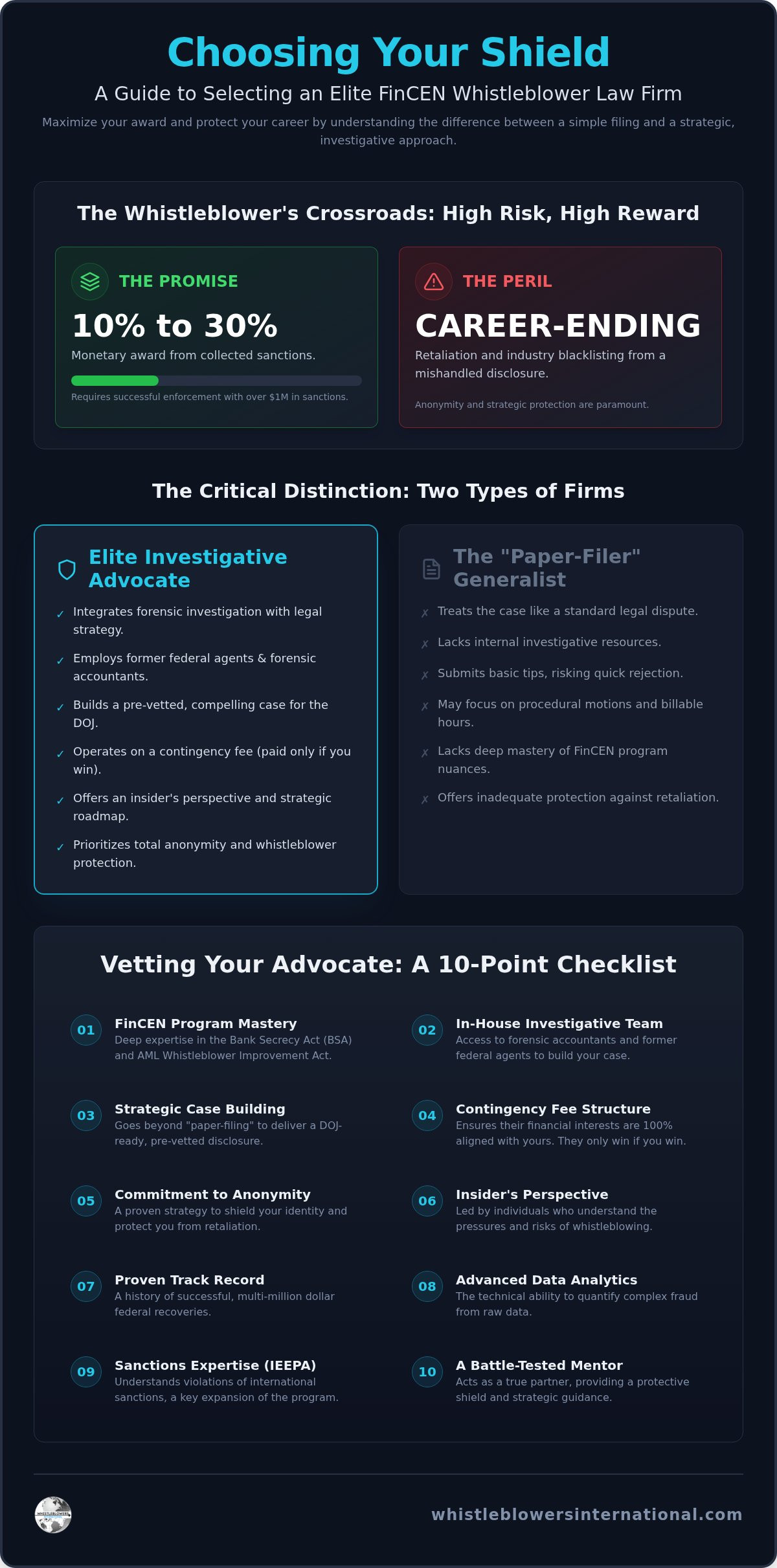
The “Paper-Filer” vs. The Investigative Advocate
Many firms operate as “paper-filers,” believing that simply filing a Form TD F 90-22.1 or a basic digital tip is enough to secure a result. Within complex AML cases, this approach is often insufficient and potentially dangerous. If a firm lacks the internal resources to perform independent evidence vetting, they risk submitting incomplete or inaccurate information that can lead to a quick rejection by federal authorities. An investigative advocate employs in-house forensic accountants and former federal agents to verify every claim. This depth of preparation significantly increases the likelihood of a Department of Justice (DOJ) intervention, as prosecutors are more likely to adopt a case that is already supported by a rigorous investigative foundation.
The Insider Advantage: Why Perspective Matters
Perspective is the invisible asset that separates adequate representation from exceptional advocacy. There is unique value in partnering with a firm led by individuals who have personally managed the whistleblowing process. This firsthand experience fosters a deep empathy for the whistleblower’s risk profile, leading to more nuanced strategic decisions regarding timing and anonymity. These leaders understand the professional anxiety involved and prioritize whistleblower protections at every stage. Insider knowledge is also indispensable for anticipating government skepticism. By understanding how federal investigators think, an elite firm can proactively address potential weaknesses in a disclosure, ensuring that the FinCEN whistleblower program works for the individual rather than against them.
Technical Expertise and FinCEN Program-Specific Mastery
Mastery of the legal architecture is non-negotiable for any firm seeking to maximize a client’s recovery. The FinCEN whistleblower program operates under a precise statutory framework, primarily anchored by the Anti-Money Laundering (AML) Whistleblower Improvement Act of 2022. This legislation didn’t just refine existing rules; it fundamentally expanded the program’s reach to include violations of the International Emergency Economic Powers Act (IEEPA), which covers sanctions evasion. An elite advocate must possess the technical proficiency to identify when a financial institution’s actions cross the line from a mere procedural oversight into a clear violation of these federal statutes. This level of scrutiny is often found in firms like Lakinberg Law PLLC, which specialize in the complex corporate governance and fintech regulatory landscapes that define modern financial enforcement.
The stakes are high because of the $1 million threshold. For a whistleblower to be eligible for an award of 10% to 30%, the information provided must lead to a successful enforcement action where monetary sanctions exceed $1,000,000. This requires more than just a general understanding of finance. Your legal team must be able to link your evidence to the specific enforcement priorities of the Financial Crimes Enforcement Network. If a filing fails to articulate how the reported conduct undermines national security or the integrity of the U.S. financial system, it’s unlikely to gain the necessary traction with federal investigators.
Navigating Bank Secrecy Act (BSA) Violations
Success in this field often hinges on a firm’s ability to identify systemic failures in “Know Your Customer” (KYC) protocols. It’s not enough to point to a single suspicious transaction. You need an advocate who can demonstrate a pattern of negligence in how an institution vets its clients or monitors high-risk accounts. Understanding what is fincen and its evolving expectations for Suspicious Activity Report (SAR) filings is essential. If an institution is intentionally ignoring red flags to maintain a profitable but illicit relationship, an elite firm will know how to document that intent for the government. You might consider reviewing the specifics of your disclosure with an expert who understands these nuances.
Sanctions Evasion and Kleptocracy Awards
The modern enforcement environment places a heavy emphasis on reporting sanctioned entities and oligarchic assets. As global conflicts shift, the intersection of FinCEN claims and Department of Treasury oversight has become increasingly complex. An elite firm understands how to track the movement of assets belonging to sanctioned individuals, often involving intricate layers of shell companies. This work frequently overlaps with other jurisdictions, making it helpful to consult an FCPA Whistleblower Lawyer: A 2026 Guide to Reporting Foreign Bribery for cross-border context. When you can connect sanctions evasion to broader kleptocracy, you significantly increase the strategic value of your disclosure to federal authorities.
The Investigative Edge: Beyond Legal Filings
Filing a digital tip for the FinCEN whistleblower program is merely the entry point into a complex federal process. To ensure the government prioritizes your disclosure, the evidence must be presented with undeniable clarity and tactical precision. Elite law firms distinguish themselves by moving beyond basic legal filings to provide a full-scale investigative engine. By employing former federal agents and forensic accountants, these firms vet every document and transaction before it ever reaches a prosecutor’s desk. This internal scrutiny ensures that your information is not just “original,” but immediately actionable for enforcement agencies.
A firm’s ability to quantify the total financial impact of the fraud is what ultimately drives the final award percentage. If your legal team cannot accurately calculate the scale of the illicit activity, they cannot effectively argue for the maximum 10% to 30% recovery. An investigative firm “packages” a case so it arrives at the Department of Justice as a prosecution-ready file. This strategic preparation reduces the government’s investigative burden, which significantly increases the likelihood of a formal intervention and a successful recovery.
Forensic Accounting and Financial Scrutiny
Raw transaction data is often a chaotic labyrinth of shell companies, nested accounts, and offshore transfers. Forensic accountants specialize in turning this digital noise into a cohesive narrative of illicit finance. This depth of preparation acts as a safeguard for your personal credibility. When government investigators conduct formal interviews, having a verified, forensic trail of evidence prevents the small inconsistencies that can sometimes undermine a whistleblower’s case. Sophisticated forensic tools allow these experts to track the flow of funds through complex jurisdictions, exposing the ultimate beneficiaries of the scheme.
Global Reach for US Federal Actions
Financial crimes rarely respect national borders, and neither should your legal representation. International whistleblowers often possess the most critical evidence but face unique challenges when attempting to navigate US federal actions from abroad. It’s essential to select a firm with a strong national US presence that understands the global nature of money laundering. Handling cross-border evidence collection requires extreme care to avoid violating foreign privacy laws or local banking secrecy acts. This global perspective is particularly relevant when reporting trade fraud, where illicit transactions are frequently buried within legitimate international commerce. An elite firm manages these complexities, ensuring your identity remains protected while your evidence is strategically weaponized in US courts.
Transparency, Fees, and the Attorney-Client Partnership
A partnership within the FinCEN whistleblower program is built on the foundation of shared risk and total transparency. When you step forward with high-level information, you’re not just hiring a service provider; you’re engaging an ally who must be as invested in the outcome as you are. An elite firm operates exclusively on a whistleblower lawyer contingency fee structure. This model ensures that the firm only receives compensation if they successfully secure a monetary award for you. It’s a powerful validation of your case’s merit, as it signifies the firm is willing to commit its own resources to your success.
Beyond the fee structure, you must evaluate a firm’s willingness to invest significant capital into your case development. High-stakes AML investigations require expensive tools and specialized personnel. If a firm is hesitant to deploy its own funds for forensic accounting or expert witnesses, they aren’t truly aligned with your goals. A credible advocate manages your identity with extreme care, employing sophisticated anonymity protocols to protect your standing in the financial sector while the government evaluates your disclosure.
Understanding the Financial Alignment
The gold standard for elite representation is a “no upfront costs” commitment. This means the firm covers all necessary expenses, including filing fees, data analytics, and the costs of seasoned investigators. This financial stability is crucial because whistleblower actions often span several years. If a firm lacks the capital to sustain multi-year litigation, they might feel pressure to settle early for a lower amount. You need a powerhouse that can go the distance, ensuring that the final recovery reflects the true scale of the reported fraud. It’s vital to evaluate a firm’s financial track record before entrusting them with your future.
Privacy and Retaliation Protection
Anonymity is the primary concern for most financial professionals. An elite firm utilizes a “Shield” strategy, leveraging attorney-client privilege to keep your identity confidential during the investigative phase. When people ask what happens if an employer finds out, the answer lies in the firm’s proactive management of the disclosure. Under the Anti-Money Laundering Act, there are robust anti-retaliation protections designed to shield you from professional harm. Your legal team’s role is to advise you on these protections while ensuring that your name remains disconnected from the evidence for as long as the law allows. This protective posture lets you focus on providing information while your advocates handle the strategic defense of your career.
Vetting Your Advocate: A 10-Point Selection Checklist
Choosing the right counsel is the most significant strategic decision you’ll make after deciding to report illicit financial activity. The FinCEN whistleblower program demands a level of technical and investigative depth that standard litigation firms simply don’t possess. Because the financial industry is notoriously small and retaliation is a legitimate threat, your advocate must function as both a legal expert and a protective shield. Use the following criteria to ensure your firm has the “teeth” required to protect your interests and maximize your potential recovery.
- 1. Program Specificity: Confirm the firm has a dedicated FinCEN and AML practice rather than just a general whistleblower department. The nuances of the Bank Secrecy Act require specialized focus.
- 2. Investigative Resources: An elite firm like Piacentile & Associates LLP utilizes in-house forensic accountants and former federal agents to vet evidence before it reaches the government.
- 3. Insider Perspective: Leadership should have firsthand experience with the process. For instance, Dr. Joseph Piacentile’s history as a former whistleblower provides a unique, empathetic perspective that informs every strategic decision.
- 4. Proven Results: Verify a track record in high-value federal recoveries. You need a firm that has successfully navigated the complexities of multi-million dollar sanctions.
- 5. Direct Partner Involvement: Ensure a senior partner leads your strategy and handles government communications rather than delegating the case to a junior associate.
The Final Five: Deep Vetting Questions
Once you’ve confirmed the firm’s basic credentials, you must dig deeper into their operational standards. Ask if they have a reputation for submitting “prosecution-ready” files to the Department of Justice; this credibility is what gets your case moved to the top of the pile. Ensure the contingency fee structure is clearly defined in writing, confirming they only get paid if you win. Given the global nature of money laundering, they must possess the capability to handle international evidence without violating foreign privacy laws. Finally, demand a secure, encrypted channel for all communications. If you don’t feel a sense of resolute protection during the initial consultation, they aren’t the right partner for a high-stakes FinCEN whistleblower program filing.
Next Steps: Initiating a Confidential Evaluation
Preparation is essential when initiating a claim. It’s critical that you don’t use company devices, networks, or email accounts to research your options or contact a lawyer. Create a timeline of the suspected violations and identify specific transactions or patterns of BSA non-compliance, but avoid taking proprietary data that could complicate your legal standing. When you’re ready to move forward, you deserve an ally who has stood where you are standing. Contact Piacentile & Associates for a confidential case evaluation to discuss your evidence with a battle-tested mentor who prioritizes your anonymity and success.
Securing Your Future in Financial Enforcement
The path to a successful recovery through the FinCEN whistleblower program requires more than just evidence; it requires a strategic alliance with a firm that possesses the investigative depth to quantify systemic fraud. You’ve learned that an elite advocate must offer specialized mastery of the Bank Secrecy Act and a contingency model that aligns their interests with your own. Identifying a partner who provides both legal expertise and forensic scrutiny is the most critical step you can take toward securing a 10% to 30% monetary reward.
Piacentile & Associates LLP provides this level of sophisticated, protective representation. Led by Dr. Joseph Piacentile, a former whistleblower who understands the professional gravity of your decision, our firm offers global representation for US federal reward programs. We operate exclusively on a contingency basis, which means we only receive payment if you successfully secure an award. It’s our mission to ensure that your integrity is rewarded while your identity remains shielded from industry retaliation.
Secure a confidential evaluation with our investigative legal team today to discuss your evidence with a battle-tested mentor. You’ve already done the hard work of uncovering the truth; now, let us help you weaponize that information for maximum impact.
Frequently Asked Questions
How do I know if a whistleblower law firm is legitimate?
Legitimacy is verified through a firm’s specialized track record in federal recoveries and their commitment to transparency. Look for leadership with direct experience in the field, such as an attorney who has navigated the process personally. A legitimate firm will never charge upfront fees and will provide a clear, written contingency agreement. Check for a history of handling high-stakes cases and verify their standing with professional oversight bodies to ensure they are qualified.
Do I have to pay a whistleblower lawyer upfront?
No, you shouldn’t pay any upfront costs when engaging an elite advocate for high-stakes federal actions. Professional whistleblower firms operate exclusively on a contingency fee basis, meaning they invest their own capital into your case development. They cover all investigative expenses, forensic accounting fees, and filing costs. If a firm requests a retainer or hourly consulting fees, it’s a clear signal they may lack the resources required for complex litigation.
What is the difference between a FinCEN whistleblower lawyer and a general employment lawyer?
A FinCEN whistleblower lawyer specializes in the technical nuances of the Bank Secrecy Act and the FinCEN whistleblower program rather than standard workplace disputes. While an employment lawyer focuses on wrongful termination or harassment, a whistleblower advocate builds a strategic case for federal recovery. They use forensic tools to uncover financial crimes and navigate the complex intersection of national security and financial regulation to maximize your potential award of 10% to 30%.
Can a whistleblower law firm represent me if I live outside the United States?
Yes, elite firms provide global representation for individuals reporting violations of US federal law regardless of their residency. The Anti-Money Laundering Act applies to any individual who provides original information about covered violations. Because financial crimes often cross international borders, your legal team must possess the global reach to collect evidence and manage cross-border disclosures. This ensures that international professionals can safely access the rewards and protections offered by the US government.
What happens if the government declines to take my FinCEN case?
If the government declines to intervene, your legal team will evaluate the feasibility of moving forward independently or seeking other avenues for recovery. While government intervention is the preferred outcome, a declination doesn’t necessarily mean your case lacks merit. An experienced firm will have pre-vetted your evidence to ensure it meets the $1 million threshold, providing you with a clear assessment of your options if federal authorities choose not to pursue the action.
How much of my whistleblower award will the law firm take?
The law firm’s compensation is a pre-negotiated percentage of the final award recovered from the government. This fee is specified in your written contingency agreement and reflects the firm’s legal expertise, investigative resources, and the financial risk they assumed by funding the case. Because the firm operates on a contingency basis, they only receive payment if your case is successful. You don’t owe any fees if the action doesn’t result in a monetary recovery.
Can I change whistleblower law firms if I am unhappy with the progress?
You have the right to change legal counsel at any time if you feel your current representation isn’t meeting your needs. However, switching firms during active litigation can be complex due to existing fee liens and the transfer of sensitive evidence. It’s essential to review your initial engagement letter to understand the implications of termination. An elite advocate will prioritize a smooth transition to ensure your claim remains protected throughout the process.
How long does a typical FinCEN whistleblower case take to resolve?
A typical case involving the FinCEN whistleblower program can take several years to reach a final resolution. With the program’s rules being finalized in 2026, the government is established to process claims methodically. The timeline depends on the complexity of the financial fraud and the government’s enforcement priorities. Your advocate should provide regular updates and manage your expectations regarding the duration of this process, which includes initial vetting and formal government review.