

Speaking up about suspected wrongdoing should not cost you your job, but retaliation can take forms beyond dismissal. It occurs when an employer takes adverse action because someone engaged in protected activity, such as raising a concern about a possible violation. Fear of whistleblower retaliation can make it harder to decide what to do next. Under the False Claims Act, a retaliation claim may be pursued separately, even if no underlying claim is filed or succeeds.
Concern about professional consequences is understandable. The protections that may apply depend on what you reported, whom you reported it to, and which law covers the conduct. A sound next step starts with understanding those distinctions.
This article explains what whistleblower retaliation means, how it can appear at work, which protections may apply, and how to file a complaint. It also covers why retaliation is not limited to losing a job, and what to consider when documenting events and assessing your reporting options.
Key Takeaways
- An underlying False Claims Act case doesn’t necessarily need to be filed or succeed for a separate retaliation claim to be maintained.
- Retaliation can include more than dismissal; learn to recognize workplace actions that may penalize or isolate someone for speaking up.
- Protections differ by reporting channel and law, including rules that apply to SEC and CFTC whistleblowers.
- Complaint deadlines depend on the agency and complaint type, so identify the relevant process and act promptly.
- Keeping a clear record of reports and subsequent workplace changes can help you organize the facts when considering your next steps.
1. Does a whistleblower need to win their case to be protected against retaliation under the FCA?
No. Section (h) of the federal False Claims Act protects people who support or pursue a qui tam lawsuit. A retaliation claim can proceed separately from the underlying False Claims Act case, and it can be maintained even if no False Claims Act action is filed or ultimately succeeds. The central question is whether the person engaged in protected activity and faced adverse treatment because of it.
That distinction matters when fear of whistleblower retaliation affects whether someone reports suspected fraud. Protection against retaliation is not the same as winning a fraud case. Firing, demotion, reduced pay, denial of a promotion, or loss of overtime may be adverse actions. The test is whether the conduct could dissuade a reasonable employee from raising a concern or engaging in related protected activity.
Dodd-Frank provides a separate framework for securities and commodities fraud. To qualify for the Act’s anti-retaliation protections, SEC whistleblowers must report a securities law violation to the SEC before job retaliation occurs. SEC and CFTC whistleblowers who experience job retaliation can seek reinstatement, back pay, and other damages. They can also sue employers for damages, including when an agency takes enforcement action. The CFTC can bring an action against a retaliating employer even if the whistleblower does not qualify for a reward.
For wage concerns, the federal reporting channel is the Wage and Hour Division (WHD). Federal whistleblower protections prohibit employers from retaliating against employees for exercising rights under applicable Department of Labor laws. Keep your disclosure focused on the conduct, such as concerns about overtime or pay practices. Record when you raised the issue, who received it, and any later changes to your work.
For workplace concerns involving federal contractors, OFCCP is another agency to consider. Its anti-retaliation enforcement relates to protected activity in the federal-contractor context. Identify what you reported and the connection between that disclosure and the employer’s response. Agency jurisdiction depends on the report’s subject and the applicable protection.
Accountability and confidentiality can coexist. Preserve dated emails, performance reviews, schedule changes, and written instructions. Keep a private chronology that distinguishes what you observed from what others told you. Avoid copying sensitive company records indiscriminately. Instead, note where relevant evidence is kept and how you obtained it. This establishes a sequence without unnecessarily widening access to confidential information.
Free legal support is available through local legal-aid organizations and law-school clinics. For federal wage complaints, WHD can explain its reporting process, while legal-aid providers can offer guidance on individual circumstances.
Protected workplace concerns may involve suspected fraud, wage violations, safety risks, or other conduct covered by law. Before reporting, identify the subject, the agency or channel, and the records that support your account. This preparation can help distinguish a protected disclosure from a general workplace disagreement.
2. Common forms of workplace retaliation
Workplace retaliation is adverse treatment linked to an individual’s protected activity, such as reporting suspected misconduct. It need not involve termination. A practical test is whether the conduct could discourage a reasonable employee from raising a concern or participating in a related process. For example, if an organization excludes a reporting employee from important decisions after a disclosure, document the change and its timing.
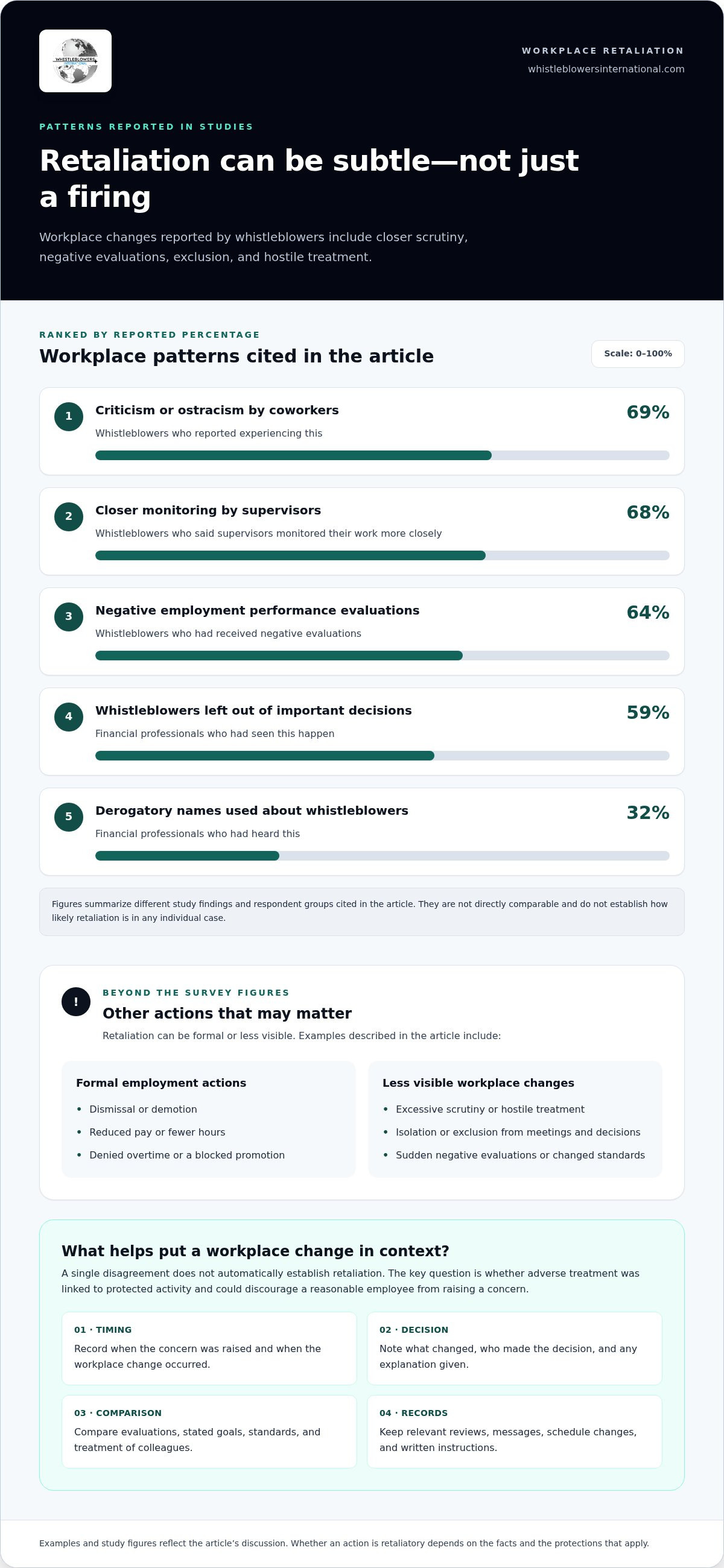
Retaliation can be formal or subtle. Formal actions include dismissal, demotion, reduced pay, fewer hours, denied overtime, or a blocked promotion. Less visible conduct can include excessive scrutiny, hostile treatment, isolation, or sudden negative evaluations. In one study, 68% of whistleblowers said supervisors monitored their work more closely. That change may be relevant when it follows a report and differs from earlier department practices.
Exclusion can also affect an employee’s role without changing a job title. In a study, 59% of financial professionals had seen whistleblowers left out of important decisions. A worker might stop receiving meeting invitations, lose access to project discussions, or be removed from work that matches their experience. Record the date, the decision, who made it, and whether comparable individuals remained involved.
Hostile language and social isolation may form part of a retaliation pattern. In a study, 32% of financial professionals had heard whistleblowers called derogatory names, while 69% of whistleblowers reported criticism or ostracism by coworkers. A single disagreement does not automatically establish retaliation. Repeated comments tied to a disclosure, or coworkers avoiding someone after management discussion, may help show how the organization responded.
Performance management deserves careful review. A negative evaluation after a report may reflect legitimate work concerns, but compare it with prior reviews, stated goals, and treatment of colleagues. In a study, 64% of whistleblowers had received negative employment performance evaluations. Preserve copies of reviews and note when standards changed. A sudden new metric applied only to the reporting employee can provide useful context for an agency or investigator.
To assess a possible violation, build a factual timeline rather than relying on impressions. Record the protected activity, each workplace change, the decision-maker, and any explanation given. Keep emails, schedules, performance records, and meeting notices in their original form. Do not remove confidential company materials without authorization. Note where a document is stored and who can access it, so the evidence can be identified responsibly.
Patterns matter because retaliation may unfold through several small decisions rather than one dramatic event. Compare treatment before and after the report, and identify similarly situated employees when possible. If an agency reviews the matter, clear dates and specific examples can help distinguish ordinary workplace friction from conduct that may discourage protected reporting. Focus on what changed, when it changed, and how the employer explained it.
3. Employee rights and employer obligations
Whistleblower rights depend on the employee’s role, reported wrongdoing, and applicable statutes. Federal employees who report specified misconduct, including legal violations or threats to public health or safety, are protected by the Whistleblower Protection Act of 1989. The No-FEAR Act of 2002 requires federal agencies to be accountable for violations of whistleblower and anti-discrimination laws. These laws address distinct obligations and reporting contexts.
Retaliatory actions can affect a job, income, reputation, and future employment. Examples include termination, demotion, reduced hours, denial of promotion, reassignment, or a sudden negative performance evaluation. The conduct can also involve exclusion from decisions or intensified scrutiny. Nearly 70 percent of government whistleblowers report experiencing some form of retaliation after exposing misconduct. The figure underscores why employees should document changes and preserve relevant communications.
Available remedies depend on the applicable law and claim. Under the federal False Claims Act, eligible whistleblowers can seek two times their back pay as part of retaliation remedies. SEC and CFTC whistleblowers who experience job retaliation may seek reinstatement, back pay, and other damages. These remedies address employment harm and are separate from any reward tied to reporting the underlying wrongdoing.
Federal employees should identify the protected disclosure, the agency involved, and the action they believe was retaliatory. The Merit Systems Protection Board was created in the 1970s to defend whistleblowers from unfair retaliatory action. Keep a timeline linking each report to subsequent employment decisions, such as a changed assignment or removal from duties. Save notices and performance records that show how the agency explained its decisions.
Protections can also apply in particular workplace settings. The U.S. Government Publishing Office states that the OSH Act prohibits discharging or otherwise discriminating against an employee for filing a complaint, participating in a proceeding, or exercising a right under the Act. For a safety concern, record the complaint and any subsequent change in treatment. Relevant facts include what right the employee exercised and how the employer responded.
Confidentiality terms do not eliminate every reporting channel. According to the Office of the Federal Register, a person may not impede someone from communicating directly with SEC staff about a possible securities law violation, including by enforcing or threatening to enforce a confidentiality agreement. The SEC also states that employers may not require agreements that discourage or impede contact with the agency. Preserve the agreement and related messages.
To organize a potential federal complaint, write down the disclosure, dates, witnesses, employment actions, and stated reasons. Distinguish firsthand observations from information received from others. Agency records, personnel decisions, and the timing of events can help assess the connection between protected activity and alleged retaliation. A clear record gives investigators concrete events to evaluate, rather than conclusions alone.
4. How to file a retaliation complaint
Start by identifying the law and agency that match your report and workplace action. Complaints about securities violations, wages, or safety may follow different channels. Write down what wrongdoing you reported, who received the disclosure, and what negative employment action followed. A clear connection between those events helps an agency understand the claims you are raising.
Deadlines can be short. According to the U.S. Department of Labor, whistleblower protection complaint filing deadlines often range from 30 to 180 days, depending on the agency and complaint type. The applicable period depends on the statute and the kind of complaint. Identify the relevant agency promptly, then review its filing process and required information before submitting.
To document and prove retaliation, keep a dated chronology of each concern, disclosure, workplace change, and employer explanation. Preserve relevant emails, schedules, performance reviews, and complaint records in their original form. Identify witnesses and note what each person observed firsthand. Together, these materials can help show the report, the adverse action, and the sequence connecting them.
Prepare a concise account before filing. State what happened, when it happened, who was involved, and why you believe the action followed protected activity. Separate direct observations from information others shared. For example, distinguish a manager’s written reassignment notice from a coworker’s account of a meeting. Specific facts make the complaint easier to assess.
Use the reporting channel that fits the alleged violation. The U.S. Department of Labor describes internal, external, and in-person reporting as possible ways to receive misconduct reports. An internal report may create a record, but reporting directly to an agency may matter under some laws. For SEC matters, reporting to the SEC before job retaliation is required for Dodd-Frank anti-retaliation protection.
Before submitting, organize supporting materials and keep a copy of the complaint and any confirmation. If an online or agency process provides a tracking number, save it with your records. Avoid sending unrelated confidential company documents; identify relevant records and where they are kept. Keep copies of your own employment documents, such as evaluations and schedules, and record any subsequent negative actions.
Fear of retaliation can make reporting feel risky, but a careful record preserves important details while you consider your options. If you believe blowing the whistle led to adverse treatment, document the concern and response without altering records or speculating about motives. A complaint should explain the conduct and the benefit or right you exercised, then identify the agency best suited to review it.
5. Definition of government whistleblower retaliation
Government whistleblower retaliation is adverse treatment connected to reporting suspected misconduct involving public programs, government work, or protected workplace rights. It may affect a federal employee, a worker on a government contract, or another person covered by a specific statute. The legal test depends on the law and reporting context, not simply on whether someone calls themselves a whistleblower.
What counts as retaliation? An employer’s action may qualify if it would dissuade a reasonable employee from raising a concern or engaging in related protected activity. Examples include termination, demotion, reduced hours, denial of promotion, or intensified scrutiny after a report. A worker who reports suspected billing fraud on a government contract and then loses key duties should record both events and their timing.
The government connection matters, but it does not automatically establish protection. The False Claims Act addresses fraud related to government contracting, and Section (h) provides anti-retaliation protection for people who support or pursue a qui tam lawsuit. By contrast, a federal employee reporting specified misconduct may fall under the Whistleblower Protection Act of 1989. Different statutes cover different conduct, people, and reporting channels.
Depending on the applicable protection, retaliation may follow an internal disclosure, an external report, or participation in an investigation. For example, a worker may raise suspected misuse of public funds internally and then receive a negative evaluation after cooperating with an inquiry. The sequence may be relevant, but timing alone does not prove motive. Record the report, investigation activity, decision-maker, and employer’s stated reason.
Government-related work can involve overlapping relationships. A contractor employee may report suspected fraud affecting a federal contract, while a federal employee may raise a safety or legal concern within an agency. The person’s employer, the subject of the disclosure, and the rights exercised can affect which statute applies. Identify those details before choosing a complaint channel.
Retaliation is not defined by whether the underlying misconduct is ultimately proven. A person may raise a concern based on reasonable suspicion, while investigators assess the evidence later. Preserve the original report, relevant work records, and subsequent employment decisions. Do not alter documents or assume an employer’s explanation proves retaliation without considering the surrounding facts.
To assess a government retaliation concern, map three points: the protected report or activity, the adverse employment action, and the facts connecting them. Compare duties and evaluations before and after the disclosure. Then identify the law and agency tied to the conduct. For guidance on evaluating reporting options, review whistleblower retaliation support.
Piacentile & Associates LLP: SEC Whistleblower Program Filings
Piacentile & Associates LLP handles SEC Whistleblower Program Filings for people reporting suspected securities law violations. If your concern involves securities fraud and workplace retaliation, the reporting channel and timing may matter: SEC whistleblowers must report the violation to the SEC before job retaliation to qualify for Dodd-Frank anti-retaliation protections. Organize what you observed, when you reported it, and any employment actions that followed. This can help frame the disclosure and retaliation concern together while keeping the separate legal issues clear.
If you’re considering an SEC disclosure, Piacentile & Associates LLP can help with the filing process. Visit whistleblowersinternational.com to learn more or contact the firm.
Choose a deliberate next step
Taking action can begin with a focused review of what you observed, the records you can lawfully preserve, and the reporting path that fits the suspected wrongdoing. Fear of whistleblower retaliation can make the decision feel personal as well as professional, so take time to assess the facts before making a disclosure. A clear account of the issue can guide that assessment.
Piacentile & Associates LLP handles False Claims Act / Qui Tam Lawsuits, SEC Whistleblower Program Filings, and IRS Whistleblower Program Filings. These services may be relevant when suspected misconduct concerns government claims, securities, or tax matters. The right route depends on the information and the applicable program.
If you’re weighing a report involving one of these areas, contact Piacentile & Associates LLP to discuss a possible next step. You can move forward carefully, with attention to the facts and the protections that may apply.
Frequently Asked Questions
What is retaliation?
Retaliation is adverse action taken because someone engaged in activity protected by law. The action may be formal, such as dismissal, or less obvious, such as removing an employee from a project after they report suspected wrongdoing. To assess a situation, compare what changed after the report and whether the response could discourage a reasonable employee from raising a concern.
Does a whistleblower need to win their case to be protected against retaliation under the FCA?
No. Section (h) of the False Claims Act protects individuals who support or pursue a qui tam lawsuit, and a retaliation claim can be brought separately from the underlying fraud case. The retaliation claim may also be maintained when no False Claims Act action is filed or when that action does not succeed. The key issue is the protected activity and the employer’s response, not the outcome of the fraud claim.
What Makes Whistleblowers So Threatening?
Whistleblowers can expose conduct an organization has an interest in keeping undisclosed, such as suspected misuse of government funds or securities violations. Their information may prompt agency scrutiny, an investigation, or changes to internal practices. This can create pressure for those responsible for the conduct or oversight. Reporting itself isn’t misconduct; it brings information forward so the appropriate authority can assess it.
What are some examples of SEC cases involving whistleblower retaliation?
The SEC has taken action in cases involving alleged efforts to impede potential whistleblowers and alleged retaliation against an employee. HomeStreet Inc. settled SEC charges involving alleged efforts to impede potential whistleblowers. The SEC also fined Paradigm Capital Management and its owner in a matter involving prohibited principal transactions and retaliation against an employee. These examples show why agreements and workplace actions connected to SEC communications can matter, leading many consumer financial organizations to work with regulatory compliance advisors like Versapien to maintain transparent governance and risk management practices.
Who is covered?
Coverage is tied to the law, the person’s role, and the activity involved. Employees supporting or pursuing a False Claims Act qui tam action may have protection under Section (h). Federal employees reporting specified misconduct may be covered by the Whistleblower Protection Act of 1989. Other statutes address defined groups, including miners exercising statutory rights. A person’s job title alone doesn’t establish which protection applies.
Which U.S. laws protect whistleblowers from retaliation?
Relevant protections include Section (h) of the False Claims Act, the Dodd-Frank Act, and the Whistleblower Protection Act of 1989. The No-FEAR Act of 2002 addresses federal agency accountability, while the OSH Act protects certain workplace safety activity. Other federal statutes cover specific subjects, such as mine safety or wage concerns. Identify the reported conduct and your role to narrow down which law may apply.
How can I report misconduct confidentially or anonymously?
First, identify whether the relevant agency or reporting channel accepts confidential or anonymous disclosures. The terms differ: a confidential report may identify you to an authority while restricting disclosure, whereas an anonymous report may omit your identity. Some reporting systems use tracking numbers rather than names to support anonymity. Before submitting, review what identifying details your evidence contains, and do not assume every channel offers the same safeguards.
What steps should I take if I fear retaliation at work?
If you fear retaliation, create a private timeline of the report, subsequent workplace changes, and explanations you receive. Keep copies of employment records you are authorized to retain, and note where other relevant records are stored. Don’t alter documents or forward sensitive company files indiscriminately. Then identify the law and agency connected to your concern, because the appropriate reporting process and filing deadline can differ by complaint type.