
What happens after filing a whistleblower claim, and who sees the information you’ve provided? Filing may feel like the decisive moment, but it usually begins a careful review rather than an immediate decision. The process that follows depends on the federal program involved, and updates may be limited while an agency assesses the information.
It’s understandable to worry about whether your employer will learn of the filing, whether your identity will remain protected, and whether you’ll be asked to provide more evidence. Confidentiality and disclosure rules vary, so filing shouldn’t be treated as a guarantee of anonymity. What follows can include requests for documents or interviews, further investigation, and a government decision about enforcement or next steps. These cases are very complex and take a very long time to resolve.
This guide explains the likely stages after filing, the kinds of communication or cooperation an agency may request, and how investigations and award decisions can differ across programs. You’ll also learn why realistic expectations and careful protection of your rights and privacy matter as a case progresses. Past results do not guarantee future outcomes.
Key Takeaways
- “Claim” may refer to a court-filed qui tam action or a submission to a federal agency, and the applicable program shapes what happens next.
- Learn how investigators may assess allegations, records, witnesses, and other evidence as they evaluate a filing.
- Understand the possible paths after review, including government action or a decision not to proceed.
- Find out what happens after filing a whistleblower claim, including why follow-up may be limited and case progress may not be visible for long periods.
- See how legal representation can help you respond to requests and protect your rights and privacy without promising anonymity or a particular outcome.
What happens first after filing a whistleblower claim?
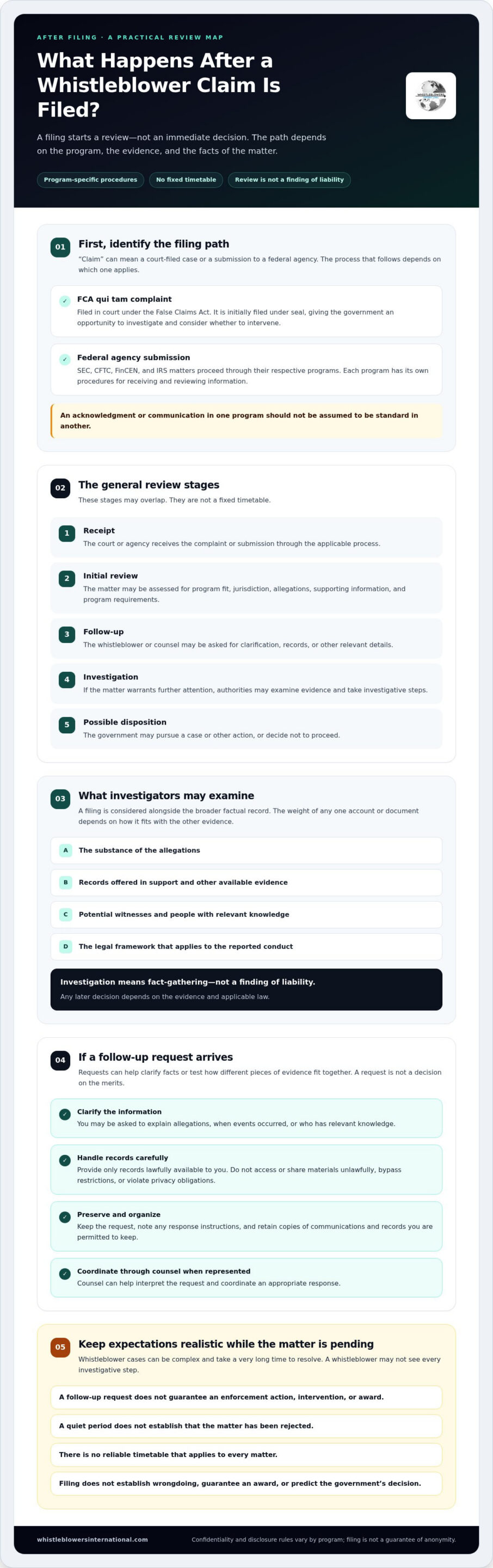
The first step depends on what “claim” means in your case. It may be a qui tam complaint filed in court under the False Claims Act (FCA), or information submitted to a federal agency through a whistleblower program. The receiving court or agency, and the procedures it follows, depend on the applicable U.S. program. That distinction is central to understanding what happens after filing a whistleblower claim.
In either path, filing starts a review; it doesn’t establish that wrongdoing occurred, guarantee an award, or predict the government’s decision. Review may involve assessing whether the matter falls within the program’s jurisdiction, what the allegations describe, whether supporting records are available, and whether program requirements appear to be met. The process can be lengthy: whistleblower cases are very complex and take a very long time to resolve.
Does every whistleblower claim follow the same first steps?
No. An FCA qui tam complaint is filed in court, while SEC, CFTC, FinCEN, and IRS matters proceed through their respective federal agency programs. Each has program-specific procedures for receiving and reviewing information. An acknowledgment or other communication in one program shouldn’t be treated as a standard step in another. For broader context about whistleblowing and its forms, see Whistleblower.
Although the details differ, a filing may move through these general stages. They aren’t a fixed timetable, and some may overlap:
- Receipt: The court or agency receives the complaint or submission through the applicable process.
- Initial review: The matter is assessed for program fit, jurisdiction, allegations, and available supporting information.
- Follow-up: The whistleblower or counsel may be asked for clarification, records, or other relevant details.
- Investigation: If the matter warrants further attention, authorities may examine evidence and pursue investigative steps.
- Possible disposition: The government may pursue a case or other action, or decide not to proceed.
What may happen after a False Claims Act qui tam filing?
An FCA qui tam complaint is initially filed under seal, meaning it isn’t immediately available to the public in the ordinary way. While the seal remains in effect, the government has an opportunity to investigate the allegations and consider whether to intervene in the case. The seal and investigation are part of this particular court process, not a template for every agency submission. A False Claims Act guide can explain the broader legal framework, while the next steps in an individual matter depend on its facts and procedural posture.
For agency filings, the agency’s review and communications follow that program’s procedures instead. In any pathway, keep relevant records organized and route official requests through counsel when represented. A request for information is part of review, not proof that a claim has been accepted or that an award will follow.
How do investigators assess a whistleblower filing?
Investigators assess the substance of the allegations, the records offered in support, potential witnesses, and the legal framework that applies to the reported conduct. They may consider the filing alongside other evidence already available or investigative work conducted separately. The weight of any one document or account depends on how it fits with the broader factual record.
A request for more information is not a decision on the merits. Investigators may ask questions because a detail needs clarification or because they’re testing how different pieces of evidence fit together. A follow-up request doesn’t guarantee that the government will bring an enforcement action, intervene in a lawsuit, or issue an award. Nor does a quiet period establish that the matter has been rejected.
A government investigation is a fact-gathering process, not a finding of liability. Investigators examine information; any later decision depends on the evidence and applicable law.
What information might the government seek?
Depending on the program and case, a whistleblower may be asked to clarify the allegations, explain when events occurred, identify people with relevant knowledge, or provide records already lawfully available to them. A clear chronology can help explain how the information fits together, but the appropriate response depends on the request, the facts, program rules, and whether counsel represents the whistleblower.
If a request arrives, preserve it and note any stated response instructions. Don’t access or share materials unlawfully, bypass restrictions, or violate privacy obligations in an effort to assist an inquiry. When represented, discuss how to respond with counsel, who can help interpret the request and coordinate an appropriate response. Keep copies of communications and records you’re permitted to retain.
Why can an investigation take a long time?
Allegations can involve multiple events, people, or records. Investigators may need to corroborate accounts, review documents, interview witnesses, and coordinate investigative work before they can assess what the evidence supports. Those steps can proceed at different paces, and a whistleblower may not see each one taking place. There isn’t a reliable timetable that applies to every matter.
Piacentile & Associates LLP describes whistleblower matters as very complex and very lengthy. Patience matters, but so does understanding what a request means and how to respond without compromising rights or privacy. For context, the U.S. Department of Labor’s Whistleblower Protection Program addresses workplace retaliation investigations, a distinct process from fraud-program claims. If you’re weighing how counsel can help with a federal filing, learn about whistleblower filing representation and the role it may play as a matter develops.
What decisions can follow a whistleblower investigation?
An investigation can lead to different outcomes, and the available paths depend on whether the filing is a False Claims Act (FCA) qui tam action or a submission to an agency program. The government may pursue a case, take another enforcement or administrative action, or decide not to proceed. The decision reflects the government’s assessment of the matter; it isn’t, by itself, a complete account of what the whistleblower alleged or why the government chose that path.
Filing a claim alone does not guarantee government action or a whistleblower award. An award is conditional on the requirements of the applicable program and a qualifying monetary recovery. For example, the SEC Whistleblower Program has its own rules for award consideration, separate from the FCA’s court-based process.
What does government intervention mean in a qui tam case?
Intervention means the government chooses to take the lead in pursuing the FCA action. If it declines, the relator may have the option to continue the case under applicable law, but that possibility isn’t automatic and depends on the procedural posture and legal requirements. The distinction matters because intervention changes who leads the litigation, not whether the allegations have been proven. Understanding qui tam lawsuit basics can help clarify those roles.
What if the government does not intervene or an agency takes no public action?
Non-intervention and limited public updates don’t, by themselves, establish why the government acted as it did. An agency may also conduct work that isn’t publicly visible. The next steps depend on the program, the case’s procedural posture, and case-specific legal advice. Don’t assume every declined matter can proceed, or that silence means rejection. Ask counsel to explain what the decision means for your filing and any available procedural options.
These decisions may also be distinct from an award determination. A whistleblower generally must satisfy the relevant program’s requirements, and an award depends on a qualifying recovery and the program’s rules. Because these matters are very complex and take a very long time to resolve, an investigative decision may not provide immediate clarity about an individual whistleblower’s award eligibility. Past results do not guarantee future outcomes.
What should whistleblowers expect while a claim is pending?
A pending claim may involve long stretches with no visible activity. Agencies may limit updates to protect an investigation, and court proceedings may not be public at every stage. You may receive follow-up questions or requests for information, but the timing and frequency of communication depend on the program and your case. Silence alone doesn’t tell you whether the government is advancing, assessing, or setting aside the matter.
For many whistleblowers, uncertainty extends beyond case progress. They may be concerned about who can identify them, whether an employer could learn of the report, or how to respond if workplace treatment changes. The answer depends on the governing law and the facts. Confidential handling is not the same as permanent anonymity, and no single protection applies universally across federal programs.
Will the employer or subject of the report learn who filed?
Disclosure can depend on the program, court filings, and later procedural developments. An FCA qui tam case begins under seal, but that does not promise that the whistleblower’s identity will remain secret at every later stage. Agency submissions also follow program-specific rules. Before sharing information or discussing a filing, understand how identity may be handled in your particular matter with case-specific legal guidance.
While a claim is pending, use care with communications and records. Keep a private, accurate log of relevant events and communications you’re lawfully entitled to retain, such as dates of official requests and your responses. Avoid discussing sensitive case details with people who don’t need to know, and don’t remove or disclose employer materials in violation of law, workplace rules, or privacy obligations. If counsel represents you, coordinate responses through counsel.
What if the whistleblower experiences retaliation?
Retaliation can broadly mean adverse treatment connected to protected reporting, where the applicable law provides that protection. The covered conduct, available remedies, and complaint procedures vary by statute and circumstances. If workplace treatment changes after reporting, record what happened, when it occurred, who was involved, and any related communications you’re lawfully able to preserve. Promptly seek legal advice about the relevant protections and options; don’t assume one deadline or process applies to every claim.
Practical steps can help you stay organized without compromising your position:
- Save official correspondence and make a dated note of calls or meetings about the matter.
- Keep personal records secure and separate from employer systems where appropriate.
- Ask counsel how to handle new agency requests, workplace developments, or questions about identity.
Understanding what happens after filing a whistleblower claim includes recognizing that privacy and rights require ongoing attention, not a one-time filing decision. Piacentile & Associates LLP represents individual whistleblowers in federal legal actions and agency filings, with a focus on protecting client rights and privacy. Discuss your whistleblower claim with counsel to understand the issues that may arise while it remains pending.
How can legal representation help after filing a whistleblower claim?
Filing begins a process in which requests, investigative steps, and procedural decisions may require careful interpretation. Counsel can help you understand what an agency or court communication asks for, prepare an appropriate response, communicate with authorities, and assess what a development means for your case. This guidance is especially important when a response could affect your rights, privacy, or options under a particular federal program.
Legal representation also supports ongoing case development. An attorney can review how the allegations, records, and relevant legal framework fit together, then help identify issues that may need clarification or further investigation. No attorney can promise secrecy, government action, an award, or a particular result. Whistleblower matters are very complex and take a very long time to resolve, so counsel’s role includes helping you understand the process as it unfolds.
What support can an attorney provide as a case develops?
Support may include explaining procedural developments, organizing relevant information, evaluating follow-up questions, and coordinating communications with authorities. A legal team may also use research and investigative techniques to develop a case and assess how available evidence relates to the allegations. The precise work depends on the filing, applicable program, and stage of the matter.
Piacentile & Associates LLP, also known as Whistleblowers International, represents individual whistleblowers in U.S. federal legal actions and agency filings, including matters involving the SEC, CFTC, FinCEN, and IRS. Its legal team includes an experienced former whistleblower. That experience informs the team’s perspective, but it doesn’t promise a particular advantage or outcome. If you’re reviewing how fees work, understand the terms of whistleblower lawyer contingency fees before proceeding.
What is a practical next step after filing?
Start by identifying the program involved and keeping relevant communications organized. Retain lawful personal records of filings, agency or court correspondence, and requests you receive. Don’t access, remove, or share materials unlawfully or contrary to privacy obligations. If a new request or workplace development arises, discuss it with counsel before deciding how to respond. The appropriate course depends on the facts and applicable rules.
The firm works on a contingency fee basis and is paid only if it wins a monetary award. This doesn’t mean an award is guaranteed, or that every filing will result in one; eligibility and outcomes depend on the applicable program and case.
If you’re weighing what happens after filing a whistleblower claim, a discussion with counsel can help clarify the next procedural steps and the issues that may affect your rights and privacy. Discuss your whistleblower matter with our legal team.
Move Forward With a Clearer Case Strategy
Understanding what happens after filing a whistleblower claim is only part of preparing for what comes next. Consider what questions remain specific to your situation: how to respond to a new request, what procedural developments may mean, and how to safeguard your rights and privacy as the matter progresses. Getting clear guidance can help you make informed decisions rather than interpret each development alone.
Piacentile & Associates LLP, also known as Whistleblowers International, represents individuals in U.S. federal whistleblower actions and agency filings. Its legal team includes an experienced former whistleblower, and the firm emphasizes protecting each client’s rights and privacy. That support is focused on your circumstances, not a promise of secrecy, government action, or a particular result.
If you’re ready to discuss the questions and developments that matter in your case, discuss your whistleblower matter with our legal team. A thoughtful next step can help you approach the process with greater clarity and confidence.
Frequently Asked Questions
How long does it take for a whistleblower claim to be investigated?
There’s no single investigation timeline; it depends on the program, evidence, and complexity of the allegations. Whistleblower matters are very complex and take a very long time to resolve. For example, records spanning multiple transactions or involving several witnesses may require substantial review. A period without an update doesn’t reliably show whether investigators are active or what decision they may reach, so avoid treating elapsed time as a prediction.
Can I remain anonymous after filing a whistleblower claim?
Sometimes a program may allow information to be submitted anonymously through an attorney, but anonymity isn’t guaranteed throughout every stage. The rules depend on the program and how the matter proceeds. For example, a court filing, an agency process, or later litigation may affect whether identity is disclosed. Before filing or responding to a request, discuss with counsel what identity protections may apply and what limits could arise in your specific matter.
What happens if the government declines to intervene in a False Claims Act case?
If the government declines intervention, it hasn’t taken the lead in pursuing the qui tam case. The relator may be able to continue under the False Claims Act, subject to applicable law and court procedures, but that option isn’t automatic. The decision doesn’t by itself mean the allegations were found false. Get case-specific legal guidance before deciding what to do next, since deadlines and procedural requirements can affect available options.
Will I receive updates after submitting a whistleblower tip?
Possibly, but the amount and timing of communication vary by agency and program. An agency may contact you or your attorney with a clarification request, while other periods may pass without a visible update. Keep your contact information current through the appropriate channel and retain copies of any communications you receive. If you’re represented, coordinate responses with counsel rather than assuming that a lack of updates signals a decision.
Can I receive a whistleblower award just for filing a claim?
No. Filing alone doesn’t establish eligibility for an award or guarantee payment. Award consideration depends on the specific program’s requirements and, generally, a qualifying monetary recovery connected to the information. A tip may prompt review without producing an enforcement action or collected proceeds. Keep records of your submission and any related communications, and ask counsel to explain the award process and documentation requirements for the program involved.
What should I do if I face retaliation after filing a whistleblower claim?
Document what happened and promptly seek legal advice about protections that may apply. Record dates, people involved, and relevant communications, and preserve only materials you’re lawfully entitled to keep. Retaliation protections and complaint routes differ according to the governing law and circumstances, so don’t assume one process or deadline covers every situation. If an adverse workplace change occurs, discuss its timing and connection to your reporting with counsel.
Does filing a whistleblower claim mean the government has confirmed fraud?
No. A filing presents allegations and information for review; it isn’t a government finding that fraud occurred. Authorities may assess the evidence, seek additional information, or decide whether action is appropriate. Even an investigation is a fact-gathering process, not a final determination of liability. Keep statements about the matter accurate and avoid presenting an allegation as proven unless an official finding or court judgment supports that description.