

What if the recovery figure in a headline isn’t the amount used to estimate your potential award? A whistleblower award percentage calculator can offer a starting point, but the result depends on more than the value of alleged fraud. In many programs, the relevant base is money the government actually collects, and the rules differ by program.
It’s reasonable to want a clear answer about which percentage might apply and how much you could receive. This guide explains how estimates are built, which program rules may matter, and why a calculator can’t determine eligibility or predict an award. You’ll learn how collections, your contribution, and other program-specific factors may affect the calculation.
We’ll compare key distinctions across federal whistleblower programs and identify information that can make an estimate more realistic. Because a calculator can’t assess the evidence or circumstances behind your report, treat its result as an illustration, not a promise. A confidential discussion with qualified counsel can help you consider program fit, supporting information, and the assumptions behind an estimate.
Key Takeaways
- Use a whistleblower award percentage calculator as an educational estimate, not as a decision about eligibility or a promise of payment.
- Start by identifying the potentially applicable program, then estimate what the government may collect rather than relying on the total alleged fraud.
- Compare program rules carefully: award percentages, calculation bases, and important caveats differ across the False Claims Act, SEC, CFTC, and IRS programs.
- Before estimating, organize what you personally observed, when it happened, and what records may support your account. Avoid sharing confidential material publicly.
- Qualified counsel can assess program fit, evidence, and the assumptions behind an estimate, but can’t guarantee an award, government action, or collection.
What a Whistleblower Award Percentage Calculator Can, and Cannot, Estimate
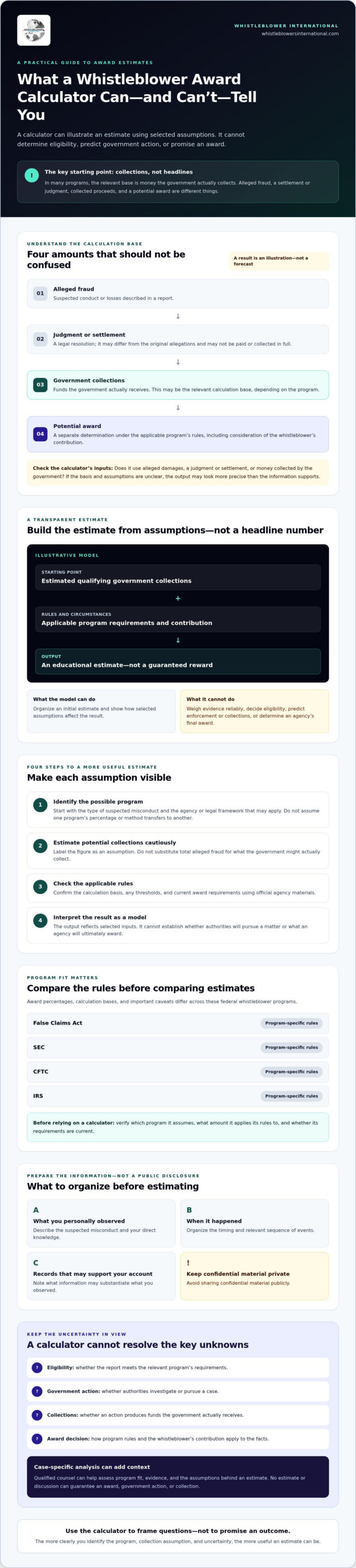
A whistleblower award percentage calculator is an educational tool that applies assumed program rules to estimated qualifying government collections to illustrate a possible award range. It can help organize an initial estimate, but it can’t determine eligibility, predict enforcement action, or promise payment. The applicable program and the facts behind a report matter. Percentages and calculation bases aren’t interchangeable across programs.
The distinction matters: alleged fraud describes suspected conduct or losses, while a judgment or settlement reflects a legal resolution. Collected proceeds are funds the government actually receives, and a potential award is a separate determination under the relevant program’s rules. An overview of Whistleblower protection in the United States can provide broader context, but it shouldn’t replace checking current program requirements.
What does an award percentage apply to?
An estimate usually needs to be tied to qualifying collections, not simply the largest alleged-loss figure or a headline settlement amount. A settlement may not have been paid or collected in full, and the amount resolved may differ from the original allegations. The result therefore depends on the amount the calculator treats as collected, the program it assumes applies, and whether it accounts for that program’s rules.
Before relying on a result, check its inputs. Does it use alleged damages, a judgment or settlement figure, or money collected by the government? Does it identify the specific program and explain its assumptions? If those details aren’t clear, the number may look more precise than the information supports. It isn’t a forecast that authorities will investigate or pursue a case.
Why is a calculator result not a guaranteed reward?
Potential eligibility is only one part of the process. A report may not lead to an enforcement action, and even a successful action may not produce collected funds. If funds are collected, the award decision can still depend on program-specific requirements and an assessment of the whistleblower’s contribution. Evidence, cooperation, and procedural facts may also matter. A general calculator can’t reliably weigh them.
Use the whistleblower award percentage calculator as a starting point for questions, not as a personal award forecast. For example, a result based on the full value of alleged losses may overstate the possible calculation if the government collects less or program rules use a different basis. Individual outcomes require case-specific legal analysis of the facts, evidence, applicable program, and collection assumptions. No estimate can guarantee an award, government action, or recovery.
How to Calculate a Potential Whistleblower Award Step by Step
A useful estimate starts with transparent assumptions, not a single percentage applied to the largest number in a report. Follow these steps to understand what a calculator is assuming and where the result remains uncertain.
- Identify the possible program. Start with the type of suspected misconduct and the agency or legal framework that may apply. Don’t assume one program’s percentage or calculation method transfers to another.
- Estimate potential collections. Use a cautious working assumption about what the government might actually collect if an action succeeds. Label it as an estimate, not a known recovery, and don’t substitute total alleged fraud for likely collections.
- Check the applicable rules. Confirm the calculation basis, any thresholds, and the current award range using official agency materials. For example, the SEC Office of the Whistleblower describes the SEC program. Verify its current requirements before relying on a calculator’s inputs.
- Interpret the result cautiously. Treat the output as a model built from selected assumptions. It can’t determine whether authorities will pursue a matter or what an agency will ultimately award.
Which inputs should a calculator ask for?
At a minimum, identify the potential program and describe the suspected misconduct before entering figures. Use a collection estimate only as a clearly labeled assumption, separate from alleged losses, a proposed settlement, or a judgment. Evidence and contribution may matter, but avoid assigning yourself a score for “strength” or “originality” unless the tool explains a valid, program-specific method. An unsupported scoring system can create false precision.
Keep the figures distinct: the amount alleged, any amount resolved, and the amount actually collected aren’t necessarily the same. If you don’t know what may be collected, record that uncertainty rather than presenting a guess as fact. Confirm thresholds and calculations against current official sources, since program rules may change.
How should you interpret the result?
A range is useful only when it reflects the specific program’s current rules. A published percentage band isn’t the same as an award determination. Discretionary factors and case-specific assessments may affect where an award falls within a permitted range. For instance, the SEC program’s stated award range is 10% to 30% of monetary sanctions collected, but that range alone doesn’t establish eligibility or predict an individual award.
A calculator models a possible result from assumed inputs; only the relevant agency can determine an award under the applicable program rules. Exclusions, reductions, competing claims, and the amount ultimately collected may alter the outcome where those factors apply under current rules. To discuss program fit and the assumptions behind an estimate, consider speaking confidentially with counsel experienced in whistleblower program filings.
How Whistleblower Award Percentages Differ Across Federal Programs
A percentage is meaningful only when paired with the correct program, calculation base, and procedural rules. A whistleblower award percentage calculator that applies one program’s assumptions to another can produce a misleading comparison. The overview below is a starting point, not a substitute for checking current official guidance and the facts of a particular matter.
| Program | Governing framework | Calculation basis | Key caveat |
|---|---|---|---|
| False Claims Act (FCA) | Federal qui tam provisions | Generally 15% to 30% of the government’s recovery | Share ranges depend in part on whether the government intervenes; other statutory requirements can affect the determination. |
| SEC | SEC Whistleblower Program | 10% to 30% of monetary sanctions collected | A covered action must result in more than $1 million in sanctions; eligibility and award decisions depend on program rules. |
| CFTC | CFTC Whistleblower Program | 10% to 30% of monetary sanctions collected | A successful enforcement action must result in more than $1 million in sanctions; verify current rules and any applicable award provisions. |
| IRS | IRS Whistleblower Program | Generally 15% to 30% of collected proceeds | Thresholds and other requirements apply, and the calculation concerns collected proceeds, not simply alleged tax underpayment. |
How do False Claims Act relator shares work?
Under the FCA, the relator’s share is tied to the government’s recovery. The applicable statutory range depends in part on the case’s posture. If the government intervenes, the general range is 15% to 25%; if it declines and the relator proceeds independently, the general range is 25% to 30%. These aren’t automatic payouts. Statutory requirements and case-specific facts still matter. The share is calculated from the recovery under the applicable rules, not from the total amount initially alleged.
How do SEC, CFTC, and IRS award frameworks differ?
The SEC and CFTC programs concern securities and commodity-related enforcement, respectively. The IRS program concerns tax matters. Although SEC and CFTC awards generally use a 10% to 30% range and require more than $1 million in collected sanctions from a covered action, their procedures remain distinct. The IRS generally calculates awards from collected proceeds and applies its own thresholds. The IRS Whistleblower Awards guidance explains its framework. Confirm current thresholds and definitions with official agency sources before estimating.
For IRS claims, the amount in dispute generally must exceed $2 million, and if the taxpayer is an individual, gross income must be at least $200,000. These conditions differ from SEC and CFTC thresholds. FinCEN is not included here because its current award rules should be confirmed before applying a percentage. In every program, eligibility, evidence, contribution, and filing procedures depend on specific facts. Don’t treat one agency’s formula as a universal calculator setting.
What Information Should You Gather Before Using a Whistleblower Calculator?
A calculator can only work with the information entered, so organize the facts before estimating. You don’t need to upload sensitive evidence or decide whether your claim qualifies. The goal is to create a clear record that separates what is known from what is uncertain and highlights what may need confidential legal review.
Which facts can help clarify a preliminary estimate?
Make a private working note with the following details. Separate what you personally observed from information you heard from others and assumptions you’ve drawn.
- Possible program and conduct: Note the type of suspected misconduct and which agency or program might be relevant, if known.
- Dates and sequence: Record when events occurred, when you learned about them, and whether the conduct appears ongoing.
- Your firsthand knowledge: Describe what you directly saw, did, or were told, and identify who provided information you didn’t witness yourself.
- Potential supporting records: List record types and where they’re held, such as relevant business records, correspondence, or transaction information. Don’t upload sensitive files to an unverified calculator.
- Prior reports and government knowledge: Note whether the matter was previously reported, discussed publicly, or may already be known to an agency. Public disclosure and prior reports can require careful legal analysis.
- Known procedural developments: Record any known government involvement or related enforcement activity, without treating it as confirmation that an award will follow.
Mark estimates as estimates. For example, distinguish an amount you personally observed in records from a total you inferred or heard from someone else. This helps prevent uncertain figures from being treated as established losses or likely collections.
How can you protect sensitive information while assessing a claim?
Don’t remove, alter, copy, or share protected records until you understand the duties that may apply to you. Rules concerning confidentiality and anonymity vary by program and can depend on the procedural stage. Before transmitting company, client, financial, or personal information, seek advice from qualified counsel about how to preserve and discuss it appropriately.
A preliminary worksheet should identify records by category and location, not expose their contents. Keep notes factual, limit access to sensitive materials, and avoid public posts that describe confidential information. If you’re considering representation, review the firm’s published contingency-fee guide for information about that arrangement. Confirm representation terms directly, since a calculator doesn’t determine them.
For a confidential discussion of program fit, evidence, and the assumptions behind an estimate, request a confidential case review. A review can help assess the facts, but it can’t guarantee agency action, collection, or an award.
When a Whistleblower Attorney Can Help Interpret an Award Estimate
A calculator can apply a percentage to an assumed recovery, but it can’t assess whether your facts fit a particular program, how your evidence may be evaluated, or which procedural issues could affect a potential claim. An attorney can review those details and test the assumptions behind a whistleblower award percentage calculator result, including whether it uses the right program and calculation basis.
That review isn’t a prediction of what an agency will do. Legal representation can’t guarantee an award, government action, or collection. It can help identify questions a general calculator can’t resolve and clarify what information needs further verification.
What can case-specific legal review clarify?
A review may help assess whether the reported conduct could fit a federal whistleblower program and whether the evidence supports what you personally know. Counsel can also consider your contribution, prior disclosures, potential public information, known government involvement, and procedural circumstances. These facts may affect how an estimate should be interpreted, but they shouldn’t be reduced to unsupported calculator scores.
Piacentile & Associates LLP represents whistleblowers in federal programs, including False Claims Act, SEC, CFTC, IRS, and FinCEN matters. The firm works on a contingency fee basis, with representation terms explained directly. Don’t assume a fee percentage based on a calculator or general estimate. Its team includes former whistleblowers and uses investigative techniques to evaluate matters, without guaranteeing a particular outcome.
What should you ask before moving forward?
A careful discussion should leave you clearer about the process and its uncertainties. Consider asking:
- How will confidentiality, communications, and sensitive materials be handled?
- Which program may apply, and what facts or requirements still need verification?
- What collection assumptions and program rules were used to produce the preliminary estimate?
- How might evidence, prior disclosures, or procedural posture affect the assessment?
- What are the representation terms, and what remains uncertain about a potential award?
Bring a factual outline and a list of relevant records, but ask before sending sensitive documents. A confidential discussion can help separate known facts from assumptions and clarify whether the estimate uses a defensible framework. To discuss the circumstances and questions behind your estimate, Discuss a potential whistleblower matter. No calculator result can replace a case-specific review, and no review can promise what authorities or a court will ultimately decide.
Turn Your Estimate Into a Clearer Next Step
A whistleblower award percentage calculator can help you explore a possible estimate, but its result depends on program rules and assumptions about funds the government may actually collect. Alleged losses, a settlement or judgment, and collected proceeds aren’t necessarily the same. An estimate also can’t establish eligibility or predict whether an enforcement action or award will follow.
Before drawing conclusions, identify which federal program may fit, check its current requirements, and separate what you know firsthand from what remains uncertain. A case-specific review can examine program fit, evidence, contribution, and calculation assumptions in ways a general tool can’t.
Piacentile & Associates LLP represents whistleblowers across multiple U.S. federal programs on a contingency fee basis, and the firm is paid only if it secures a monetary award. Its team includes former whistleblowers, bringing direct perspective to the review of potential matters. Representation can’t guarantee an award, government action, or collection.
If you’re ready to discuss your circumstances confidentially, request a confidential review of your potential whistleblower matter. A careful conversation can help you understand the questions to consider and choose an informed next step.
Frequently Asked Questions
How accurate is a whistleblower award percentage calculator?
A whistleblower award percentage calculator can illustrate how a percentage might apply to stated assumptions, but it can’t determine eligibility, predict government action, or guarantee payment. Results depend on the program, its current rules, the claimant’s contribution, and whether qualifying funds are collected. Treat the output as preliminary. Before relying on it, confirm legal details against current official sources and seek case-specific legal advice about how the rules may apply.
What amount is a whistleblower award percentage based on?
The calculation base depends on the program. An award may be tied to qualifying proceeds or sanctions collected, rather than the alleged value of misconduct or the headline amount of a judgment. A settlement, for example, may not be collected in full. Program rules can also define the relevant proceeds differently, so confirm the current rules for the potentially applicable program before using a recovery figure in an estimate.
Can I calculate my whistleblower reward before reporting fraud?
Yes, you can explore hypothetical scenarios, but an early estimate is highly uncertain. You may not know which program applies, whether your information qualifies, how authorities will respond, or what they may ultimately collect. Don’t enter sensitive details into a calculator without first reviewing its privacy practices. A qualified whistleblower attorney can assess the facts and help distinguish what’s known from what remains uncertain, without promising an outcome.
How do False Claims Act award percentages change if the government intervenes?
The False Claims Act provides different relator-share ranges depending on the government’s role. Generally, the range is 15% to 25% if the government proceeds with the action, and 25% to 30% if it declines and the relator continues independently. These ranges don’t guarantee a particular award. The applicable rules and case-specific circumstances require review, so a calculator shouldn’t assume intervention status or treat a range as a payment prediction.
Do SEC and CFTC whistleblower awards use the same percentage rules?
No. The SEC and CFTC programs have distinct governing frameworks, eligibility requirements, definitions, and procedures, even though both generally provide awards of 10% to 30% of monetary sanctions collected. Each program also generally requires a successful covered action resulting in more than $1 million in sanctions. Verify current agency guidance before comparing estimates, particularly if it’s unclear whether sanctions meet the applicable threshold or qualify under that program.
Does a whistleblower receive an award if the government does not collect money?
A potential award generally depends on the relevant program’s rules and a qualifying enforcement result or collected proceeds. If authorities take no action, a defendant can’t pay, or funds aren’t collected, a hypothetical percentage may not translate into a payment. The precise effect depends on the program and circumstances. Don’t interpret a calculator’s result as evidence that an award is available or that a recovery will occur.
Should I speak with a whistleblower lawyer before using a calculator?
Legal review can be useful before you share sensitive information, assess program fit, or rely on a projected figure. Counsel can examine evidence, prior disclosures, confidentiality concerns, and assumptions that a calculator can’t evaluate. Piacentile & Associates LLP represents whistleblowers in U.S. federal programs on a contingency fee basis and is paid only if it secures a monetary award. Discuss representation terms directly with the firm. No outcome is guaranteed.