
Can you report fraud affecting U.S. interests, qualify for a reward, and never set foot in the United States? In many cases, yes. U.S. whistleblower programs generally don’t require citizenship or residency, but the reported misconduct must have a connection to the United States. If you’re weighing evidence against possible local legal, contract, or retaliation risks, a whistleblower lawyer for foreign nationals can help you understand your options before you act.
You may also be wondering whether U.S. laws apply to conduct abroad, whether you can report anonymously, and how to afford legal representation. The answers depend on the program and the facts. For example, SEC and CFTC tips may be submitted anonymously through an attorney, but confidentiality isn’t an absolute guarantee in every process.
This 2026 guide explains the main U.S. reward pathways, including SEC, CFTC, IRS, and False Claims Act cases, and how international fraud such as customs evasion may come within their reach. It also explains contingency representation. Piacentile & Associates LLP represents whistleblowers worldwide on a contingency fee basis. The firm’s team includes former whistleblowers and uses investigative techniques to develop claims while handling sensitive information carefully.
Key Takeaways
- Assess whether the reported conduct has a meaningful U.S. connection, even if the events and evidence are based abroad.
- Compare SEC and CFTC reporting pathways to identify which program may fit information about financial or commodities-related misconduct.
- Understand how attorney-assisted anonymous filings work and why confidentiality and retaliation risks require careful planning.
- A whistleblower lawyer for foreign nationals can help assess jurisdiction and organize evidence for a potential claim.
- Explore contingency representation, which provides legal representation without upfront attorney fees and ties the firm’s fee to a monetary award.
Do U.S. Whistleblower Laws Apply to Foreign Nationals?
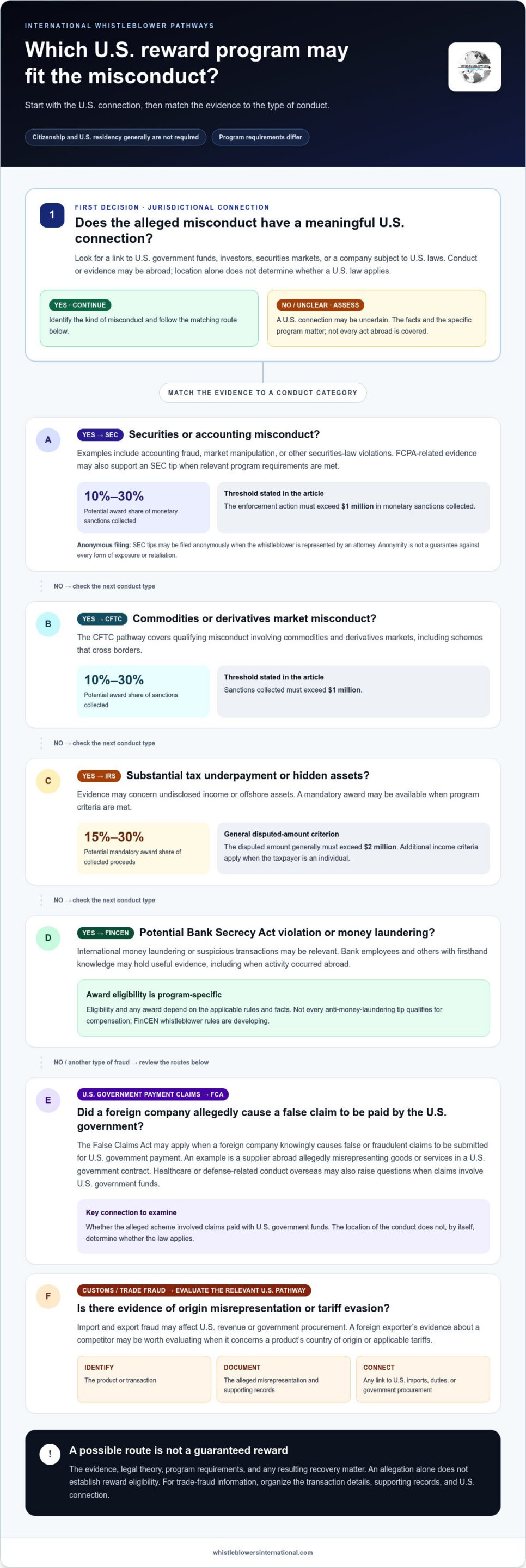
Yes. Foreign nationals can report qualifying misconduct and may be eligible for rewards under U.S. whistleblower programs. Citizenship and U.S. residency generally aren’t requirements. The central issue is whether the alleged fraud has a sufficient connection to the United States, often called a jurisdictional nexus. That connection might involve U.S. government funds, investors, securities markets, or a company subject to U.S. laws. U.S. statutes don’t automatically cover every act committed abroad, so the facts and the specific program matter.
Information from abroad can help U.S. authorities investigate schemes that cross borders, including alleged customs evasion, bribery, or false claims for government payment. A whistleblower lawyer for foreign nationals can assess how the evidence connects the conduct to a U.S. agency, market, or financial interest, then identify a potentially relevant reporting pathway. Piacentile & Associates LLP represents whistleblowers worldwide, and its team includes former whistleblowers familiar with the sensitivity of coming forward.
The Global Reach of the False Claims Act
The False Claims Act (FCA) may apply when a foreign company knowingly causes false or fraudulent claims to be submitted for payment by the U.S. government. For example, a supplier abroad that allegedly misrepresents goods or services in a U.S. government contract may raise an FCA issue. Similar questions can arise from healthcare or defense-related conduct overseas if the alleged scheme involves claims paid with U.S. government funds. The location of the conduct matters, but it doesn’t by itself determine whether the law applies. For more on the statute and reporting process, see the False Claims Act guide for whistleblowers.
The Foreign Corrupt Practices Act (FCPA) and SEC Rewards
The FCPA addresses bribery of foreign officials by certain companies and individuals, and its accounting provisions apply to companies subject to U.S. securities laws. A foreign national with relevant evidence may be able to submit an SEC whistleblower tip. Eligible foreign nationals can qualify for rewards when program requirements are met. SEC tips may be filed anonymously when the whistleblower is represented by an attorney. Anonymity is a reporting mechanism, not a guarantee against every form of exposure or retaliation. The Whistleblower Protection Act provides protections in specific federal-employee contexts; protections for other whistleblowers depend on the applicable statute and circumstances.
Key U.S. Reward Programs for International Whistleblowers
The right reporting channel depends on the misconduct, the evidence, and the U.S. connection. Foreign nationals may be eligible for rewards under several U.S. programs, but each has distinct filing requirements and award criteria. A tip about securities fraud, for example, follows a different process from information about tax underpayment or money laundering. Start by identifying what the conduct involved, what you personally know, and how it may affect U.S. interests.
- SEC: Reports may concern accounting fraud, market manipulation, or other securities-law violations. Eligible whistleblowers may receive 10% to 30% of monetary sanctions collected in an enforcement action exceeding $1 million. The SEC Office of the Whistleblower explains the program and filing process.
- CFTC: This program covers qualifying misconduct involving commodities and derivatives markets, including schemes that cross borders. Eligible awards range from 10% to 30% of sanctions collected when they exceed $1 million.
- IRS: The program may apply to evidence of substantial tax underpayment, including undisclosed income or offshore assets. For a mandatory award of 15% to 30% of collected proceeds, the disputed amount generally must exceed $2 million; additional income criteria apply when the taxpayer is an individual.
- FinCEN: Information about potential Bank Secrecy Act violations and international money laundering may be relevant to FinCEN reporting. Eligibility and any award depend on the applicable rules and the facts, so not every AML tip qualifies for compensation.
Reporting Customs and Trade Fraud
Import and export fraud can affect U.S. revenue and government procurement. A foreign exporter with evidence that a competitor misrepresented a product’s country of origin or evaded applicable tariffs may have information worth evaluating under a relevant U.S. enforcement pathway. To make the information useful, identify the product or transaction, the alleged misrepresentation, the records supporting it, and any connection to U.S. imports, duties, or government procurement. An allegation alone doesn’t establish reward eligibility; the legal theory, evidence, and resulting recovery matter. Review the 2026 trade fraud reward guide for more on reporting these concerns.
Anti-Money Laundering and FinCEN
Bank employees and others with firsthand knowledge of suspicious transactions may hold useful evidence even when the activity occurred abroad. FinCEN whistleblower rules are developing, and reporting requirements and possible awards are program-specific. A whistleblower lawyer for foreign nationals can help evaluate whether the information fits a FinCEN filing or another reporting route, and distinguish documented facts from suspicion. A clear chronology and records showing the transactions or communications at issue can help explain the basis for a tip.
The same conduct can raise issues under more than one program. Careful legal review can help identify the appropriate route without overlooking relevant evidence or filing through a mismatched program. Piacentile & Associates LLP represents whistleblowers worldwide on a contingency fee basis. Learn more about the firm at Piacentile & Associates LLP.
Protecting Foreign Nationals: Anonymity and Retaliation Risks
Confidential reporting can reduce exposure, but anonymity is not the same as absolute secrecy. Under the SEC and CFTC programs, a whistleblower may submit information anonymously if represented by an attorney. Counsel provides the whistleblower’s identity to the agency as required while the tip is submitted without the person’s name appearing in the initial filing. The SEC Whistleblower Program describes the SEC’s process. Program rules and later award procedures matter, so understand when identity may need to be disclosed.
Protection against retaliation is also statute-specific. U.S. law may prohibit certain retaliatory conduct connected to a qualifying report, but the reach of those protections can be complicated when the whistleblower works and lives outside the United States. Local whistleblower rules, employment law, secrecy obligations, and data-protection requirements may apply at the same time. A whistleblower lawyer for foreign nationals can assess these overlapping risks before documents are transmitted or a report is filed.
Managing Local Non-Disclosure Agreements
An NDA does not automatically prevent lawful reporting, but it also isn’t safe to assume a U.S. public-policy rule will override a foreign contract or protect you from local litigation. The result depends on governing law, the agreement, the information, and the reporting channel. Before sharing confidential records, have counsel review the NDA and applicable local requirements. Preserve relevant material lawfully, don’t remove files you aren’t authorized to take, and avoid discussing the matter with colleagues or the subject of the report.
Digital Security for International Evidence
Protect communications without altering or concealing evidence. Use a personal device and account, not employer-issued equipment or workplace networks, to contact counsel. Ask counsel to provide an appropriate secure channel before sending sensitive material. Don’t bypass access controls, copy restricted databases, or delete messages or files to hide activity. Instead, record what you lawfully observed, note dates and sources, and let counsel guide the secure preservation and transfer of evidence.
Local privacy rules may limit how personal, financial, or employee data can be collected, stored, or sent across borders. Encryption can help protect a communication in transit, but it doesn’t make an unlawful collection lawful or eliminate every trace of access. If you’re concerned that a report could expose you to employment action, contract claims, or local proceedings, raise those concerns with counsel before filing. Piacentile & Associates LLP’s team includes former whistleblowers, bringing direct experience to the careful planning these cases demand.
The Legal Process: How a Foreign National Files a Claim
For a foreign national, filing begins with assessing whether the information fits a U.S. program and how the evidence can be shared lawfully. A whistleblower lawyer for foreign nationals can review the alleged conduct, identify a potential U.S. connection, and help organize records before a formal submission. Early legal review can also help distinguish firsthand evidence from assumptions and flag privacy or confidentiality concerns.
Step-by-Step International Filing
A strong whistleblower submission explains what happened, who was involved, when it occurred, and how the information supports the allegation. It should also make clear how the conduct may connect to U.S. interests or a specific program. Relevant records may include contracts, payment documents, correspondence, or transaction data, provided they’re obtained and shared lawfully. A chronology that identifies dates, people, events, and the source of each record can make the evidence easier to assess.
The filing route depends on the program. SEC matters generally involve a whistleblower tip, commonly submitted on Form TCR. A False Claims Act case follows a different procedure: the whistleblower, known as a relator, files a qui tam lawsuit under seal, and the government investigates before deciding whether to intervene. In international FCA matters, the Department of Justice may assess the alleged harm to U.S. funds and seek evidence or cooperation across borders.
There’s no dependable universal timeline for an international claim. Government review, investigation, litigation, and collection can take years, and duration varies with the evidence, complexity, and enforcement decisions. Treat any fixed estimate, including a two-to-five-year range, as uncertain rather than a prediction for your case.
Evidence can often be reviewed and discussed remotely, but transmission should be planned carefully. Don’t access, copy, or send records in violation of local law or company access restrictions. Keep a factual chronology, preserve original files without altering them, and ask counsel to identify a secure method for transferring materials before sending sensitive information. A clear record of where each item came from can help investigators evaluate it.
Maximizing the Whistleblower Award Percentage
Original information that materially assists an investigation can strengthen a submission, particularly when it is specific, credible, and supported by records not already known to authorities. Under the FCA, eligible relators may receive 15% to 30% of the government’s recovery; the applicable share depends in part on whether the government intervenes. Counsel can present the whistleblower’s contribution and evidence, but the government and applicable program rules determine the award. No percentage or recovery is guaranteed.
Read about international whistleblower claims and the firm’s representation.
Whistleblower Representation on a Contingency Fee Basis
For foreign nationals, distance from the U.S. legal system can make the cost of representation feel like another barrier to reporting. A contingency fee arrangement ties the law firm’s fee to a successful recovery, so clients don’t pay attorney fees upfront. Piacentile & Associates LLP represents whistleblowers on this basis and receives a portion of the final government recovery or agency award if it secures a monetary award for the client. The written agreement should explain how the fee is calculated and how case expenses are handled.
The fee is generally set out in the written agreement as a percentage of a recovery, but the percentage and calculation depend on the agreement and applicable program. Review how the fee applies to the whistleblower’s award and whether expenses are treated separately. Don’t assume every cost is covered by the contingency fee. Understanding the terms at the outset helps you assess the financial arrangement without confusing it with the government program’s rules for calculating an award.
No Upfront Costs for Global Clients
A contingency arrangement can make U.S. representation accessible to foreign nationals who can’t fund a complex matter in advance. Because the firm’s fee is tied to securing a monetary award, clients don’t pay attorney fees upfront. The agreement should explain what happens if the claim doesn’t result in an award and how any expenses are addressed. For a fuller explanation, read the 2026 guide to whistleblower lawyer contingency fees.
Why a Former Whistleblower Perspective Matters
Legal strategy is only part of representation. Reporting misconduct can bring uncertainty, pressure, and concern about personal consequences. Piacentile & Associates LLP is led by a former whistleblower, and its team includes former whistleblowers. That perspective informs how the firm approaches client privacy, sensitive evidence, and the demands of a reporting process. The firm represents whistleblowers worldwide on a contingency fee basis.
If you’re considering reporting fraud and want to understand the representation and fee terms that may apply, contact our whistleblower lawyers for a confidential evaluation.
Take the Next Step Toward a Protected Report
Your citizenship doesn’t automatically prevent you from pursuing a U.S. whistleblower claim. The key questions are whether the alleged misconduct has a sufficient U.S. connection, which reward program fits the evidence, and how to report without overlooking confidentiality, retaliation, or local legal risks. SEC and CFTC rules may allow anonymous submissions through an attorney, but protections and procedures differ by program.
A whistleblower lawyer for foreign nationals can evaluate those issues and help you make informed decisions before submitting sensitive information. Piacentile & Associates LLP represents whistleblowers worldwide, with a team that includes former whistleblowers. Its contingency-based representation means no upfront attorney fees, with the firm’s fee tied to the written agreement and a monetary award.
If you have evidence of fraud affecting U.S. interests, take time to understand your options and protect the integrity of your information. Secure your confidential consultation with an international whistleblower lawyer today. Careful guidance can help you move forward with greater clarity.
Frequently Asked Questions
Can I report fraud if I am not a U.S. citizen?
Yes. U.S. citizenship or residency generally isn’t required to report qualifying misconduct or seek a reward through programs such as the SEC, CFTC, IRS, or False Claims Act. The reported conduct must have a sufficient connection to the United States, such as affecting U.S. investors, markets, or government funds. A whistleblower lawyer for foreign nationals can help assess that connection and identify a potentially relevant reporting pathway.
Do I have to travel to the United States to file a whistleblower claim?
Usually, you can begin the reporting process from abroad and work with U.S. counsel remotely. The filing method depends on the program: an SEC matter involves submitting a tip, while a False Claims Act case requires a qui tam lawsuit filed under seal. Investigators may request follow-up information or cooperation. Whether travel is ever needed depends on the case and its procedural demands, so don’t assume every step will be remote.
How much does it cost to hire a U.S. whistleblower lawyer from abroad?
Piacentile & Associates LLP represents whistleblowers on a contingency fee basis, so clients don’t pay attorney fees upfront. The firm receives a portion of the final government recovery or agency award if it secures a monetary award for the client. The specific percentage and treatment of case expenses depend on the written agreement. Review those terms before representation begins so you understand how payment works if there’s no award.
Can I remain anonymous if I report a company to the SEC or IRS?
SEC whistleblowers may submit tips anonymously when represented by an attorney, subject to program requirements. IRS reporting isn’t the same: don’t assume you can file anonymously or that your identity will remain unknown to the IRS. Tax information is subject to confidentiality rules, but confidentiality differs from anonymity. Before sending records, ask counsel to explain how identity is handled under the specific program and at each stage of a potential award claim.
What is the average reward for an international whistleblower?
There’s no single reliable average for international whistleblower awards; outcomes depend on the program, information, enforcement result, and money collected. Under the SEC and CFTC programs, eligible awards generally range from 10% to 30% of collected sanctions in qualifying cases exceeding $1 million. Eligible False Claims Act relators may receive 15% to 30% of the government’s recovery. These are program ranges, not predictions or guarantees of an individual award.
Will the U.S. government protect me from retaliation in my home country?
U.S. statutes may prohibit certain retaliation tied to whistleblowing, but protections can be harder to apply when the person works and lives abroad. The result depends on the program, the facts, and the location and nature of the alleged retaliation. Local employment, contract, or data-protection laws may also matter. Before reporting, discuss the risks with counsel; don’t treat a U.S. filing as a guarantee against consequences in another country.
What kind of evidence do I need to provide for a successful claim?
Useful evidence is specific, credible, and connected to the alleged misconduct and its U.S. impact. Depending on the case, it may include contracts, invoices, payment records, emails, or transaction details, along with a clear chronology of what you observed and when. You don’t need to prove the entire case alone. Preserve original records, document their source, and don’t access or transmit information in violation of local law or access restrictions.
How long does the whistleblower reward process take for foreign nationals?
There’s no fixed timeline, and international claims can take years to resolve. The process may involve initial agency review, investigation, litigation or enforcement action, collection of sanctions, and a separate award determination. Timing depends on the program, complexity of the evidence, cooperation across borders, and government decisions. A filing doesn’t guarantee an investigation, recovery, or award, so avoid relying on a specific estimate as a promise for your case.