
Reporting a multibillion-dollar foreign bribery scheme is often viewed as a career-ending risk, but in the current regulatory environment, it is actually a strategic financial move that can secure your future. If you’ve uncovered evidence of illicit payments to foreign officials, you’re likely grappling with the fear of professional retaliation and the sheer complexity of international law. It’s natural to feel uncertain about which U.S. agency should receive your information or how to protect your identity while seeking justice. Engaging an experienced FCPA whistleblower lawyer allows you to transform this high-stakes risk into a protected, reward-eligible action, ensuring that your integrity is rewarded rather than punished.
This guide provides a comprehensive roadmap for navigating the Foreign Corrupt Practices Act in 2026, detailing how the SEC Whistleblower Program protects your career through total anonymity. You will learn the specific criteria required to qualify for a significant monetary reward (which typically ranges from 10% to 30% of sanctions exceeding $1 million) and how federal intervention can finally stop the corrupt practices you’ve witnessed. We will examine the latest enforcement priorities of the DOJ and SEC, the emerging role of FinCEN in foreign bribery cases, and the methodical steps an elite legal team takes to maximize your recovery while shielding you from the fallout of a global investigation.
Key Takeaways
- Understand the dual enforcement roles of the DOJ and SEC and how the SEC Whistleblower Program serves as the primary mechanism for financial rewards.
- Learn to identify actionable violations that extend beyond cash bribes, including gift-giving, travel, and complex third-party intermediary schemes.
- Discover how a specialized FCPA whistleblower lawyer acts as a critical shield, allowing you to report misconduct anonymously while maximizing your potential award.
- Master the procedural requirements for filing an SEC claim, ensuring your original information meets the rigorous standards for a successful federal enforcement action.
- Explore why a contingency-based legal model and an insider’s perspective are essential for navigating the high-stakes landscape of international anti-corruption law.
The Foreign Corrupt Practices Act (FCPA): A Global Mandate for Corporate Integrity
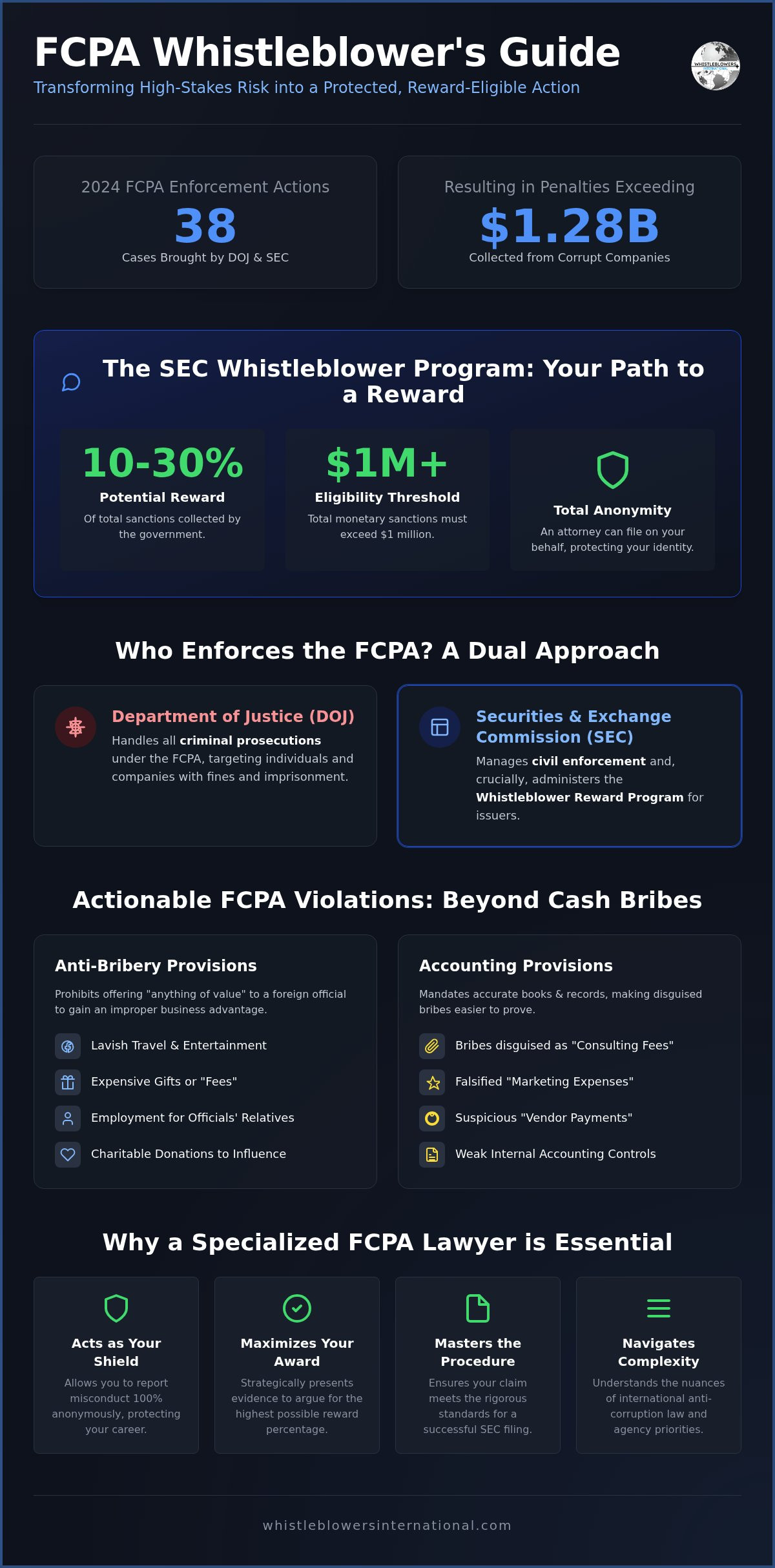
The Foreign Corrupt Practices Act (FCPA) represents the cornerstone of American efforts to combat global corruption. Enacted to ensure that international competition is based on price and quality rather than illicit influence, it imposes strict requirements on companies with a U.S. presence. Enforcement is a coordinated effort between the Department of Justice (DOJ), which handles criminal prosecutions, and the Securities and Exchange Commission (SEC), which manages civil enforcement for issuers. In 2026, the gravity of these violations remains immense. The DOJ and SEC brought 38 enforcement actions in 2024 alone, resulting in penalties exceeding $1.28 billion. For a potential whistleblower, reporting these crimes isn’t just about the reward; it’s a mission-driven act to restore market transparency and ethical standards.
The Anti-Bribery Provisions
These provisions prohibit offering, promising, or giving “anything of value” to a foreign official to secure an improper business advantage. In a modern corporate environment, this definition extends far beyond suitcases of cash. It includes:
- Lavish travel and entertainment expenses.
- Expensive gifts or “facilitation” fees.
- Charitable donations intended to influence a decision.
- Employment opportunities for an official’s family members.
A “foreign official” is broadly defined to include employees of state-owned enterprises, such as a doctor at a government-run hospital or an executive at a national oil company. To establish a violation, the government applies the “business purpose” test, which evaluates whether the payment was intended to assist the company in obtaining or retaining business. If you’ve witnessed such transactions, consulting an FCPA whistleblower lawyer is vital to determine if the evidence meets these specific federal thresholds.
The Accounting and Internal Control Provisions
While bribery is the most visible offense, the FCPA also mandates that companies maintain accurate books and records and implement robust internal accounting controls. These “books and records” violations are often easier for the SEC to prove than direct bribery because they focus on the mischaracterization of funds. If a company disguises a bribe as a “consulting fee,” “marketing expense,” or “vendor payment,” it has violated federal law regardless of whether the underlying bribe can be fully documented.
Companies must maintain systems that provide reasonable assurance that transactions are executed in accordance with management’s authorization. For an FCPA whistleblower lawyer, these accounting failures often provide the most direct path to a successful enforcement action. When a firm fails to flag suspicious payments to third-party intermediaries, it exposes itself to massive liability, creating a clear opportunity for a whistleblower to intervene and secure a significant award.
How the SEC Whistleblower Program Facilitates FCPA Rewards
The SEC Whistleblower Program serves as the primary engine for incentivizing the disclosure of international corruption. While the DOJ’s FCPA enforcement focuses on criminal penalties, the SEC provides the financial infrastructure that rewards individuals for their courage. To qualify for a payout, an individual must provide “original information” that leads to a successful enforcement action. This information must be derived from the whistleblower’s independent knowledge or analysis and not already known to the Commission. The critical threshold for these rewards is a total monetary sanction exceeding $1 million. When this benchmark is met, the SEC’s high-stakes authority ensures that a portion of the collected funds is reserved for those who initiated the investigation.
Reward Percentages and Financial Incentives
If the SEC successfully collects sanctions, the whistleblower is eligible for an award ranging from 10% to 30% of the total amount. The specific percentage is determined during a rigorous adjudication process. Factors that typically increase an award include the timeliness of the report, the degree of assistance provided by the FCPA whistleblower lawyer, and the significance of the information in uncovering complex fraud. For instance, in a landmark settlement like the $1.06 billion Ericsson case in 2019, a maximum 30% award would have theoretically resulted in over $300 million for eligible whistleblowers. This scale of financial incentive reflects the government’s commitment to dismantling systemic corruption.
Global Reach: Reporting from Outside the United States
The reach of the SEC program is truly international. You don’t need to be a U.S. citizen or resident to qualify for a reward. Many of the most significant FCPA cases involve misconduct occurring entirely on foreign soil. These actions fall under U.S. jurisdiction if the company is an issuer or utilizes U.S. financial systems. Managing cross-border evidence requires a sophisticated understanding of both local privacy laws and American evidentiary standards. A seasoned legal team ensures that digital trails and witness testimonies are preserved in a manner that satisfies federal investigators. This global framework is similar to other oversight areas, such as Reporting Investment Fraud to the SEC: A Comprehensive Legal Guide (2026), where international cooperation is vital for success. If you are considering a filing from abroad, it’s wise to secure professional representation for your SEC filing to ensure all jurisdictional nuances are addressed.
Identifying Actionable FCPA Violations: Beyond Simple Bribery
Identifying a violation requires more than just witnessing a physical hand-off of cash. In a sophisticated global economy, corruption is often woven into the fabric of legitimate business transactions. Scrutinizing these patterns requires an insider’s perspective to differentiate between standard operational costs and illicit influence. For a whistleblower, it is vital to understand that the Foreign Corrupt Practices Act does not require a bribe to be successful to trigger liability. The mere offer, promise, or authorization of a corrupt payment constitutes a completed violation of the law. If you have uncovered evidence of such an attempt, consulting an FCPA whistleblower lawyer is the first step in transforming that knowledge into a protected legal claim.
The landscape of enforcement has evolved significantly as we move through 2026. Federal authorities have intensified their focus on digital asset bribery, where cryptocurrency or NFTs are utilized to bypass traditional banking oversight. These “off-chain” transactions are increasingly scrutinized by specialized investigative units at the SEC and DOJ. Whether the corruption involves traditional currency or digital tokens, the underlying legal framework remains the same: any transfer of value intended to secure an improper business advantage is actionable.
Common Red Flags in International Business
Spotting corruption often involves identifying anomalies in financial documentation. These red flags frequently serve as the “smoking gun” in federal investigations. Common indicators include:
- Excessive Commissions: Payments to third-party agents or consultants that significantly exceed industry standards (for example, a 25% commission where 5% is the norm).
- Vague Invoicing: Descriptions such as “marketing support,” “facilitation fees,” or “miscellaneous expenses” that lack detailed backup documentation.
- Offshore Structures: The use of shell companies or accounts in jurisdictions known for banking secrecy to route payments to government officials.
The Role of Internal Accounting Controls
The SEC frequently pursues enforcement actions based solely on the failure of a company’s internal accounting controls. These provisions require issuers to maintain a system that provides reasonable assurance that transactions are recorded accurately. When a company bypasses its own standard procurement procedures to fast-track a payment, it creates a direct opening for an SEC investigation.
Reporting the intentional falsification of financial statements to hide foreign payments is often the most effective way to secure a reward. Because these violations are documented within the company’s own “books and records,” they provide objective evidence that is difficult for a corporation to dispute. An FCPA whistleblower lawyer can help you evaluate whether a company’s failure to implement these controls meets the threshold for a significant SEC whistleblower award. In cases where illicit funds are routed through complex financial networks, understanding what is FinCEN and how the Financial Crimes Enforcement Network investigates money laundering can help you recognize when your evidence may trigger multiple overlapping federal enforcement actions.
Why Specialized Legal Representation is Essential for FCPA Claims
The decision to expose international corruption is often hindered by a single, pervasive obstacle: the fear of professional and personal retaliation. Multinational corporations possess vast resources to protect their interests, which can leave an individual feeling exposed and vulnerable. An experienced FCPA whistleblower lawyer serves as a necessary protective shield, transforming an isolated individual into a formidable legal adversary. By acting as a sophisticated buffer between you and the government, your counsel ensures that your communication with the SEC and DOJ is handled with the precision required to maintain your safety while advancing the investigation.
Our firm operates on a contingency fee model, which fundamentally aligns our success with your own. This structure removes the financial barriers to elite legal advocacy, as we only receive compensation if we successfully secure a whistleblower award on your behalf. This partnership allows you to leverage high-level investigative expertise without the burden of upfront costs. It also ensures that your legal team is deeply committed to avoiding the common mistakes in SEC whistleblower claims that frequently lead to the denial of otherwise valid rewards.
Anonymity and the SEC TCR Filing Process
One of the most significant protections provided by the SEC Whistleblower Program is the right to remain anonymous. However, this right is conditional: the SEC rules specify that whistleblowers must be represented by an attorney to submit information anonymously. Your FCPA whistleblower lawyer manages the entire submission process, including the preparation and filing of Form TCR (Tip, Complaint, or Referral). Counsel submits the evidence under their own name and firm letterhead, meaning your identity is not disclosed to the SEC or the target company during the initial stages of the inquiry. This layer of separation is vital for protecting your career and reputation while the government evaluates the merits of your claim. Understanding the full scope of SEC whistleblower anonymity rules — including common myths about when and how your identity could be exposed — is essential before you take any steps toward filing.
The Advantage of an Investigative Legal Team
Elite legal representation goes beyond mere paperwork; it involves the rigorous scrutiny and validation of evidence to ensure it is “prosecution-ready.” A battle-tested legal team, often including former federal investigators, understands the specific evidentiary nuances that SEC and DOJ attorneys look for when deciding which cases to prioritize. We package your information into a comprehensive narrative that highlights the most egregious violations and provides a clear roadmap for federal authorities to follow. This methodical approach increases the likelihood of a successful enforcement action and, consequently, the maximization of your final award. If you are ready to take the next step in this process, contact our team for a confidential consultation to discuss the specifics of your case.
The Procedural Journey: From Evidence Collection to SEC Filing
The path from discovering corporate misconduct to receiving a federal award is rarely a straight line. It is a labyrinthine process that requires a steady, guiding hand to navigate the shifting priorities of federal agencies and the rigorous evidentiary standards of the SEC. A successful claim isn’t built overnight; it’s the result of a methodical, patient strategy that prioritizes your safety and the integrity of the information provided. While every case is unique, the journey typically follows a three-phase structure designed to maximize the impact of your disclosure and protect your professional future. Understanding this timeline helps set realistic expectations for a process that can span several years from the initial report to the final settlement.
Phase 1: Confidential Case Evaluation
The foundation of any successful claim is a rigorous strategic evaluation. During this initial phase, an FCPA whistleblower lawyer scrutinizes your evidence to determine if it meets the legal definitions of “original” and “non-public” information. If the data is already known to the government or has been reported in the media, it may not qualify for a reward. We also assess the potential maximization of your eventual recovery by evaluating the scale of the sanctions the SEC might impose. This phase is entirely confidential, allowing you to weigh your options with a battle-tested mentor before making any formal commitment to the government.
Phase 2: Evidence Packaging and Strategic Filing
Once we determine that your case has merit, we move into the critical packaging phase. This involves more than just gathering documents; we must uncover and document the fraud in a way that avoids violating corporate privacy laws or data security protocols. Your legal team drafts a comprehensive narrative that connects the dots for federal investigators, clearly outlining how the corrupt payments were authorized and hidden within the company’s financial records. After the formal submission of Form TCR, we maintain a methodical follow-up with agency staff, ensuring that your tip remains a priority for the Commission’s investigative units.
Phase 3: Investigation and Award Application
After the filing, the case enters a “quiet phase” where federal authorities conduct their own investigation. This period requires patience, as complex international bribery cases often take years to resolve. Your FCPA whistleblower lawyer stays informed through regular contact with agency staff, providing supplemental information as needed. Once a successful enforcement action is announced and a settlement is reached, we handle the procedural steps for the award application. This involves demonstrating how your specific information led to the success of the case. Finally, we finalize the contingency fee arrangement, ensuring your financial future is secured through the significant reward you’ve earned for your commitment to transparency.
Secure Your Future by Exposing Global Corruption
Reporting foreign bribery is a transformative act of integrity that restores transparency to global markets while offering substantial financial security. By navigating the dual jurisdiction of the DOJ and SEC, you can ensure that illicit payments and accounting failures are met with federal scrutiny. The Foreign Corrupt Practices Act provides a robust framework for these rewards, provided your information is original and presented through the correct procedural channels.
Engaging a specialized FCPA whistleblower lawyer is the most effective way to maintain your anonymity and maximize your potential recovery. At Piacentile & Associates LLP, we bring an insider’s perspective to every case, as our firm is led by a former whistleblower who understands the nuances of high-stakes investigations. We offer global expertise and operate on a contingency-based model, which means we only get paid if you win. Secure your legacy and your future-contact Piacentile & Associates LLP for a confidential case evaluation. Your courage is the first step toward a more ethical global economy.
Frequently Asked Questions
What is the Foreign Corrupt Practices Act (FCPA)?
The Foreign Corrupt Practices Act is a federal statute that prohibits individuals and entities from offering anything of value to foreign officials to obtain business. It also mandates that publicly traded companies maintain accurate books and records. If a firm utilizes U.S. capital markets, it must comply with these anti-corruption standards regardless of where the misconduct occurs. These provisions are enforced jointly by the Department of Justice and the SEC.
Can a non-U.S. citizen receive an FCPA whistleblower reward?
Yes, foreign nationals are fully eligible for rewards under the SEC program. You don’t need to be a U.S. citizen or reside within the United States to file a claim. If the corrupt activity involves a company listed on a U.S. exchange or utilizes the American financial system, the SEC has jurisdiction. This global reach ensures that international whistleblowers can secure financial rewards while remaining protected from local professional fallout.
How much can I expect to receive as an FCPA whistleblower reward?
Whistleblowers can receive between 10% and 30% of the total monetary sanctions collected by the government. For an award to be triggered, the total sanctions in a successful enforcement action must exceed $1 million. The SEC considers several factors when determining the final percentage, including the significance of your information and the level of assistance provided by your FCPA whistleblower lawyer during the investigation.
Do I need an FCPA whistleblower lawyer to file an anonymous claim?
The SEC Whistleblower Program specifically mandates that you must have legal representation to submit a tip anonymously. An attorney allows you to file a Form TCR without disclosing your identity to the Commission during the initial stages. This requirement ensures that your privacy is protected while your counsel manages all communication with federal investigators. Filing through a lawyer is the only way to shield your name from the target company.
Is there a deadline or statute of limitations for reporting FCPA violations?
Most criminal FCPA violations carry a five-year statute of limitations, though certain circumstances can extend this window. However, for whistleblower purposes, the timing of your report is vital. To qualify for a reward, your information must be “original.” If another individual or the government uncovers the fraud first, you may lose your eligibility. Understanding the precise SEC whistleblower statute of limitations and eligibility requirements is essential to ensuring your claim is filed within the correct window. Acting promptly ensures your FCPA whistleblower lawyer can secure your place as the first to report.
What kind of evidence do I need to prove a violation of the FCPA?
Actionable evidence typically includes internal emails, financial ledgers, or contracts that document illicit payments to foreign officials. Proof of “anything of value” might also include travel records, gift receipts, or evidence of sham consulting agreements used to disguise bribes. You don’t need to have every document to start the process. A strategic legal team can help you evaluate which records are most effective for building a “prosecution-ready” case for the SEC.
Will the SEC or DOJ protect me from retaliation if I report my employer?
Federal law provides significant anti-retaliation protections for whistleblowers who report to the SEC. Companies are prohibited from firing, demoting, or harassing employees who provide information about securities law violations. If retaliation occurs, you may be entitled to reinstatement, double back pay, and other damages. The most effective protection, however, is the ability to file anonymously through counsel, which prevents the employer from identifying you as the source of the investigation.
How does a contingency fee work for a whistleblower lawyer?
A contingency fee model means that you don’t pay any hourly rates or upfront costs for legal representation. The firm’s compensation is a pre-agreed percentage of the final whistleblower award secured from the government. If the investigation doesn’t result in a successful enforcement action and a subsequent payout, you owe nothing. This structure ensures that your legal team is fully invested in maximizing the results of your claim while removing financial risk for you.